Quick Answer
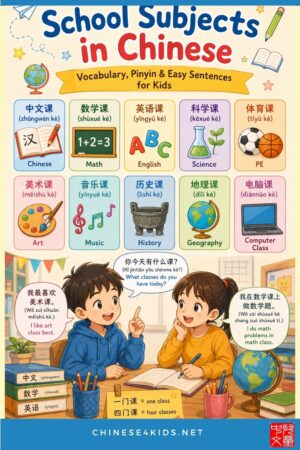
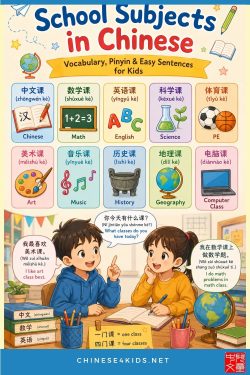
School subjects in Chinese are called 科目 (kēmù), 学科 (xuékē), or simply 课 (kè), depending on context. Common school subjects include 数学 (shùxué, math), 英语 (yīngyǔ, English), 中文 (zhōngwén, Chinese), 科学 (kēxué, science), 体育 (tǐyù, PE), 美术 (měishù, art), and 音乐 (yīnyuè, music).
How Do You Say “School Subject” in Chinese?
There are three key words for talking about school subjects. Understanding the difference helps you use them correctly.
科目 (kēmù) — Subject
科目 is the most common word for “school subject” when talking about the subjects children learn.
科目 is the most common word for “school subject” when talking about the subjects children learn.
数学是我最喜欢的科目。 Math is my favorite subject.
学科 (xuékē) — Academic Subject / Discipline
学科 is more formal and often used in educational or academic contexts.
学科 is more formal and often used in educational or academic contexts.
中文是一门重要的学科。 Chinese is an important academic subject.
课 (kè) — Class / Lesson
课 means the class itself or a specific lesson.
课 means the class itself or a specific lesson.
我今天有四门课。 I have four classes today.
我喜欢数学课。 I like math class.
Key pattern to remember:
subjects + 课
数学 (math) → 数学课 (math class)
英语 (English) → 英语课 (English class)
中文 (Chinese) → 中文课 (Chinese class)
10 Common School Subjects in Chinese
Here are the most useful school subjects for your child to learn first.
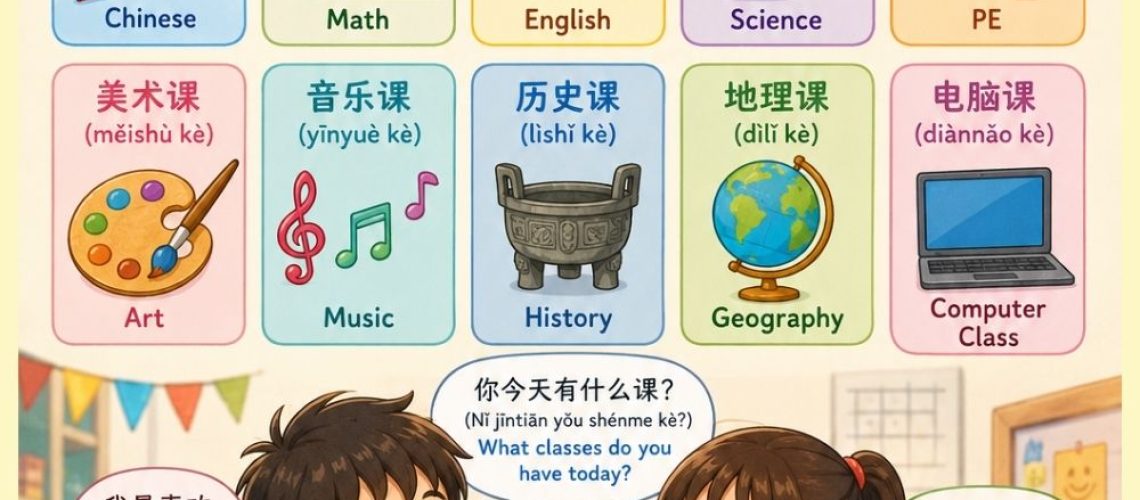
| Subject | Chinese | Pinyin | Example |
|---|---|---|---|
| Chinese | 中文 | zhōngwén | 中文课 |
| Math | 数学 | shùxué | 数学课 |
| English | 英语 | yīngyǔ | 英语课 |
| Science | 科学 | kēxué | 科学课 |
| PE | 体育 | tǐyù | 体育课 |
| Art | 美术 | měishù | 美术课 |
| Music | 音乐 | yīnyuè | 音乐课 |
| History | 历史 | lìshǐ | 历史课 |
| Geography | 地理 | dìlǐ | 地理课 |
| Computer class | 电脑课 | diànnǎo kè | 电脑课 |
More School Subjects in Chinese
As children advance, they may learn these additional subjects.
化学 (huàxué) — Chemistry
物理 (wùlǐ) — Physics
生物 (shēngwù) — Biology
外语 (wàiyǔ) — Foreign Language
Understanding the 10 Common Subjects
中文 (Zhōngwén) — Chinese
The study of the Chinese language and literature. Children learn to read and write characters (汉字), study classical and modern texts, and explore Chinese poetry and storytelling.
Sample sentences:
我喜欢中文课。 I like Chinese class.
中文很有意思。 Chinese is very interesting.
数学 (Shùxué) — Math
Mathematics covers numbers, addition, subtraction, geometry, and other mathematical concepts. It’s essential for problem-solving and logical thinking.
Sample sentences:
我喜欢数学。 I like math.
数学很难。 Math is difficult.
英语 (Yīngyǔ) — English
English language study is common in schools worldwide. Children learn speaking, listening, reading, and writing skills.
Sample sentences:
我在学英语。 I’m learning English.
英语课很好玩。 English class is fun.
科学 (Kēxué) — Science
Science teaches children about the natural world. This includes topics like nature (自然), the environment (环境), animals, plants, and how things work.
Sample sentences:
我喜欢科学课。 I like science class.
科学很有趣。 Science is interesting.
体育 (Tǐyù) — PE (Physical Education)
PE class includes sports and exercise. Children might play basketball (篮球), soccer (足球), badminton (羽毛球), or do other physical activities.
Sample sentences:
我喜欢体育课。 I like PE class.
体育课很有意思。 PE is interesting.
美术 (Měishù) — Art
Art class teaches drawing, painting, sculpture, and other creative skills. Children learn about colors (颜色) and express their creativity (创意).
Sample sentences:
我最喜欢美术课。 I like art class best.
美术很好玩。 Art is fun.
音乐 (Yīnyuè) — Music
Music class teaches rhythm (节奏), melody (旋律), and instruments (乐器). Children sing songs (唱歌) and learn musical expression.
Sample sentences:
我喜欢音乐课。 I like music class.
音乐很美。 Music is beautiful.
历史 (Lìshǐ) — History
History teaches children about the past (过去), famous people (人物), and important events (事件). China has over 5,000 years of recorded history.
Sample sentences:
历史很有意思。 History is interesting.
地理 (Dìlǐ) — Geography
Geography teaches about Earth (地球), maps (地图), different countries (国家), and cultures (文化).
Sample sentences:
地理课很有趣。 Geography is interesting.
电脑课 (Diànnǎo Kè) — Computer Class
Computer class teaches typing, coding (编程), and digital skills. Note: 电脑 means “computer,” but we say 电脑课 when referring to the subject.
Sample sentences:
我喜欢电脑课。 I like computer class.
What Do You Do in Each Class?
This is a natural follow-up question children ask. Help them connect the subject name to what happens in that class.
- 数学课 — 做数学题 (do math problems)
- 英语课 — 学英语单词 (learn English words)
- 中文课 — 读书、写汉字 (read and write Chinese characters)
- 美术课 — 画画 (draw or paint)
- 音乐课 — 唱歌 (sing)
- 体育课 — 做运动 (exercise or play sports)
- 科学课 — 做实验 (do experiments)
- 地理课 — 看地图 (look at maps)
Talk About Your School Subjects in Chinese
Asking About Classes
- 你今天有什么课? Nǐ jīntiān yǒu shénme kè? What classes do you have today?
- 你今天上了什么课? Nǐ jīntiān shàng le shénme kè? What classes did you have today?
Talking About Favorites
- 你最喜欢的课是什么? Nǐ zuì xǐhuān de kè shì shénme? What’s your favorite class?
- 你最喜欢哪门课? Nǐ zuì xǐhuān nǎ mén kè? Which class do you like best?
- 我最喜欢美术课。 Wǒ zuì xǐhuān měishù kè. I like art class best.
Talking About Dislikes
- 我不太喜欢数学。 Wǒ búbù tài xǐhuān shùxué. I don’t really like math.
- 数学很难。 Shùxué hěn nán. Math is difficult.
Talking About What You Do
- 你在数学课上做什么? Nǐ zài shùxué kè shang zuò shénme? What do you do in math class?
- 我做数学题。 Wǒ zuò shùxué tí. I do math problems.
Common Mistakes to Avoid
❌ Mistake 1: Confusing 中文 vs 汉语
中文 (zhōngwén) and 汉语 (hànyǔ) both mean Chinese language.
✅ For young learners and school subjects, 中文 is the most natural choice.
✅ 汉语 is also correct but more commonly used in formal or language-learning contexts.
❌ Mistake 2: Using 电脑 without 课
❌ “电脑 is a subject” (incorrect)
✅ “电脑课 is a subject” (correct – computer class)
电脑 means “computer” (the object). 电脑课 means “computer class” (the subject).
❌ Mistake 3: Wrong sentence structure
❌ 你的最喜欢的课是什么?(incorrect word order)
✅ 你最喜欢的课是什么?(correct)
✅ 你最喜欢哪门课?(also correct and natural)
❌ Mistake 4: Forgetting the measure word 门 (mén)
The measure word 门 is commonly used for subjects and classes.
✅ 一门课 = one class
✅ 四门课 = four classes
Using the measure word correctly shows native-like speech.
Sample Sentences for Practice
These are real sentences your child can use every day.
Sentence 1
今天我有四门课:数学、英语、中文和科学。
wǒ yǒu sì mén kè: shùxué, yīngyǔ, zhōngwén hé kēxué.
Today I have four classes: math, English, Chinese, and science.
Sentence 2
我最喜欢的科目是美术。
Wǒ zuì xǐhuān de kēmù shì měishù.
My favorite subject is art.
Sentence 3
我喜欢体育,但我不喜欢数学。
Wǒ xǐhuān tǐyù, dàn wǒ búxǐhuān shùxué.
I like PE, but I don’t like math.
Sentence 4
你最喜欢哪门课?
Nǐ zuì xǐhuān nǎ mén kè?
Which class is your favorite?
5 Fun Ways to Practice School Subjects in Chinese
1. Make a Weekly Timetable in Chinese
Create a simple timetable showing your child’s actual school schedule. Use the Chinese subject names next to each time slot.
Place it where your child can see it daily. Each morning, point to the day’s subjects and ask: “你今天有什么课?”
Tip: Use our School Subjects Chinese Learning Pack for ready-to-print subject labels and timetable cards.
2. Play Subject Flashcard Matching Games
Print subject names and pictures. Mix them up and have your child match the word to the picture.
Start with 5 subjects, then add more as they improve.
3. Add Labels to Your Classroom or Home
Print Chinese subject words and display them around your learning space. This creates visual reinforcement.
Point to each label and practice saying the word together daily.
4. Create a “Guess the Subject” Game
Describe what you do in a class without saying the subject name. Your child guesses which subject you’re describing.
Example: “We do experiments in this class. What is it?” (科学)
5. Talk About Your Real School Day
The best practice is using real language about your child’s actual schedule.
After school, ask:
你今天上了什么课?
你最喜欢的课是什么?
你在美术课上做了什么?
This makes the vocabulary personal and meaningful.
Learning School Vocabulary You Can Connect To
These related topics naturally connect to school subjects:
- School Objects in Chinese — Learn classroom objects like desk (课桌), whiteboard (白板), pencil (铅笔)
- School Life in Chinese — Broader vocabulary including people at school, daily routines, and classroom activities
- Back to School in Chinese — Seasonal vocabulary and first-day-of-school phrases
- Chinese Classroom Setup — How to create a bilingual Chinese learning space with labels and displays
Resources That Support This Learning
- School Subjects Flashcards Set Teach 10 Mandarin school subject words — Chinese, maths, English, science and more — with Montessori 3-part flashcards. Includes 20 vocabulary cards, 10 sentence cards, and 1 audio file.
- Chinese Classroom Setup Pack. Perfect for teachers creating a bilingual classroom. Includes subject labels, classroom rules, welcome signs, and other classroom display materials.
- School Objects Flashcards Set Teach 10 Mandarin classroom object words — books, pens, desks, chairs and more — with Montessori 3-part flashcards. Includes 20 vocabulary cards, 10 sentence cards, and 1 audio file.
Frequently Asked Questions
Should I teach all 10 subjects at once?
No. Start with 5-7 main subjects:
数学 (math)
英语 (English)
中文 (Chinese)
体育 (PE)
美术 (art)
Add more subjects gradually as your child becomes comfortable with these.
What’s the difference between 中文 and 汉语?
Both mean Chinese language.
中文 (zhōngwén) is very common in everyday usage and is a natural choice when talking about Chinese as a school subject.
汉语 (hànyǔ) is also correct and commonly used in formal educational contexts and language-learning materials.
For young learners, 中文 is simpler.
How often should we practice?
Daily practice is most effective—even just 5-10 minutes a day produces much better results than once-a-week practice.
Try practicing when discussing your child’s school day:
Morning: “你今天有什么课?”
After school: “你最喜欢哪门课?”
What measure word is used for school subjects?
The measure word 门 (mén) is used for subjects and classes:
一门课 = one class
两门课 = two classes
四门课 = four classes
Using 门 correctly helps your child sound more natural.
Should I teach traditional or simplified characters?
Simplified characters (简体字) are used in mainland China and most international schools. This is the best choice for most learners.
Traditional characters (繁体字) are used in Taiwan and Hong Kong but are less commonly taught to new learners.
At what age can children learn school subjects?
Language development varies, but general guidelines:
Younger children (4-6): Focus on listening and saying words with pictures. Don’t worry about characters yet.
Beginning readers (6-8): Add characters and pinyin. Practice reading and writing.
More advanced learners (8+): Use subjects in sentences and conversations. Add grammar.
Key Takeaways
- Start simple: Begin with 5-7 core subjects before adding more.
- Remember the three key words: 科目 (subject), 学科 (academic subject), 课 (class).
- Use the pattern: Many subjects add 课 to form the class name.
- Practice daily: Even 5-10 minutes daily beats once-a-week practice.
- Make it personal: Talk about your child’s real school schedule.
- Connect to related vocabulary: Learn school objects and school life alongside subjects.
- Use the measure word: Remember 门 (mén) for counting classes/subjects.
If you like this post, share it