
What Are Chinese Pictogram Characters?
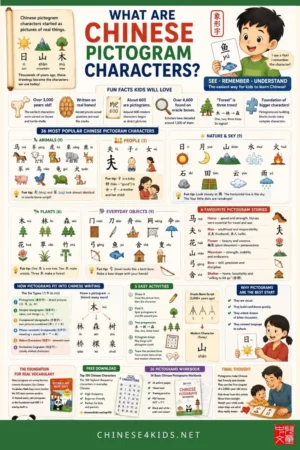
Chinese pictogram characters are drawings. They started as pictures of real things — a sun, a mountain, a tree, a fish. Over thousands of years, these pictures became the characters we use today.
If you look at a pictogram carefully, you can often see what it means. The character 山 (shān) looks like three mountain peaks. 木 (mù) looks like a tree with branches and roots. And the character 日 (rì) is a simple drawing of the sun.
This makes pictograms the easiest entry point into Chinese writing — especially for children. Kids don’t need to memorise. They just need to see.
In this updated guide, you’ll find:
- A short history of pictograms (with fun facts kids will remember)
- The 36 most popular Chinese pictogram characters, grouped by theme
- Character-by-character stories — what each one really means
- How pictograms fit into the bigger picture of Chinese writing
- Easy activities for parents and teachers
- A free printable to help you get started
Let’s begin.
Fun Facts About Chinese Pictogram Characters
Before you show your child a single character, share these facts. They turn vocabulary into a story — and stories stick.
🦴 They are more than 3,000 years old. The oldest Chinese characters were carved on bones and turtle shells during the Shang Dynasty (around 1300 BCE). These are called oracle bone script (甲骨文 jiǎgǔwén).
🐢 They were written on real bones. Yes — actual ox shoulder blades and turtle bottoms. Ancient priests carved questions on them, heated them in fire, and read the cracks. The questions were written in pictograms.
🔢 About 600 modern characters are pictograms. Out of tens of thousands of Chinese characters, only around 600 began as direct pictures. But many of them are the most common, useful characters in daily life.
🔍 Over 4,600 different characters have been found on oracle bones. Scholars have decoded around 1,300 of them. Many are still used today, almost unchanged.
🌳 The character for “forest” is just three trees. 木 (tree) → 林 (woods) → 森 (forest). Three trees, three sizes. That’s logic a five-year-old can follow.
🎯 Pictograms are the foundation of bigger characters. Once your child knows the basics, they will start spotting them inside more complex characters. Recognising 木 inside 林, 森, 树, 桌 makes Chinese feel a lot less scary.
For a deeper look at how Chinese writing evolved — from pictures carved into bone, to bronze inscriptions, to the standardised characters of today — see our introduction to Chinese characters and the 6 types.
The 36 Most Popular Chinese Pictogram Characters
Below are 36 classic Chinese pictogram characters, grouped by theme. Look carefully — many of them still look like the thing they describe.
🐎 Animals (9 characters)
| Character | Pinyin | Meaning | What to look for |
|---|---|---|---|
| 马 | mǎ | horse | head, mane, four legs |
| 羊 | yáng | sheep | horns curving outward at the top |
| 虎 | hǔ | tiger | body and tail of a striped cat |
| 象 | xiàng | elephant | the long trunk on the right |
| 鹿 | lù | deer | antlers and slender body |
| 豕 | shǐ | pig | a stout body with short legs |
| 鸟 | niǎo | bird | eye, beak, feathers |
| 龟 | guī | turtle | the head and shell |
| 犬 | quǎn | dog | a slim creature with a curled tail |
🐕 Fun tip: 犬 (dog) and 豕 (pig) look almost identical in oracle bone script. The Chinese had to be very careful with their drawings!
👨👩👧 People (3 characters)
| Character | Pinyin | Meaning | What to look for |
|---|---|---|---|
| 夫 | fū | husband / man | a person with arms stretched out |
| 子 | zǐ | child | a baby’s big head and small body |
| 女 | nǚ | woman | a kneeling figure with crossed legs |
👶 Fun tip: The character 子 is a baby. The character 好 (hǎo — “good”) is 女 + 子 — a mother and her child. Logical, right?
☀️ Nature & Sky (9 characters)
| Character | Pinyin | Meaning | What to look for |
|---|---|---|---|
| 日 | rì | sun / day | a circle with a dot |
| 月 | yuè | moon / month | a thin crescent shape |
| 山 | shān | mountain | three peaks |
| 水 | shuǐ | water | flowing streams |
| 火 | huǒ | fire | flames rising upward |
| 石 | shí | stone | a rock falling from a cliff |
| 田 | tián | field | a square divided into four |
| 云 | yún | cloud | a swirl floating in the sky |
| 雨 | yǔ | rain | drops falling from a cloud |
🌲 Fun tip: This is the perfect “tree progression” trick. 一木一棵树 (one 木 is one tree). 两木一片林 (two 木 make woods). 三木一座森 (three 木 make a forest).
🪁 Everyday Objects (9 characters)
| Character | Pinyin | Meaning | What to look for |
|---|---|---|---|
| 门 | mén | door | two door panels |
| 刀 | dāo | knife | a curved blade with a handle |
| 舟 | zhōu | boat | a long, narrow vessel |
| 网 | wǎng | net | the woven crossing pattern |
| 伞 | sǎn | umbrella | the canopy and stem |
| 弓 | gōng | bow | a curved bow ready to shoot |
| 鱼 | yú | fish | head, body, fins, tail |
| 舍 | shè | house / shelter | the roof at the top |
| 叟 | sǒu | old man | an elderly figure with a stick |
🏹 Fun tip: 弓 (bow) really does look like a bent bow. Make a bow shape with your hands — that’s the character. Kids love this one.
The Stories Behind 6 Favourite Pictograms
Every Chinese pictogram tells a story. Here are six of the most loved characters — what they meant in ancient times, and what they still mean today.
马 (mǎ) — Horse
The character 马 reflects the head, neck, mane, and legs of a galloping horse. In ancient China, horses were essential — for travel, for farming, for war. Over time, 马 kept its original meaning, but it also came to symbolise speed, strength, and freedom. You’ll see horses everywhere in Chinese art, poetry, and idioms (一马当先 — taking the lead, like a horse out in front).
夫 (fū) — Man
The character 夫 shows a standing person with arms stretched wide. In ancient times, it referred to an adult man — particularly a husband or father. Today 夫 still means man, but it also carries the idea of adulthood, responsibility, and steadiness. The word 丈夫 (zhàngfu) means “husband.” 夫人 (fūrén) is a respectful word for “wife” or “lady.”
花 (huā) — Flower
The character 花 has petals at the top and a stem at the bottom. Flowers hold deep cultural meaning in China — beauty, delicacy, the changing seasons. The plum blossom (梅花) symbolises perseverance through winter. The lotus (莲花) symbolises purity rising from muddy water. When your child learns 花, they’re meeting one of the most poetic characters in the language.
山 (shān) — Mountain
Three peaks. That’s the whole character. But in Chinese culture, mountains mean far more than rock and stone — they symbolise strength, stability, and endurance. China’s “Five Sacred Mountains” (五岳) have been visited by emperors and poets for thousands of years. The character 山 hides inside hundreds of place names and family names — once your child knows it, they’ll see it everywhere.
弓 (gōng) — Bow
弓 began as a simple drawing of a curved bow with a string. Bows were used for hunting and warfare. Over time, the character came to represent skill, precision, and discipline — the qualities of a good archer. Even today, 弓 appears in words for archery, for arching shapes, and for the act of bowing in respect.
舍 (shè) — Shelter
舍 has a roof at the top and shelter underneath. It originally meant a simple home or dwelling. Today the character still means house — but it also carries warm meanings like community, hospitality, and giving up (as in 舍得 — “willing to let go”). Every Chinese pictogram, once you scratch the surface, has a story like this.
These are just 6 stories. The other 30 in this article each have their own.
How Pictograms Fit Into the Bigger Picture
Pictograms are only one of the six types of Chinese characters. The full system is called 六书 (liù shū) — “the six writings.” Knowing this helps parents and teachers explain Chinese writing in a way that makes sense to children.
Here are the six types in plain language:
- Pictograms (象形字) — direct pictures (日, 月, 山, 水)
- Simple ideographs (指事字) — drawings of ideas, not things (上 “up”, 下 “down”, 一 “one”)
- Compound ideographs (会意字) — two pictures combined (休 = person 亻 + tree 木 = rest)
- Phono-semantic compounds (形声字) — over 90% of all characters! One part gives meaning, one gives sound (菜 = grass 艹 + harvest 采)
- Rebus characters (假借字) — borrowed for sound
- Derivative cognates (转注字) — closely-related characters that share a root
Pictograms come first because they are the building blocks of all the other types. A child who recognises 木 (tree) will much more easily learn 林, 森, 树, 桥, 棵, 桌 — every one of which contains 木.
For a deeper dive into all six types, see our introduction to the 6 types of Chinese characters.
Why Pictogram Characters Are the Best Place to Start
Many parents are nervous about Chinese characters. They look complex. They have many strokes. There’s no alphabet to fall back on.
But pictograms break that fear. Here is why they work so well for beginners:
1. They are visual.
A child sees the sun and learns 日. A child sees a tree and learns 木. No memorisation needed — just recognition.
2. They build confidence quickly.
Learning 5 pictograms in one sitting is realistic for a six-year-old. That early success is what motivates the next 100.
3. They unlock dozens of other characters.
Once your child knows 日, they will spot it inside 时, 明, 早, 晚, 春. One pictogram → many characters.
4. They connect language to culture.
Pictograms come from ancient China. Each one carries a story. Children learning them are not just learning vocabulary — they are touching 3,000 years of culture.
For a complete teaching strategy, see our guide on how to teach Chinese vocabulary — from characters to words to sentences.
5 Easy Activities to Try with Pictograms
You don’t need any special tools. Try these at home or in the classroom.
1. Draw the picture, then draw the character.
Show your child a sun. Let them draw it. Then show them 日 and let them draw that too. The link between picture and character forms automatically.
2. Find the pictogram in the wild.
On a walk, point to a tree. Say 木. Point to the sky and say 日 or 月 (depending on the time of day). Real-world links beat any flashcard.
3. The “tree progression” game.
Show 木 → 林 → 森. One tree, two trees, three trees. Then ask: what would 四木 look like? (There’s no such character — but the question gets kids thinking.)
4. Pictogram bingo.
Make a simple bingo card with 9 pictograms. Call out the meanings in English. Kids cross off the matching characters. Whoever gets a line first wins.
5. Trace the oracle bone version.
Show your child the oracle bone form of 山 next to the modern form. Let them trace both. Seeing the evolution makes the character memorable.
For more visual learning ideas, see our guide to Chinese visual dictionaries for kids. To see pictogram animation in action, take a look at our Chinese character animation for zodiac animals — a short video showing how the 12 zodiac characters evolved from pictograms.
From Pictograms to a Real Vocabulary
Pictograms are a beautiful starting point. But your child won’t get far on 36 characters alone. To read Chinese — even very simple books — children need around 300 characters. To read fluently, they need more.
The good news: many pictograms appear inside the most common Chinese characters. Once your child knows 木, 火, 水, 日, 月, 山, they have already learned the radicals inside hundreds of more advanced characters. Pictograms are the first step on a clear path — not a dead end.
Our Chinese Vocabulary Made Easy course is built around this idea. It takes children from zero to the 300 most common Chinese words in twelve themed weeks, using pictograms and high-frequency characters as the foundation. The vocabulary overlaps heavily with HSK 1–2 — so your child is building exam readiness without ever doing “exam prep.”
Free Download: Top 100 Chinese Characters
Want to know which characters your child should learn first? Many of the pictograms in this article — 日, 月, 山, 水, 木, 火, 田, 雨, 鱼 — are also among the 100 most common Chinese characters in everyday use.
We’ve put together a free printable list that you can stick on the fridge or hand to your child today.
👉 Download the free Top 100 Chinese Characters here
Print it. Tick off one character a day. By the time you finish, your child will already recognise the building blocks of thousands more characters.
The Ready-Made Workbook for These 36 Pictograms
If you’d like the 36 pictograms in this article in one printable, hands-on resource, we’ve created the 36 Basic Chinese Pictographs Workbook — a digital download with one activity page for each of the 36 characters.
- ✏️ 36 activity pages — one for each pictogram (马, 夫, 花, 羊, 虎, 象, 鹿, 豕, 鸟, 龟, 门, 犬, 子, 女, 日, 山, 水, 月, 木, 林, 森, 刀, 舟, 田, 草, 竹, 鱼, 网, 云, 雨, 伞, 石, 火, 叟, 弓, 舍)
- 🖼️ Visual cue for each character so kids see why the character looks the way it does
- ✍️ Tracing practice — character strokes in the correct order
- 📄 PDF format — 8.5 × 11 inches, low-prep, ready to print
- ⚫ Black and white — easy to photocopy, easy to colour in
Perfect for kindergarten and early-primary classrooms, family Chinese lessons, or simply for a fun weekend activity.
👉See the 36 Basic Chinese Pictographs Workbook
Final Thought
Chinese pictogram characters are not just a bit of trivia. They are the best first chapter of any child’s Chinese journey. Because of them, Chinese characters feel friendly and doable. They also give kids permission to see Chinese as a beautiful puzzle, not a wall of strokes.
Pick three pictograms from this article. Show them to your child tonight. Watch them smile when they realise 山 really is a mountain.
That moment is where everything begins.
— updated in 2026
Further Reading on Chinese4kids
- 📖 Introduction to Chinese Characters — the 6 Types Explained — the bigger picture of how Chinese writing works
- 📖 How to Teach Chinese Vocabulary: From Characters to Words to Sentences — a step-by-step teaching strategy
- 📖 Guide to Chinese Visual Dictionaries for Kids — picture-based learning at every level
- 📖 Chinese Character Animation for Zodiac Animals — watch zodiac characters evolve from pictograms
If you like this article, share it