Quick Answer
The wood radical 木 (mù) appears in Chinese characters related to trees, wood, and wooden objects — including a lot of everyday furniture. It is one of the most visually intuitive radicals because the character itself looks like a tree.
The wood radical 木 (mù) appears in Chinese characters related to trees, wood, and wooden objects — including a lot of everyday furniture. It is one of the most visually intuitive radicals because the character itself looks like a tree.
木
Wood/Tree Radical — 木 (mù)
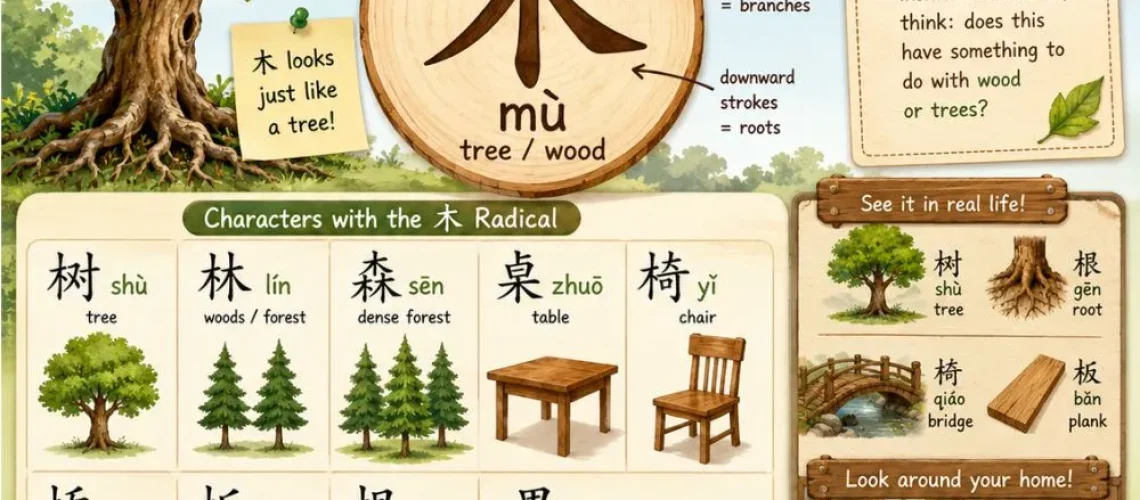
Looks like a tree: a vertical trunk, branches spreading out at the top, roots at the bottom.
Appears in: trees, forest, wood, and wooden objects like furniture.
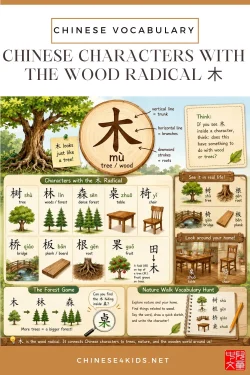
木 (mù) means tree or wood.
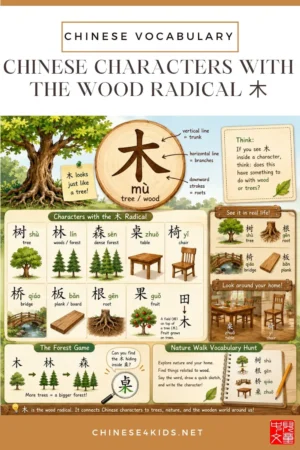
木 (mù) means tree or wood. Look at the character — you can see a tree. A vertical line for the trunk. A horizontal line for the branches. Two short strokes reaching down like roots.
When 木 appears inside another character, it usually signals that the character has something to do with trees, plants, or wooden things. A lot of furniture words contain 木 — because furniture is traditionally made from wood.
Chinese Characters with the 木 Radical
| Character | Pinyin | Meaning | Connection to wood |
|---|---|---|---|
| 树 | shù | tree | A living tree |
| 林 | lín | woods / forest | Two trees side by side |
| 森 | sēn | dense forest | Three trees — even more trees! |
| 桌 | zhuō | table | A wooden surface to eat at |
| 椅 | yǐ | chair | A wooden seat |
| 桥 | qiáo | bridge | Traditionally built from wood |
| 板 | bǎn | plank / board | A flat piece of wood |
| 根 | gēn | root | The root of a tree or plant |
💡 Say to kids: “木 looks just like a tree. If you see 木 inside a character, think: does this have something to do with wood or trees?”
Notice how 林 (woods) is simply two 木 characters side by side — two trees make a small forest. And 森 (dense forest) adds a third 木 on top. These are great characters to introduce together: they show children how radicals can literally multiply to deepen a meaning.
Fun Activity:Nature Walk Vocabulary Hunt
Nature Walk Vocabulary Hunt
Take a walk in a park, garden, or woods. Bring a small notebook or flashcards. Each time you see a tree, say 树 (shù). Point out roots and say 根 (gēn). Find a wooden bench or bridge and say 桥 (qiáo) or 板 (bǎn). When you get home, look around the house and find all the wooden furniture: 桌 (table), 椅 (chair). Write each character in the notebook next to a quick sketch of the object. The physical experience makes the connection between the radical and real-world wood feel completely natural.
The Forest Game
Show children 木, then 林, then 森. Ask: “What do you notice?” Let them see that adding more trees makes a bigger forest. Then challenge them: “Can you find the 木 hiding inside 桌 (table)?” This tree-spotting game works as a card activity or just at the whiteboard — and it teaches children to look inside characters for familiar parts.
A Note on 果 and 木
果 (guǒ, fruit) also contains 木 — a field (田) sitting on top of a tree (木). The image is intuitive: fruit grows on trees. It is a lovely character to show children as an example of how Chinese characters can tell a small story.
This article is about one of the most important Chinese Radicals for Children. Have a look at all the 30 Most Important Chinese Radicals and the posters that are good for both home and classroom use.
New to radicals? Learn the difference between piānpáng (偏旁) and bùshǒu (部首).
Further Reading
- Chinese characters with the 氵(water) radical →Full character family with examples and usage
- Chinese characters with the 木 (tree) radical →Full character family — trees, wood, and furniture
- Chinese characters with the 口 (mouth) radical →Full character family with examples and usage
- Chinese characters with the 女 (woman) radical →Full character family with examples and usage
- Chinese characters with the 亻(person) radical →Pronouns and everyday action words
- Chinese characters with the 扌(hand) radical →Action verbs — push, pull, hug, throw, and more
- Chinese characters with the 艹(grass) radical →Plants, flowers, vegetables, and nature vocabulary
- 30 Most Important Chinese Radicals for Kids →The complete guide — all 30 high-frequency radicals with examples and activities
- 30 Chinese Radical Family Poster Pack – 30 beautifully illustrated posters — one for every major Chinese radical.
If you like this post, PIN IT!