Quick Answer
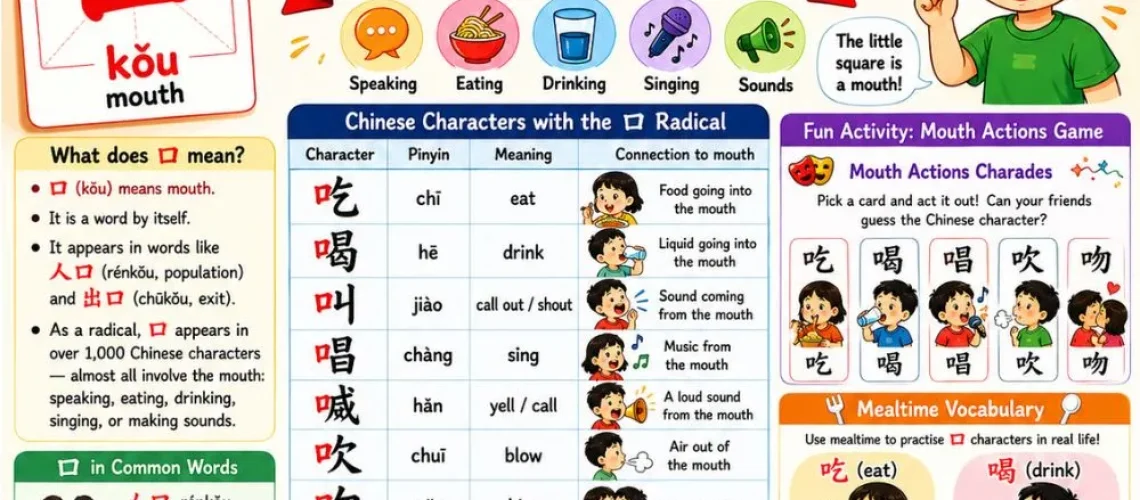
The mouth radical 口 (kǒu) is one of the most common and easiest-to-spot radicals in Chinese. It appears in characters related to speaking, eating, drinking, and sounds — and it looks exactly like what it means: an open mouth.
The mouth radical 口 (kǒu) is one of the most common and easiest-to-spot radicals in Chinese. It appears in characters related to speaking, eating, drinking, and sounds — and it looks exactly like what it means: an open mouth.
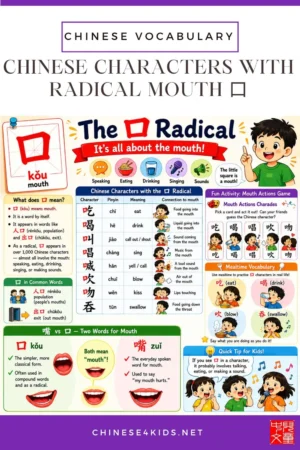
口
Mouth Radical — 口 (kǒu)
A simple square — the shape of an open mouth. One of the most common radicals in Chinese.
Appears in: speaking, eating, drinking, singing, and other mouth actions.
口 (kǒu) means mouth.
口 (kǒu) means mouth. The character is a simple square — it looks like an open mouth, and that is exactly what it means.
口 is a word by itself: 口 means mouth, and 口 is also used in words like 人口 (rénkǒu, population — literally “people’s mouths”) and 出口 (chūkǒu, exit — literally “out mouth”).
As a radical, 口 appears in over 1,000 Chinese characters. Almost all of them involve the mouth in some way — speaking, eating, drinking, singing, or making sounds.
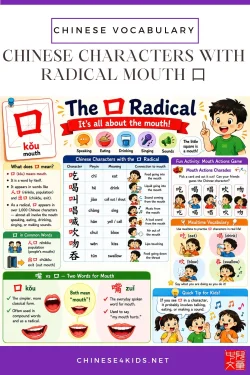
Chinese Characters with the 口 Radical
| Character | Pinyin | Meaning | Connection to mouth |
|---|---|---|---|
| 吃 | chī | eat | Food going into the mouth |
| 喝 | hē | drink | Liquid going into the mouth |
| 叫 | jiào | call out / shout | Sound coming from the mouth |
| 唱 | chàng | sing | Music from the mouth |
| 喊 | hǎn | yell / call | A loud sound from the mouth |
| 吹 | chuī | blow | Air out of the mouth |
| 吻 | wěn | kiss | Lips touching |
| 吞 | tūn | swallow | Food going down the throat |
💡 Say to kids: The little square is a mouth. If you see 口 in a character, it probably involves talking, eating, or making a sound.”
Fun Activity: Mouth Actions Game
👄 Mouth Actions Charades
Write each 口-family character on a separate card. One player picks a card and acts out the meaning — eating (吃), drinking (喝), singing (唱), blowing (吹), kissing (吻). The other players guess the character in Chinese. Because every action involves the mouth, children quickly make the connection between the radical and the meaning. This works well for 2 players at home or as a group game in the classroom.
🎵 Mealtime Vocabulary
Use mealtime to practise 口 characters in real context. Before eating: 吃 (eat) and 喝 (drink). Ask children to say what they are doing as they do it. Blow on hot food: 吹 (blow). Swallow: 吞 (swallow). The repeated exposure at every meal builds recognition fast — and children find it amusing to narrate their eating in Chinese.
嘴 vs 口 — Two Words for Mouth
There are two common Chinese words for mouth: 口 (kǒu) and 嘴 (zuǐ). 口 is the simpler, more classical form — often used in compound words and as a radical. 嘴 is the everyday spoken word for mouth — the one a child would use to say “my mouth hurts.” Both are worth knowing.
This article is about one of the most important Chinese Radicals for Children. Have a look at all the 30 Most Important Chinese Radicals and the 30 Radical Family posters that are good for both home and classroom use.
New to radicals? Learn the difference between piānpáng (偏旁) and bùshǒu (部首).
Further Reading
- Chinese characters with the 氵(water) radical →Full character family with examples and usage
- Chinese characters with the 木 (tree) radical →Full character family — trees, wood, and furniture
- Chinese characters with the 口 (mouth) radical →Full character family with examples and usage
- Chinese characters with the 女 (woman) radical →Full character family with examples and usage
- Chinese characters with the 亻(person) radical →Pronouns and everyday action words
- Chinese characters with the 扌(hand) radical →Action verbs — push, pull, hug, throw, and more
- Chinese characters with the 艹(grass) radical →Plants, flowers, vegetables, and nature vocabulary
- 30 Most Important Chinese Radicals for Kids →The complete guide — all 30 high-frequency radicals with examples and activities
- 30 Chinese Radical Family Poster Pack – 30 beautifully illustrated posters — one for every major Chinese radical.
If you like this post, PIN IT!