Quick answer:
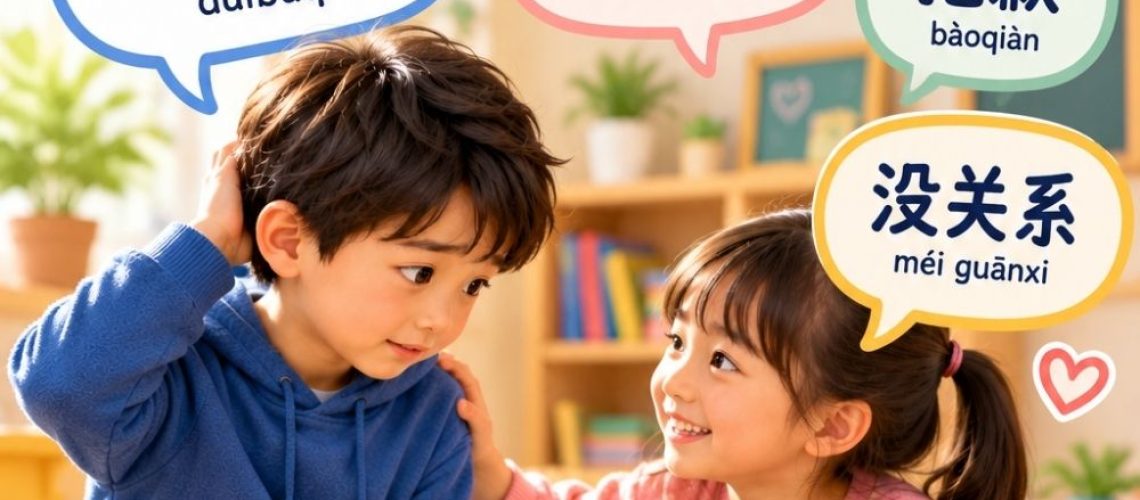
The most common way to say sorry in Mandarin is 对不起 (duìbuqǐ). For small slips and polite interruptions, say 不好意思 (bù hǎoyìsi). 抱歉 (bàoqiàn) sounds more formal. When someone says sorry to you, a simple reply is 没关系 (méi guānxi), which means “It’s okay.”
The most common way to say sorry in Mandarin is 对不起 (duìbuqǐ). For small slips and polite interruptions, say 不好意思 (bù hǎoyìsi). 抱歉 (bàoqiàn) sounds more formal. When someone says sorry to you, a simple reply is 没关系 (méi guānxi), which means “It’s okay.”
Everyone makes mistakes. Kids bump into friends, break toys and arrive late. Knowing how to apologize helps them take responsibility and keep friendships strong, in any language.
Below you’ll find four phrases with pinyin, short examples and easy activities for home or class. You don’t need to speak fluent Chinese to use them. Want more everyday expressions afterwards? Try our 30 child-friendly survival Chinese phrases.
Four Ways to Say Sorry in Chinese
| Chinese | Pinyin | Meaning | Use it when… |
|---|---|---|---|
| 对不起 | duìbuqǐ | I’m sorry | you made a mistake or hurt someone |
| 不好意思 | bù hǎoyìsi | Sorry / Excuse me | it’s a small slip, an interruption, or a slightly awkward moment |
| 抱歉 | bàoqiàn | I apologize | you want a more formal apology |
| 没关系 | méi guānxi | It’s okay | someone has apologized to you |
Which phrase should beginners learn first?
Start with 对不起 and 没关系. Together they make one tiny conversation that kids can use straight away with friends, siblings and classmates. The other two can wait. Two phrases used with confidence beat four half-remembered ones.
对不起 (duìbuqǐ): The Everyday “I’m Sorry”
对不起 is the standard apology in Mandarin. Kids can use it when they hurt someone, break something or let someone down.
对不起。
Duìbuqǐ.
I’m sorry.对不起,我迟到了。
Duìbuqǐ, wǒ chídào le.
I’m sorry I’m late.对不起,我弄坏了你的玩具。
Duìbuqǐ, wǒ nònghuài le nǐ de wánjù.
I’m sorry I broke your toy.对不起,我不是故意的。
Duìbuqǐ, wǒ bú shì gùyì de.
I’m sorry. I didn’t do it on purpose.
That last sentence is handy after an accident. Save it for when your child is comfortable with the short version.
A pronunciation tip: In everyday speech, the middle syllable 不 is usually light and quick. Say the three syllables smoothly, as one phrase, rather than one at a time.
不好意思 (bù hǎoyìsi): Sorry, or Excuse Me
不好意思 is a flexible little phrase. Depending on the moment, it can mean “sorry,” “excuse me,” or “I feel a bit embarrassed.” It works well for small inconveniences and polite interruptions.
不好意思,我来晚了。
Bù hǎoyìsi, wǒ lái wǎn le.
Sorry I’m late.不好意思,请问厕所在哪里?
Bù hǎoyìsi, qǐngwèn cèsuǒ zài nǎlǐ?
Excuse me, where is the toilet?不好意思,我可以借一下你的铅笔吗?
Bù hǎoyìsi, wǒ kěyǐ jiè yíxià nǐ de qiānbǐ ma?
Sorry to bother you, may I borrow your pencil?
对不起 or 不好意思: what’s the difference?
Both can be translated as “sorry,” but they feel a little different.
- Use 对不起 for a clear apology when you’ve done something wrong.
- Use 不好意思 for small things: stepping past someone, interrupting, or asking a favor.
Say a child knocks over a classmate’s water bottle. 对不起 fits. Say the same child wants to ask the teacher a question. 不好意思 fits. These are guidelines, not strict rules. Native speakers mix them depending on the situation, and that’s fine.
抱歉 (bàoqiàn): A More Formal Apology
抱歉 also means “I’m sorry,” but it sounds more formal. You’ll hear it in polite or professional settings, and when someone has been kept waiting. Young learners only need to recognize it for now. They can start using it later.
抱歉,我忘记带作业了。
Bàoqiàn, wǒ wàngjì dài zuòyè le.
I’m sorry, I forgot to bring my homework.很抱歉让你等了这么久。
Hěn bàoqiàn ràng nǐ děng le zhème jiǔ.
I’m very sorry to have kept you waiting so long.
How to Reply When Someone Says Sorry
Kids need to know how to answer an apology too. Here are three options.
| Chinese | Pinyin | Meaning |
|---|---|---|
| 没关系 | méi guānxi | It’s okay. / No problem. |
| 没事 | méi shì | It’s okay. / No worries. |
| 不要紧 | bú yàojǐn | It’s all right. / It doesn’t matter. |
没关系 is the best one to begin with. It’s short, friendly and used everywhere.
A: 对不起!
Duìbuqǐ!
I’m sorry!B: 没关系。
Méi guānxi.
It’s okay.
One thing to keep in mind: saying 没关系 doesn’t mean a child has to feel fine right away. They can accept the apology and still say how they feel, or ask for the problem to be fixed.
Three Short Dialogues to Act Out
New phrases stick when kids use them in a real moment. Try these at home or in class.
Dialogue 1: Bumping into a friend
A: 哎呀!
Āiyā!
Oops!A: 对不起!
Duìbuqǐ!
I’m sorry!B: 没关系。
Méi guānxi.
It’s okay.
Dialogue 2: Breaking a toy
A: 对不起,我弄坏了你的玩具。
Duìbuqǐ, wǒ nònghuài le nǐ de wánjù.
I’m sorry I broke your toy.B: 我有点难过。
Wǒ yǒudiǎn nánguò.
I’m a little sad.A: 我帮你修一下吧。
Wǒ bāng nǐ xiū yíxià ba.
Let me help you fix it.
Notice that the apology is followed by an offer to help.
Dialogue 3: Arriving late
A: 不好意思,我来晚了。
Bù hǎoyìsi, wǒ lái wǎn le.
Sorry I’m late.B: 没关系,快进来吧!
Méi guānxi, kuài jìnlái ba!
It’s okay. Come in!
Once your child knows the lines, change the situation. Let them make up their own version with a parent, a sibling or a classmate.
Four Fun Ways to Practise Saying Sorry in Chinese
1. Match the situation to the phrase
Write 对不起, 不好意思, 抱歉 and 没关系 on four cards. Read out a situation and let your child pick a card.
- You step on your friend’s foot. Which phrase fits?
- You want to interrupt the teacher politely. Which one?
- Your friend says sorry for dropping your pencil. How do you reply?
Some situations have more than one good answer. Ask your child why they chose that card. The talking is the learning.
2. Role-play with toys
Let one toy knock over another toy’s block tower. Your child speaks for both.
对不起,我把你的积木塔弄倒了。
Duìbuqǐ, wǒ bǎ nǐ de jīmùtǎ nòngdǎo le.
I’m sorry I knocked down your block tower.没关系,我们一起搭吧!
Méi guānxi, wǒmen yìqǐ dā ba!
It’s okay. Let’s build it together!
For younger kids, keep it to 对不起 and 没关系. Add longer sentences later.
3. Make a mini apology book
Fold a few sheets of paper into a booklet. On each page, draw one everyday moment and write one Chinese sentence.
- A child spills water: 对不起,我把水洒了。(Duìbuqǐ, wǒ bǎ shuǐ sǎ le.)
- A child needs to interrupt: 不好意思。(Bù hǎoyìsi.)
- A child receives an apology: 没关系。(Méi guānxi.)
Add pinyin and English underneath. The booklet doubles as a revision tool.
4. Use it when a real mishap happens
Real life gives the best practice. Next time something small goes wrong, help your child find the words.
对不起,我把你的书弄湿了。
Duìbuqǐ, wǒ bǎ nǐ de shū nòngshī le.
I’m sorry I got your book wet.
Then ask: “What could you do to help?” Maybe they wipe the book dry or fetch a cloth. That links Mandarin to empathy and problem-solving.
Teach Kids That a Good Apology Includes Action
Saying 对不起 is a great first step. Over time, children can learn that a sincere apology has three parts:
- Say what happened. Keep it simple.
- Say sorry. Use 对不起 or another phrase that fits.
- Make it right. Offer help, fix the damage, or promise to do better.
For example:
对不起,我没问你就拿了你的铅笔。我还给你,以后会先问你。
Duìbuqǐ, wǒ méi wèn nǐ jiù ná le nǐ de qiānbǐ. Wǒ huán gěi nǐ, yǐhòu huì xiān wèn nǐ.
I’m sorry I took your pencil without asking. I’ll give it back, and I’ll ask first next time.
For younger children, a few sincere words and a helpful action are plenty. The goal isn’t a child who repeats “sorry” on command. It’s a child who understands what the words mean.
Frequently Asked Questions
How do you say “I’m sorry” in Chinese?
Say 对不起 (duìbuqǐ). It’s the standard apology in Mandarin and works when you’ve made a mistake or hurt someone’s feelings.
What is the difference between 对不起 and 不好意思?
对不起 is a direct apology. 不好意思 is softer and often used for small inconveniences, polite interruptions or awkward moments. Both can mean “sorry,” depending on the situation.
How do you say “It’s okay” in Chinese?
Say 没关系 (méi guānxi). 没事 (méi shì) is another natural choice in casual conversation.
How do you say “I’m very sorry” in Chinese?
Say 很抱歉 (hěn bàoqiàn) or 非常抱歉 (fēicháng bàoqiàn). Both sound formal, and the second is more emphatic.
Is 抱歉 more polite than 对不起?
抱歉 usually sounds more formal. 对不起 is polite too and fits most everyday moments.
How can I teach my child to apologize in Chinese?
Begin with 对不起 and 没关系. Practise both sides, saying sorry and replying, through role-play and real situations. Add 不好意思 and 抱歉 as their Chinese grows.
Do kids need to learn all four phrases at once?
No. One apology and one reply are enough to start.
Keep Learning Everyday Chinese
Polite phrases make Chinese feel real. Once your child can say sorry, these posts are a natural next step:
- 30 child-friendly survival Chinese phrases
- How to say hello in Chinese
- How to say thank you in Chinese
- How to say goodbye in Chinese
Remember: 对不起 (duìbuqǐ) plus 没关系 (méi guānxi) is enough to start. Use them in real moments, talk about what the words mean, and let your child see that a good apology comes with a kind action.
Want more ready-to-use phrases for daily life? Speak Chinese with Kids gives parents everyday conversations, 30 useful sentences per scene, with audio, video and printable scripts. You can follow along without being fluent.
Teaching a class or home group? Our Lesson Plans are built theme by theme, so you can teach polite expressions and more without planning from scratch.
If you find this article, share it