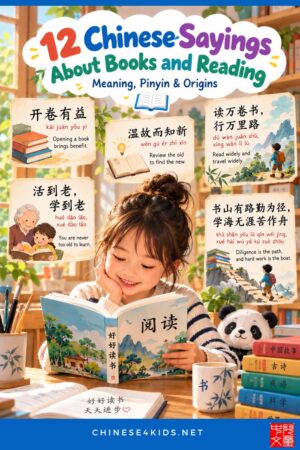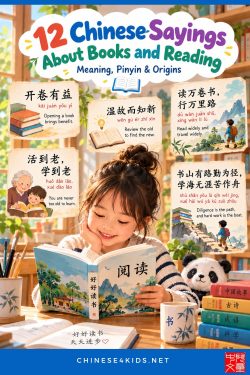
Quick answer: Chinese sayings about books return to four ideas: reading is worth the time, books and real life belong together, good reading takes steady effort, and good readers think for themselves. 开卷有益 (kāi juàn yǒu yì), “opening a book brings benefit,” has just four characters. 读万卷书,行万里路 (dú wàn juàn shū, xíng wàn lǐ lù), “read ten thousand volumes, walk ten thousand miles,” teaches that books and real life work together. Below are 12 sayings with Chinese characters, pinyin, a plain English meaning, the source, and a practical tip for children.
Chinese sayings about reading are short and rhythmic, often just four characters. They come from old books, poems, and everyday wisdom, and they are easy to say out loud. Each one gives a simple idea about why we read and how to read well.
When we know who said a saying, we tell you. When we do not, we say “traditional,” because many websites give the wrong author.
The 12 sayings are grouped into three levels, from beginner-friendly to more challenging. If your child is new to Chinese, start with the first five, and add one new saying every week or two.
What do Chinese sayings say about books and reading?
Four ideas appear again and again:
- Reading is worth the time. 开卷有益 says that any book you open gives you something.
- Books and real life belong together. 读万卷书,行万里路 asks readers to travel and learn from experience as well.
- Good reading takes effort. 书山有路勤为径 and 读书百遍,其义自见 describe patience and repetition.
- Good readers think for themselves. 学而不思则罔 reminds us to ask questions about what we read.
What is a Chinese saying?
Chinese has several names for short, memorable wisdom. Knowing which is which helps you teach each one accurately. Many sayings fit more than one type, so treat the labels as a guide, not a strict rule.
| Type | What it is | Example in this post |
|---|---|---|
| 谚语 (yànyǔ), proverb | A traditional folk saying, usually with no known author | 活到老,学到老; 书到用时方恨少 |
| 成语 (chéng yǔ), idiom | A fixed phrase, often four characters, often with a story behind it | 开卷有益; 温故而知新 (also written 温故知新) |
| 名言 (míng yán), famous quotation | Words from a named person or text | 学而不思则罔,思而不学则殆 (Confucius); 读书破万卷,下笔如有神 (Du Fu) |
| 对联 (duì lián), couplet | Two matching lines | 书山有路勤为径,学海无涯苦作舟 |
All 12 sayings at a glance
| # | Chinese | Pinyin | Meaning | Source | Level |
|---|---|---|---|---|---|
| 01 | 开卷有益 | kāi juàn yǒu yì | Opening a book brings benefit | Anecdote about Emperor Taizong of Song | Beginner |
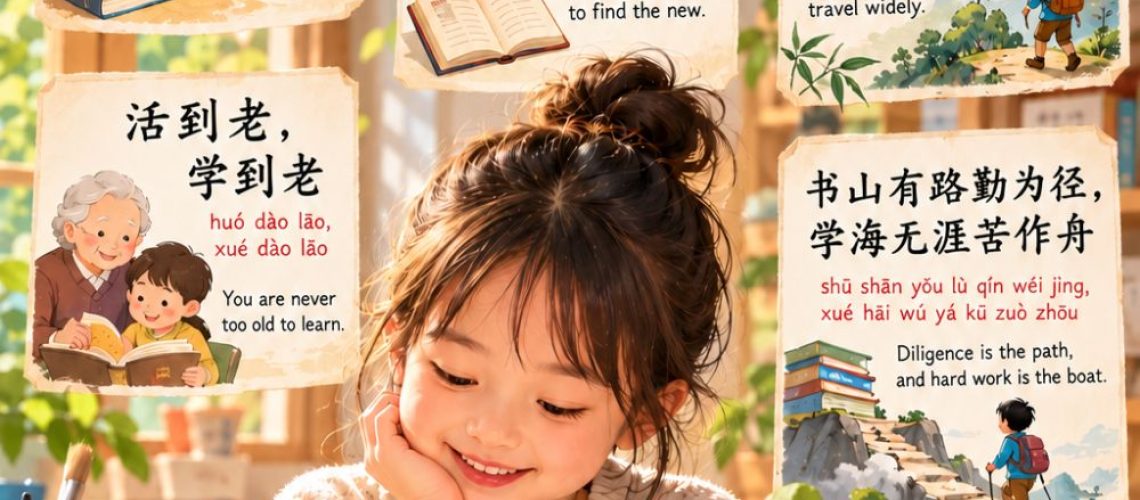
| 02 | 活到老,学到老 | huó dào lǎo, xué dào lǎo | You are never too old to learn | Traditional proverb | Beginner |
| 03 | 读书好,多读书,读好书 | dú shū hǎo, duō dú shū, dú hǎo shū | Reading is good; read more; read good books | Bing Xin (冰心) | Beginner |
| 04 | 书中自有黄金屋 | shū zhōng zì yǒu huáng jīn wū | Books hold a golden house | Poem attributed to Emperor Zhenzong of Song | Beginner |
| 05 | 温故而知新 | wēn gù ér zhī xīn | Review the old to find the new | Analects 2.11 | Beginner |
| 06 | 读万卷书,行万里路 | dú wàn juàn shū, xíng wàn lǐ lù | Read widely and travel widely | Dong Qichang (董其昌) | Growing reader |
| 07 | 书到用时方恨少 | shū dào yòng shí fāng hèn shǎo | You wish you had read more when you need the knowledge | Traditional saying | Growing reader |
| 08 | 读书百遍,其义自见 | dú shū bǎi biàn, qí yì zì xiàn | Read it a hundred times and the meaning appears | Dong Yu (董遇), via 《魏略》 | Growing reader |
| 09 | 读书有三到 | dú shū yǒu sān dào | Reading needs mind, eyes, and mouth | Zhu Xi (朱熹) | Growing reader |
| 10 | 读书破万卷,下笔如有神 | dú shū pò wàn juàn, xià bǐ rú yǒu shén | Wide reading makes writing flow | Du Fu (杜甫) | Challenging |
| 11 | 书山有路勤为径,学海无涯苦作舟 | shū shān yǒu lù qín wéi jìng, xué hǎi wú yá kǔ zuò zhōu | Diligence is the path and hard work is the boat | Traditional couplet | Challenging |
| 12 | 学而不思则罔,思而不学则殆 | xué ér bù sī zé wǎng, sī ér bù xué zé dài | Learning and thinking need each other | Analects 2.15 | Challenging |
The story behind 开卷有益
Emperor Taizong of Song (宋太宗) ordered scholars to compile an encyclopedia of 1,000 volumes, first called 《太平总类》. When it was finished in 983, he decided to read three volumes a day and finish the whole work in a year. The book was renamed 《太平御览》, which means roughly “the emperor’s reading of the Taiping era.”
Busy days made him fall behind, so he caught up on free days. When attendants worried the reading would tire him, he replied that opening a book brings benefit, so he did not find it tiring. His ministers saw how hard he worked and started reading more too.
The story is usually traced to 《渑水燕谈录》, and retellings vary in their exact words.
A note on resources: Want these sayings on the wall? The Chinese Inspirational Quote Posters put short Chinese sayings on classroom-ready pages, and this guide shows how to build a positive learning space with them.
Sayings 01–06: explained
Saying 01 · Reading is worth it
开卷有益
kāi juàn yǒu yì
Opening a book brings benefit.
In one sentence: Any book you open gives you something, so just start.
Origin: A traditional anecdote about Emperor Taizong of Song, usually traced to 《渑水燕谈录》. See the story above.
Practical tip: Let your child pick any book from the shelf today, even a comic or a picture book, and read a few pages together.
Saying 02 · Never too old to learn
活到老,学到老
huó dào lǎo, xué dào lǎo
Live until you are old, and keep learning until you are old.
In one sentence: Learning does not stop at any age.
Origin: A traditional proverb with no established author.
Practical tip: Ask a grandparent to teach your child something they know. Then your child teaches one Chinese word back.
Saying 03 · Read more, read well
读书好,多读书,读好书
dú shū hǎo, duō dú shū, dú hǎo shū
Reading is good; read more; read good books.
In one sentence: Enjoy reading, do plenty of it, and choose good books.
Origin: Bing Xin (冰心), a 20th-century writer, wrote it as an inscription for the magazine 《中学生阅读》. It sums up the reflections in her essay 《忆读书》.
Practical tip: Chant the three short parts with a clap after each one. The rhythm makes it easy to remember.
Saying 04 · What books can give you
书中自有黄金屋
shū zhōng zì yǒu huáng jīn wū
Within books there is a golden house.
In one sentence: Books can open the door to a better future.
Origin: From 《励学篇》 (also called 《劝学诗》), traditionally attributed to Emperor Zhenzong of Song. The authorship is uncertain.
Language note: In his time, studying meant preparing for the imperial exams. Treat it as encouragement, not a promise of wealth.
Practical tip: Ask your child, “What could a book help you become?” Let them draw their own “golden house.”
Saying 05 · Review to grow
温故而知新
wēn gù ér zhī xīn
Review the old and you will find something new.
In one sentence: Going back over what you know helps you understand more.
Origin: The Analects 2.11 (《论语·为政》): “温故而知新,可以为师矣.” As an idiom it is often written 温故知新.
Practical tip: Before a new story, spend two minutes rereading yesterday’s words. Notice what your child now sees that they missed.
Saying 06 · Books and the real world
读万卷书,行万里路
dú wàn juàn shū, xíng wàn lǐ lù
Read ten thousand volumes, walk ten thousand miles.
In one sentence: Learn from books and from experience, because each makes the other richer.
Origin: Dong Qichang (董其昌), Ming dynasty, in 《画禅室随笔》, writing about how painters grow.
Language note: 卷 is pronounced juàn here, meaning a volume. 万 means ten thousand and also “very many.”
Practical tip: Read a book about animals or food, then visit a park, museum, or market that connects to it.
Sayings 07–12: explained
Saying 07 · Read before you need it
书到用时方恨少
shū dào yòng shí fāng hèn shǎo
When you need knowledge, you wish you had read more.
In one sentence: Learn now, because you cannot read in a hurry when the moment comes.
Origin: A traditional saying with no established author. It is often paired with 事非经过不知难. Some sites credit Lu You, but that is unreliable.
Practical tip: Start from a real question your child has, such as “Why is the sky blue?” Then find a book that answers it.
Saying 08 · Patience with reading
读书百遍,其义自见
dú shū bǎi biàn, qí yì zì xiàn
Read a book a hundred times and its meaning shows itself.
In one sentence: Repeated reading makes the meaning clear.
Origin: Dong Yu (董遇), Three Kingdoms period, recorded in Pei Songzhi’s commentary to the 《三国志》, which quotes the 《魏略》. The original wording is 读书百遍而义自见. Dong Yu also told a busy student to use the “three spare times” (三余): winter, night, and rainy days.
Language note: 见 is pronounced xiàn here, meaning “to appear.”
Practical tip: Reread one short story three times in one week: first for the story, then for new words, then for smooth reading aloud.
Saying 09 · Three ways to read
读书有三到:心到、眼到、口到
dú shū yǒu sān dào: xīn dào, yǎn dào, kǒu dào
Reading needs three things to arrive: mind, eyes, and mouth.
In one sentence: Read with your attention, your eyes, and your voice.
Origin: A passage from Zhu Xi’s 《训学斋规》 (Song dynasty). Zhu Xi says 心到最急: focused attention matters most.
Practical tip: Have your child put a finger under each character as they read aloud. Then ask one question about what they read.
Saying 10 · Reading feeds writing
读书破万卷,下笔如有神
dú shū pò wàn juàn, xià bǐ rú yǒu shén
Read ten thousand volumes through, and your pen moves as if inspired.
In one sentence: Wide reading gives you the words and ideas to write well.
Origin: Du Fu (杜甫), Tang dynasty, in the poem 《奉赠韦左丞丈二十二韵》.
Practical tip: Read a short story together, then ask your child to write or draw a new ending.
Saying 11 · Effort carries you
书山有路勤为径,学海无涯苦作舟
shū shān yǒu lù qín wéi jìng, xué hǎi wú yá kǔ zuò zhōu
The mountain of books has a path, and diligence is the way. The sea of learning has no shore, and hard work is the boat.
In one sentence: Knowledge is huge, and steady effort is how you cross it.
Origin: A traditional couplet. Many sites credit Han Yu, but we found no reliable source, and Hong Kong’s Education Bureau lists the author as unknown. A common variant reads 苦是舟.
Language note: 为 is pronounced wéi here, meaning “to be.”
Practical tip: Learn the first line this week and the second next week. Add a five-minute daily reading chart with a sticker for each day.
Saying 12 · Think while you learn
学而不思则罔,思而不学则殆
xué ér bù sī zé wǎng, sī ér bù xué zé dài
Learning without thinking leaves you confused. Thinking without learning leaves you stuck.
In one sentence: Good learning needs both reading and reflection.
Origin: The Analects 2.15 (《论语·为政》).
Language note: 罔 (wǎng) and 殆 (dài) are rare characters. Teach the meaning and sound, not the writing.
Practical tip: After a story, ask “Why do you think that happened?” and listen to the answer before giving yours.
Which sayings work best by age or role
| Who | Start with | Why |
|---|---|---|
| Ages 5–6 | 01, 02, 03 | Short, rhythmic, and easy to say |
| Ages 7–9 | 05, 06, 07, 09 | Clear ideas children can act on |
| Ages 10 and up | 08, 10, 11, 12 | Longer lines and ideas worth discussing |
| Beginner adult learners | 01, 03, 05, 06 | Common characters with useful grammar patterns |
| Teachers | 03, 09, 12 | Work well as classroom routines and discussion starters |
How to actually use these sayings
| Moment | What to do |
|---|---|
| Before reading | Say the saying once, then open the book |
| After reading | Ask the question from the practical tip |
| Car or walk | Chant it with a rhythm or clap |
| Weekly routine | Pick one saying and revisit it for a week |
| Wall display | Post it where your child sees it daily |
Say it once, let it sit
Do not drill. Say the saying, explain it in one sentence, and move on. The meaning grows when it comes back naturally.
Start small
Begin with the first five sayings. Add the others only when your child asks for more.
Connect it to a real moment
Link the saying to something that just happened, like a long book finished or a hard page reread.
Quick pick: which saying should I teach first?
| If your child… | Try |
|---|---|
| Does not like reading yet | 开卷有益 |
| Gives up easily | 书山有路勤为径,学海无涯苦作舟 |
| Rushes through books | 读书有三到:心到、眼到、口到 |
| Forgets what they learned | 温故而知新 |
| Loves stories and wants to write | 读书破万卷,下笔如有神 |
| Accepts everything without asking why | 学而不思则罔,思而不学则殆 |
| Needs a reason to read | 书到用时方恨少 |
How to read the pinyin
Pinyin writes Mandarin sounds with the Latin alphabet. The marks above vowels show the tone:
- ā high and flat (first tone)
- á rising (second tone)
- ǎ falling then rising (third tone)
- à falling (fourth tone)
A few characters here have more than one reading. Use the pinyin in this post for each saying:
- 卷 is juàn (volume), not juǎn (to roll up)
- 见 is xiàn (to appear) in 其义自见
- 为 is wéi (to be) in 勤为径
- 罔 is wǎng and 殆 is dài, both rare in daily use
Frequently asked questions
What is the most famous Chinese saying about reading?
There is no official ranking, but 读万卷书,行万里路 is among the most widely quoted. 开卷有益 is the easiest to learn.
What does 开卷有益 mean?
It means “opening a book brings benefit.” The idea is that any reading is worth your time.
What does 读万卷书,行万里路 mean?
Books and real experience work together. Read widely, and travel and observe widely too.
How do you say “read more books” in Chinese?
You can say 多读书 (duō dú shū). The full line 读书好,多读书,读好书 adds “reading is good” and “read good books.”
Did Han Yu write 书山有路勤为径?
We found no reliable source. Many sites credit him, but it is safest to call it a traditional couplet.
Did Lu You write 书到用时方恨少?
That credit is not reliable. Call it a traditional saying.
Is 卷 pronounced juǎn or juàn in 开卷有益?
It is juàn, meaning a volume or scroll of a book.
Which sayings are best for young children?
Start with 开卷有益, 活到老,学到老, and 读书好,多读书,读好书. They are short, rhythmic, and easy to say.
Are these sayings useful for adult beginners?
Yes. They use common characters and teach real grammar patterns, and the stories make them easier to remember.
How can I teach a saying without making it feel like homework?
Say it once, explain it in one sentence, and connect it to a book you are reading. Keep each session short.
In summary
Chinese sayings about books are short, memorable, and useful at every level. Start with 开卷有益, add one saying at a time, and connect each to a real book.
Explore more
- 12 Chinese Sayings About Life
- 8 Timeless Confucius Sayings on Education
- 10 Motivational Quotes in Chinese
- Chinese Reading Books for Kids
- More Chinese quotes
If you find this article useful, share it