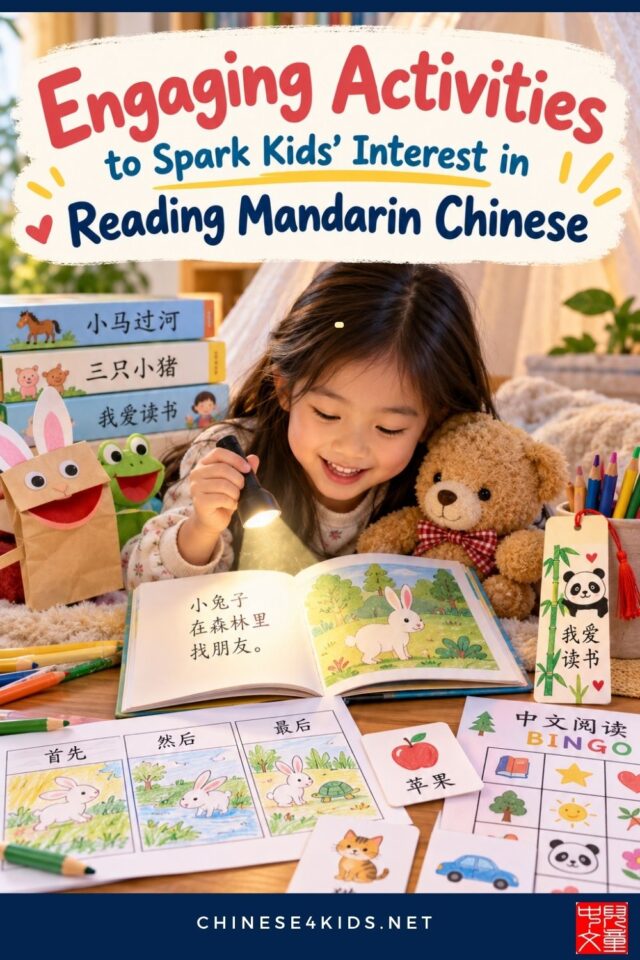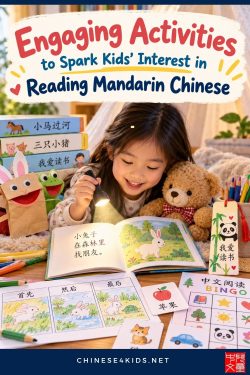
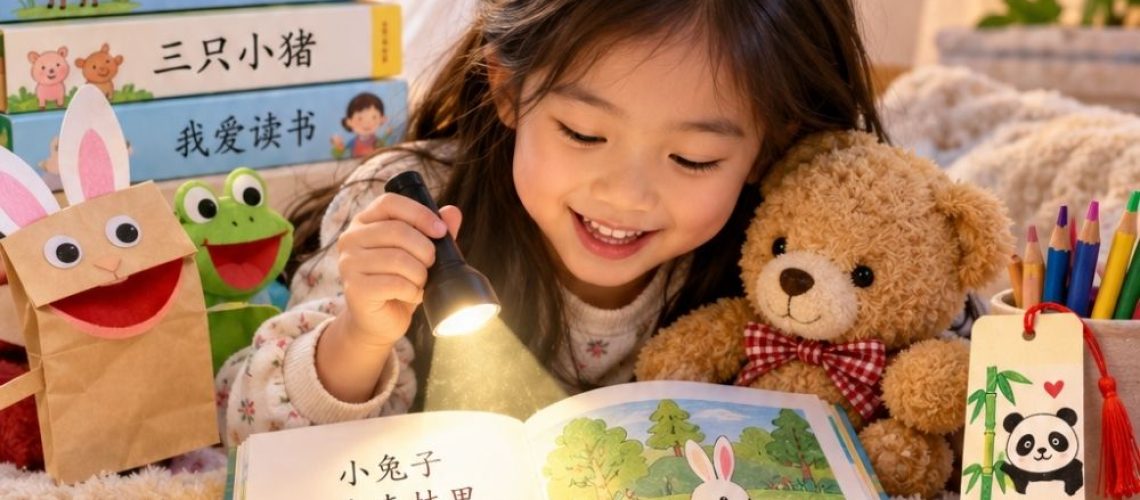
Reading is more fun when it’s not only reading. A puppet can talk. A flashlight can make a page feel like a secret. A bag of toys can turn into a word hunt. These activities help children enjoy Chinese books, and they work at home, in tutoring, and in the classroom.
Quick Answer
The best Chinese reading activities pair a book with something kids can do: act out a scene, hunt for a word, draw the ending, or label a snack. Pick one activity, use a book your child can mostly read, and keep it to ten or fifteen minutes. Every activity below includes what your child actually reads, so the fun stays connected to the Chinese.
The best Chinese reading activities pair a book with something kids can do: act out a scene, hunt for a word, draw the ending, or label a snack. Pick one activity, use a book your child can mostly read, and keep it to ten or fifteen minutes. Every activity below includes what your child actually reads, so the fun stays connected to the Chinese.
Which Chinese Reading Activity Should You Try First?
Here are the 14 main activities, and you’ll find four quick, no-prep games near the end. The ages are only suggestions. A younger child who recognizes many characters may enjoy a more advanced activity, while an older beginner may feel happier with picture-based games. Follow your child’s reading level and mood.
| Activity | Best for | Prep time | Skill |
|---|---|---|---|
| 1. Flashlight reading | Ages 4–10 | 2 min | Word recognition |
| 2. Read to a stuffed animal | Ages 4–8 | None | Fluency, confidence |
| 3. Puppet theater | Ages 5–10 | 10 min | Fluency, expression |
| 4. Retell or draw a comic | Ages 5–12 | 2 min | Comprehension |
| 5. Chinese bookmarks | Ages 5–12 | 5 min | Character recognition |
| 6. Mystery story bag | Ages 4–8 | 10 min | Vocabulary in context |
| 7. Story sequencing | Ages 5–9 | 10 min | Story comprehension |
| 8. Build a new ending | Ages 7–12 | None | Comprehension, creativity |
| 9. Character scavenger hunt | Ages 4–9 | 10 min | Character recognition |
| 10. Chinese book bingo | Ages 5–12 | 10 min | Review, motivation |
| 11. Action charades | Ages 4–10 | 5 min | Vocabulary, comprehension |
| 12. Read a recipe or food story | Ages 5–12 | 15 min | Reading for a purpose |
| 13. Festival or folktale exploration | Ages 5–12 | 10 min | Reading and culture |
| 14. Listen and spot | Ages 5–12 | 5 min | Listening, word recognition |
Prep times are estimates. Most activities take about 5 to 15 minutes to play, depending on your child’s age and reading level.
Cozy Reading and Storytelling
1. Flashlight reading
Best for ages 4–10, at any level. Prep: 2 minutes. You’ll need a flashlight and a favorite book.
Dim the lights and hand your child the flashlight. As the beam moves across the page, they read the words it lights up, or find a word you call out. At the end, ask them to “spotlight” their favorite word one more time. It feels like a little adventure, and your child is reading real Chinese the whole way through.
Easier or harder: Beginners can simply hunt for a word you name. Older kids can read a whole page aloud by flashlight.
2. Read to a stuffed animal
Best for ages 4–8, especially shy readers. No prep. You’ll need a favorite stuffed animal.
Some children freeze when an adult is listening. A teddy bear is a much gentler audience. Let your child introduce the toy, perhaps with “你好,小熊 (nǐ hǎo, xiǎoxióng, Hello, little bear)”, and then read a page just for it. When they finish, the bear can “ask” a question about the story. Nobody is correcting, and nobody is counting mistakes.
Easier or harder: Beginners can point to pictures and say the words they know. Older kids can retell the whole story to their furry friend. If a calm family pet joins in, that’s lovely, but never force an animal to take part.
Some links in this post are Amazon affiliate links. If you buy through them, we may earn a small commission at no extra cost to you.
3. Puppet theater
Best for ages 5–10, around Levels A to C. Prep: 10 minutes. You’ll need paper bags, socks, or stick puppets.
Choose a short story with dialogue, such as the folktale 小马过河 (xiǎomǎ guò hé, The Little Horse Crosses the River). Make one puppet for each character. Then read a line in each character’s voice, and act it out. Children read the words aloud with feeling, and that’s real fluency practice. For more ideas on reading with expression, see our guide to reading aloud in Chinese.
Easier or harder: Beginners can say just one line each. Older kids might add a new line in Chinese for their puppet.
4. Retell a story or draw a comic
Best for ages 5–12. Prep: 2 minutes. You’ll need paper and colored pencils.
After reading, invite your child to draw three pictures: what happened first, next, and last. Then they label each picture with a familiar word, or copy one sentence from the book. To do that, they have to go back into the text and find the right words, which is exactly the kind of looking we want. In a classroom, each child can draw one part, and you can put the pages together into a class comic.
Easier or harder: Beginners can label only. More confident readers can add speech bubbles or invent a new character.
Make and Create
5. Chinese bookmarks
Best for ages 5–12. Prep: 5 minutes. You’ll need card, colored pencils, and a few characters your child knows.
Kids decorate a bookmark with a favorite character, a picture from a story, or a short word, such as 读书 (dúshū, read books), 故事 (gùshi, story), 快乐 (kuàilè, happy), or 加油 (jiāyóu, keep going). Encourage them to choose words they’ve met in their own reading. The finished bookmark is a small keepsake, and it quietly reminds them to keep going.
Easier or harder: Beginners can copy one word. Older kids can write a short sentence from their book.
6. Mystery story bag
Best for ages 4–8, around Levels aa and A. Prep: 10 minutes. You’ll need a bag, three or four small objects, and word cards.
Fill a bag with objects from a story, such as a toy apple, a ball, and a hat. Your child reaches in, pulls one out, and finds its word card (苹果 píngguǒ, 球 qiú, 帽子 màozi). Then comes the best part: finding the page in the book where that word appears. If you’d like help making the cards, our flashcard tips are a good place to start.
Easier or harder: Start with just two objects. Later, add a sentence card for your child to match.
7. Story sequencing
Best for ages 5–9, around Levels A and B. Prep: 10 minutes. You’ll need a short book, paper, and a pencil.
Write four or five key sentences from a familiar story on strips of paper, or draw a simple picture for each event. Shuffle them. Your child reads each one and puts them in order. Then ask, “Which sentence in the book shows what happened first?” That question sends them back to the text to find proof, which builds careful reading.
Easier or harder: Beginners can use pictures with one word each. Older kids can work with full sentences.
8. Build a new ending
Best for ages 7–12, around Levels B and C. No prep. You’ll need paper, if you want to write it down.
Read a short story together, and then ask, “What if the ending were different?” Your child tells or writes a new ending, even just one sentence, using words from the book. A new ending only works if they understood the original, so this quietly checks comprehension without feeling like a quiz.
Easier or harder: Beginners can tell the new ending in their stronger language and add one Chinese word. Older kids can write two or three sentences.
Explore Words and Characters
9. Character scavenger hunt
Best for ages 4–9, around Levels aa and A. Prep: 10 minutes. You’ll need word cards or stickers, and a small prize.
Hide word cards around the room, using words from a book, such as 门 (mén, door), 床 (chuáng, bed), 书 (shū, book), and 杯子 (bēizi, cup). Your child finds a card, reads it, and then finds the matching word in the book. Little legs get moving, and little eyes get practice. For more ideas, see our post on scavenger hunts for Mandarin learning.
Easier or harder: Add pictures to the cards for beginners. For older kids, hide whole sentence cards.
10. Chinese book bingo
Best for ages 5–12, at any level. Prep: 10 minutes. You’ll need a bingo grid and a few books.
Draw a three-by-three grid. Fill each square with a small reading challenge, such as “find a character you know,” “read a funny page,” “find an animal,” “find a word that appears more than once,” or “read to a family member.” Kids mark a square each time they finish one. Every square sends your child back into a book. Bingo works all year, and you can reuse the same board with different books, so the squares stay and only the books change.
Easier or harder: Add pictures for younger kids. Add challenges such as “describe a character” for older ones.
11. Action charades
Best for ages 4–10, around Levels aa and A. Prep: 5 minutes. You’ll need word cards for action words.
Write action words on cards, such as 跳 (tiào, jump), 吃 (chī, eat), 笑 (xiào, laugh), 哭 (kū, cry), and 睡觉 (shuìjiào, sleep). One player picks a card, reads it silently, and acts it out. The others guess the Chinese word, and then everyone checks the answer on the card. Silly faces and giggles are part of the learning here.
Easier or harder: Use pictures with the words for beginners. For older kids, try short phrases such as 我在跳 (wǒ zài tiào, I am jumping), or act out a whole sentence from a book.
Culture, Food, and Media
12. Read a recipe or a food story
Best for ages 5–12. Prep: 15 minutes. You’ll need a simple recipe card or a food-themed book, plus the food itself.
Write a short recipe card with a few Chinese words, such as 面粉 (miànfěn, flour), 水 (shuǐ, water), and 肉 (ròu, meat). Your child reads the card, matches each word to a real ingredient, and then helps you put together something quick, like a snack plate. If you’d like dumplings, make or buy them beforehand so the activity stays short. At the end, your child can label the finished food with 饺子 (jiǎozi, dumplings). Reading suddenly has a real purpose, and the words stick because they taste good.
Easier or harder: Beginners can match pictures to the words. Older kids can read a short list of steps.
13. Festival or folktale exploration
Best for ages 5–12. Prep: 10 minutes. You’ll need a festival book or folktale, and a few craft supplies.
Read a story about a festival, such as this Mid-Autumn Festival story. Then pick one related activity, such as drawing the moon or making a paper lantern, and look for festival words in the book, like 月亮 (yuèliang, moon) and 月饼 (yuèbǐng, mooncake). Other festivals have their own words too. You might find 粽子 (zòngzi, rice dumplings) for the Dragon Boat Festival, and 红包 (hóngbāo, red envelope) and 灯笼 (dēnglong, lantern) for the Spring Festival. Festival books are a lovely way to connect language with culture.
Easier or harder: Beginners can find one festival word. Older kids can retell the story in a few sentences.
14. Listen and spot
Best for ages 5–12. Prep: 5 minutes. You’ll need a short audio story, song, or cartoon, and the matching book if you have one.
Before listening, choose three words from the story. As your child listens, they raise a hand or tap the table whenever they hear one. Then they find the word in the printed story, point to it, and read it aloud if they feel ready. This is wonderful for children who understand spoken Chinese better than they can read it, because listening becomes a bridge to the characters.
Easier or harder: Start with just one word. Older kids can listen for a whole phrase.
Subtitled cartoons, songs, and audio stories all work well. If you choose a film, preview it first, because some popular titles can feel intense for younger children.
Quick Family Games
These need no prep at all, so they are perfect for car rides and waiting rooms.
- Word chain. Say a word, and the next person says a word that begins with its last character. For example, 苹果 (píngguǒ, apple) leads to 果汁 (guǒzhī, juice).
- Memory match. Make pairs of cards, one with a word and one with a picture. Flip two at a time to find a match.
- I Spy with characters. Say, “I spy a word that means door.” Your child finds 门 on a card or in a book.
- Tongue twisters. This one is sound practice. Read the characters first, then say 四是四,十是十 (sì shì sì, shí shì shí, four is four, ten is ten) slowly, then a little faster. It’s great for tones.
How Do You Choose a Book for These Activities?
Pick a book your child can mostly read with little help. If every page feels hard, the activity will feel like work, and nobody wants that. A familiar story works best, because kids already know what happens and can focus on the words. For more help with choosing, see our guide to extensive Chinese reading and our step-by-step guide to Chinese reading.
Frequently Asked Questions
What are fun ways to practice reading Chinese at home?
Try an activity that connects a book to play, such as puppet theater, a character scavenger hunt, or a mystery story bag. Keep it short, and make sure your child reads real words from a book or card.
How long should a reading activity last?
Ten to fifteen minutes is plenty for most children, and younger kids may enjoy just five. Stop while they are still having fun, so they look forward to the next one.
What if my child can’t read Chinese yet?
Start with pictures and single words, and read aloud together. The scavenger hunt, charades, and mystery bag all work well for beginners, especially with a Level aa book.
Do I need to speak Chinese to run these activities?
No. Use word cards with pinyin, listen to audio together, and let your child teach you what they know. Your interest matters more than your Chinese level.
Can I use these activities in a classroom?
Yes. Most work well in pairs or small groups. Puppet theater, bingo, the scavenger hunt, and story sequencing are good choices for a class.
How are these different from a Chinese Reading Week?
These activities work any week of the year. A Reading Week is a special event with a schedule, daily routines, and a sign-up, and you can use these ideas as part of one.
Books and Next Steps
Each of these activities works best with a book at the right level. Our Chinese leveled readers are original, printable picture books made for children learning Mandarin outside China, and they run from Level aa to Level C. You can also get them together in the Chinese Reading Made Easy Book Vault.
Planning a special reading event? Our Chinese Reading Week guide offers a ready-to-use collection of challenges, reading routines, and event ideas.
Start small. Pick one activity, one book, and a few happy minutes. When reading feels like play, kids come back for more.
Want more ideas? Explore more Chinese reading resources for kids.
If you find this article useful, share it