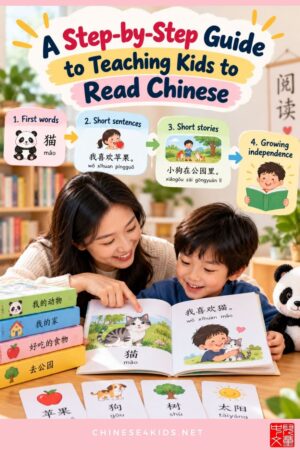

Learning to read Chinese can feel like a big mountain. There are thousands of characters, and no letters to sound out. But kids don’t climb it all at once. They take one small step at a time, and so can you. This guide walks you through the path, from a child’s first picture-book words to short stories.
Quick Answer
To teach kids to read Chinese, start with a few familiar words and pictures, then move to short sentences, and later to simple stories. Read together every day for about ten minutes, choose books your child can mostly read, and keep it fun. There’s no race. Move up a level when the current one feels easy, not when a calendar says so.
To teach kids to read Chinese, start with a few familiar words and pictures, then move to short sentences, and later to simple stories. Read together every day for about ten minutes, choose books your child can mostly read, and keep it fun. There’s no race. Move up a level when the current one feels easy, not when a calendar says so.
Contents
hide
What Are the Stages of Learning to Read Chinese?
Every child moves at their own speed. The stages below are a path, not a schedule. A child may read short sentences yet still need help with some characters, and that’s perfectly normal. Use them to see where your child is now and what to try next.
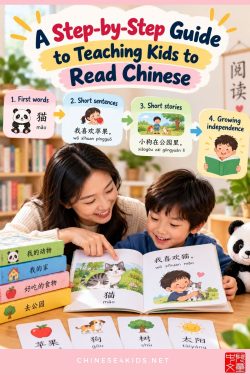
| Stage | What your child does | Book level | What you do |
|---|---|---|---|
| 1. First words | Matches a few familiar words to pictures | Level aa (one to three words per page) | Read aloud, point to words, play with sounds |
| 2. Short sentences | Reads simple, repeated sentences | Level A | Take turns reading, ask easy questions |
| 3. Short stories | Follows a story across several sentences, then simple dialogue | Levels B and C | Retell, predict, and talk about the story |
| 4. Growing independence | Chooses books, uses context clues, reads longer texts | Books matched to the child’s developing level | Offer choices, let them lead, keep reading for fun |
| All stages | Builds a daily habit | Any level that feels comfortable | Keep it short, fun, and regular |
Stage 1: Start With Familiar Words and Pictures
Begin with words your child already meets every day, like animals, toys, or family members. A picture next to each word helps a lot. The child sees 马 (mǎ, horse) beside a horse, and the meaning clicks without a translation.
Look for books where each page has just one to three words, and where the picture matches the text exactly. Pinyin can help at this stage, too. It shows how a word sounds, and it lets parents who don’t read Chinese join in. Just keep nudging your child to look at the characters as well.
- Read aloud together. Let your child hear each word first, then say it back.
- Point and say. Use a finger to follow each character.
- Match words to pictures. Show a picture of a cat and ask your child to find the matching Chinese word.
- Trace in the air or on paper. A few simple characters, like 人 (rén, person) or 大 (dà, big), are fun to trace.
- Repeat favorites. Seeing the same words again and again helps them stick.
Our Chinese leveled readers start at Level aa for exactly this stage.
Stage 2: Move to Short Sentences
When single words feel easy, your child is ready for whole sentences. Choose books with short, complete sentences and repeated words, so the language is predictable. A line like 我喜欢苹果 (wǒ xǐhuan píngguǒ, I like apples) can show up on page after page with a new fruit each time.
This is a good time to take turns. You read one page, your child reads the next. Ask a simple question after each page, such as “What does the girl like?” For more ways to read together, see our guide to reading aloud in Chinese.
Notice the parts of a character
Once kids know a handful of characters, they can start spotting the parts inside them. That turns a random shape into a puzzle. Here are some friendly examples:
- 木 (mù, tree) appears twice in 林 (lín, woods) and three times in 森 (sēn, forest).
- The water part 氵 shows up in 河 (hé, river), 海 (hǎi, sea), and 湖 (hú, lake).
- 日 (rì, sun) and 月 (yuè, moon) together make 明 (míng, bright).
Don’t worry about teaching rules. Just point out the pattern when it appears, and let your child look for more. Characters that share a part often share a hint of meaning, though not always, and not every character can be explained by adding up its parts. Treat it as a discovery game, not a formal lesson.
For a gentle start with how characters began as pictures, try our 36 Basic Chinese Pictographs Workbook.
Stage 3: Read Short Stories
Now the fun grows. Books at this stage have several sentences per page, and later simple dialogue. Our Level B readers have about 30 to 55 words, with the text in a consistent spot on each page. Level C brings in dialogue, with about 50 to 80 words across 10 pages.
At this stage, understanding matters as much as saying the words. A child might pronounce every word correctly and still miss what happened. Another might stumble over a sentence but understand the story perfectly when listening. Both skills deserve attention. Talk about the story the way you would in any language, and choose one or two questions that fit the book:
- Can you retell the story in your own words?
- What do you think will happen next?
- Why do you think the character did that?
- What was your favorite part, and why?
Beginners can answer by pointing at a picture or using their stronger language first. Over time, encourage short answers in Chinese. If a word is tricky, try one of these tricks before translating:
- Look at the picture. What clue does it give?
- Use the story. What word would make sense here?
- Break it apart. Does the new word hold a part or a word you know?
- Link it to real life. Have you seen or done something like this?
If the meaning is still unclear, just explain it simply. The goal isn’t to make reading harder. It’s to give kids a few ways to approach new words.
Try Retelling
Retelling helps children organize what they understood. They can start by naming a character or telling you one thing that happened. Later, they can describe the beginning, middle, and end. Beginners can use their stronger language first and add short Chinese phrases over time.
When your child is ready to read many easy books for fun, see extensive Chinese reading. When you’d like to study one sentence in more detail, try intensive Chinese reading.
Stage 4: Help Your Child Become an Independent Reader
Independence grows slowly. Kids need books they can understand, chances to choose, and enough practice to feel successful. Offer a small stack of suitable books and let your child pick. Some love animals, others prefer family stories or funny ones, and interest keeps them turning pages.
These level descriptions are starting points, not universal standards. A child’s real experience depends on vocabulary, earlier exposure to Chinese, and how familiar the topic is.
- Level aa: one to three words per page, with a picture for each.
- Level A: short, complete sentences and predictable language.
- Level B: several sentences, about 30 to 55 words, with text in a consistent spot.
- Level C: dialogue, about 50 to 80 words over 10 pages.
If your child needs help with nearly every word, try an easier book. If they read comfortably and can explain what it means, they may be ready for something new.
How Do You Know When to Move Up a Level?
Look for signs, not dates. Your child is probably ready for the next stage when most of these feel true:
- They read the current books without much help.
- They can find several familiar words on a page by themselves.
- They can tell you what happened, even in a few simple words.
- They ask for new books, or reread old favorites with ease.
- Reading time feels relaxed, not stressful.
If a new book feels like a struggle, go back to the easier level for a while. That isn’t a step backward. It’s how confidence grows.
Habits That Help at Every Stage
Practice a little every day
Set a regular time, such as before bed or after dinner. Ten minutes is plenty. Let your child read aloud, and praise the effort. Choose books that are mostly at your child’s level, with an occasional stretch.
Make it fun
Games, songs, and hands-on play make reading something kids look forward to. Try flashcards for characters, or a word-finding scavenger hunt around the house. You can also stick colorful labels on household items with their Chinese names, so words are part of everyday life. For listening fun, try the cartoon 大耳朵图图 or some Mandarin children’s songs, and watch together when you can.
Surround your child with Chinese books
Create a cozy reading corner with a basket of Chinese books, comics, and picture books. Visit the library if you have a Chinese section nearby, or join a local storytelling or reading club. The more often kids see Chinese on the shelf, the more natural it feels.
Keep a simple reading log
A reading log shows kids how far they’ve come. Let them write the title and date, a quick note on how it felt (easy, just right, hard), and one new word they noticed. Looking back through the log is a lovely way to see progress.
Get the Free Printable Chinese Reading Log
Want a ready-made log? Our free printable lets your child record each book, how it felt, and one new word they learned. It’s simple enough for a beginner and easy to use at home or in class.
You’ll also get occasional emails with Chinese learning tips and resources. Unsubscribe anytime.
Celebrate every step
Some links in this post are Amazon affiliate links. If you buy through them, we may earn a small commission at no extra cost to you.
Praise small wins, like recognizing a new character or finishing a first book. Here are two simple ways to track the wins.
-
- A reward chart. Your child earns a sticker for each book. After a set time, such as one month, or a set number of stickers, such as 10, they choose an agreed reward. A movie night, a trip to the zoo, or a meal at a Chinese restaurant all work well.
- A reward chart. Your child earns a sticker for each book. After a set time, such as one month, or a set number of stickers, such as 10, they choose an agreed reward. A movie night, a trip to the zoo, or a meal at a Chinese restaurant all work well.
- A punch card. Each reading session earns a punch or a sticker. When the card is full, your child gets the reward you agreed on together.
Rewards don’t need to be big, though. Choosing the next book or reading with a favorite adult can feel just as good. Avoid turning every mistake into a correction. If your child is struggling, model the word, read the sentence together, and keep going.
Don’t rush independent reading
Reading together first is a gentle path. Your child will start reading alone when they feel ready. Our post on how not to discourage children from reading Chinese books shows what to avoid.
What If You Don’t Speak Chinese?
You can still guide your child along every stage. Let your child read to you, even when you can’t follow every word. Ask about the pictures. Listen to audio together. Use pinyin as a bridge when you need it. Your interest and patience matter more than your Chinese level, and you can learn right alongside your child.
Ask questions you can both answer: “What is happening in this picture?” or “Which character do you recognize?” If a book has an English translation, you can read it first to follow the story before trying the Chinese.
Frequently Asked Questions
How do I teach my child to read Chinese?
Start with familiar words and pictures, then move to short sentences and simple stories. Read together every day for about ten minutes, and choose books your child can mostly read.
What age can kids start learning to read Chinese?
Young children can start by listening to stories and joining in with repeated words. Reading single words usually begins when a child can connect a picture with a word. There’s no fixed age, so follow your child’s interest.
Should my child learn pinyin first or characters first?
Both can work together. Pinyin shows how a word sounds and helps parents join in. Characters are what your child will read in books, so keep pointing to them as you read.
How many characters does my child need before reading books?
There’s no magic number. Level aa books use only a few words per page, so a child can begin with a small set of familiar words. A short list of the most common characters, such as our free Top 100 Chinese Characters list, is a friendly starting point.
How long should reading practice be?
Ten minutes a day is a good start. Younger children may prefer shorter sessions. Regular, relaxed practice is more important than long sessions.
What should I do if my child doesn’t want to read Chinese?
Let your child choose the book, shorten the session, and read together instead of asking them to read alone. Add a game or an activity they love. Keep the mood light, and try again tomorrow. Have a reading week or similar events to ignite the joy of reading.
How do I know if my child is making progress?
Look at the signs in the “ready to move up” list above. Your reading log is also a good guide. When your child reads more easily, recognizes more words, and asks for new books, that’s real progress.
Books and Next Steps
Every stage goes more smoothly with books at the right level. Our Chinese leveled readers are original, printable picture books made for children learning Mandarin outside China. They run from Level aa to Level C, so your child can move up when ready. You can also get them together in the Chinese Reading Made Easy Book Vault.
If your child is still building a basic set of words, Chinese Vocabulary Made Easy teaches the 300 most common Chinese words. Knowing common words makes early books easier to enjoy.
Learning to read Chinese is a journey, not a race. Start small, stay patient, and celebrate every step. With time and a little play, your child will be reading Chinese books with confidence.
Want more ideas? Explore more Chinese reading resources for kids.
If you find this article useful, share it