Quick answer
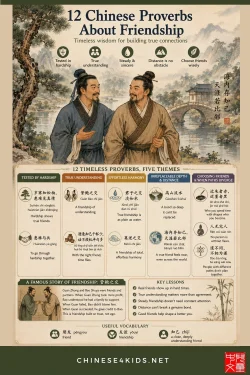
Chinese proverbs on friendship focus on a few consistent ideas: real friendship shows up in hard times, good friends don’t need constant drama to feel real, and true understanding matters more than convenience. Below are 12 genuine Chinese proverbs, sayings, and stories — each with the Chinese, pinyin, meaning, classical source, and a practical way to use it with a child.
Chinese proverbs on friendship focus on a few consistent ideas: real friendship shows up in hard times, good friends don’t need constant drama to feel real, and true understanding matters more than convenience. Below are 12 genuine Chinese proverbs, sayings, and stories — each with the Chinese, pinyin, meaning, classical source, and a practical way to use it with a child.
Abraham Lincoln said that a good part of life is made up of friendship. Chinese thought has been saying something similar for over two thousand years — in Confucius’s own words, in Daoist philosophy, in Tang dynasty poetry, and in one of the most quoted friendship stories in Chinese history.
Friendship is one of the harder things to teach directly. That’s why parents and teachers have long used Chinese proverbs to explain friendship through a memorable line or story, rather than a long lecture.
Each proverb below comes with the Chinese, the pinyin, a plain meaning, its classical source, and a practical tip. Every proverb here was checked against its earliest identifiable classical source. Where scholars disagree on attribution, or a saying appears in more than one classical text, we’ve said so rather than presenting an uncertain origin as settled fact.
What do Chinese proverbs say about friendship?
- Real friends show themselves during hardship, not in easy times.
- A healthy friendship doesn’t need constant gifts, drama, or attention to stay real.
- Being truly understood matters more than being agreed with.
- Distance — physical or emotional — doesn’t have to weaken a genuine friendship.
- Choosing good friends shapes who you become.
What is the most famous Chinese friendship proverb?
The best-known Chinese friendship proverb is 君子之交淡如水 (jūnzǐ zhī jiāo dàn rú shuǐ) — “the friendship between true gentlemen is as plain as water.” It teaches that real friendship is steady and sincere, and doesn’t depend on gifts, status, or constant attention.
Useful vocabulary
朋友 péngyǒu — friend
友谊 yǒuyì — friendship
知己 zhījǐ — a close, deeply understanding friend (closer than 朋友). In natural speech, the third tone on 己 often softens slightly rather than landing as a full, sharp dip.
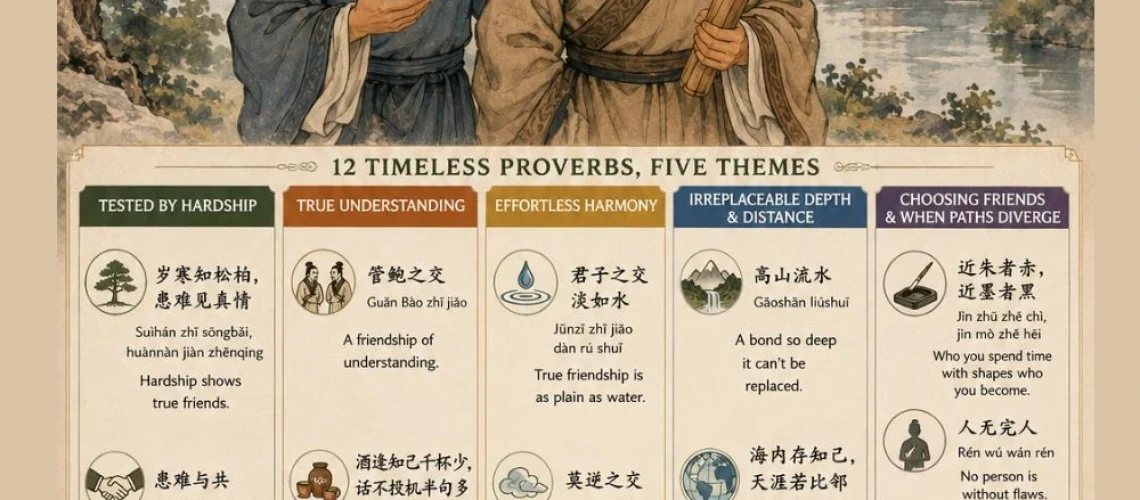
12 Chinese Friendship Proverbs, Quotes and Sayings
| Chinese | Pinyin | Meaning in one line | Theme | Source |
|---|---|---|---|---|
| 岁寒知松柏,患难见真情 | Suìhán zhī sōngbǎi, huànnàn jiàn zhēnqíng | Cold winter shows which trees stay green; hardship shows true friends. | Tested by hardship | Analects (partial) + folk couplet |
| 患难与共 | Huànnàn yǔ gòng | To go through hardship together. | Tested by hardship | Long-standing Chinese idiom |
| 管鲍之交 | Guǎn Bào zhī jiāo | “The friendship of Guan and Bao” — understood, not just liked. | True understanding | Records of the Grand Historian (史记) |
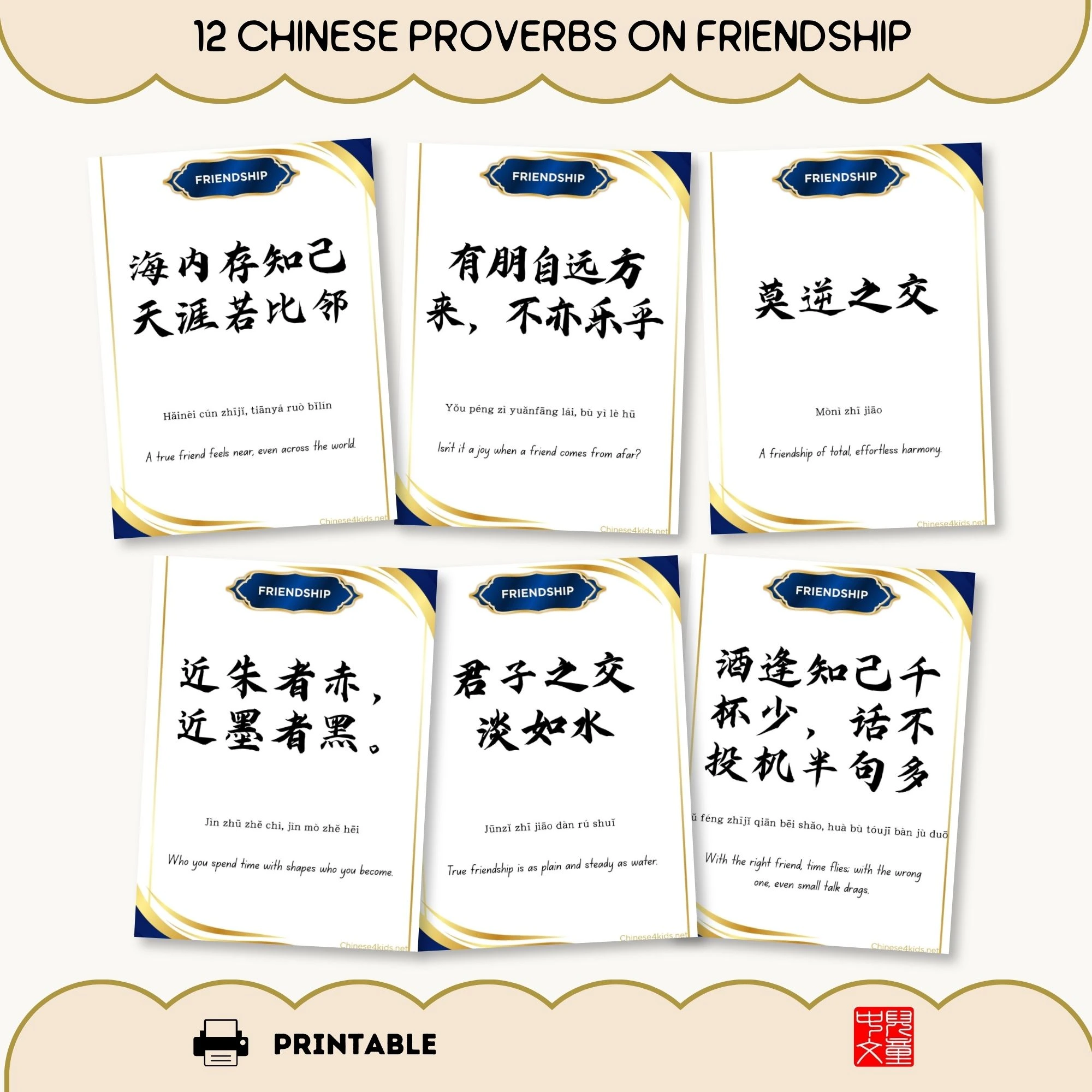
| 酒逢知己千杯少,话不投机半句多 | Jiǔ féng zhījǐ qiān bēi shǎo, huà bù tóujī bàn jù duō | With the right friend, time flies; with the wrong one, even small talk drags. | True understanding | Classical-style folk couplet |
| 近朱者赤,近墨者黑 | Jìn zhū zhě chì, jìn mò zhě hēi | Who you spend time with shapes who you become. | Choosing friends | Fu Xuan (傅玄), Jin dynasty |
| 人无完人 | Rén wú wán rén | No person is without flaws. | Choosing friends | Long-standing Chinese saying |
| 君子之交淡如水 | Jūnzǐ zhī jiāo dàn rú shuǐ | True friendship is as plain and steady as water. | Effortless harmony | Zhuangzi (庄子) |
| 莫逆之交 | Mònì zhī jiāo | A friendship of total, effortless harmony. | Effortless harmony | Zhuangzi (庄子) |
| 高山流水 | Gāoshān liúshuǐ | A bond so deep it can’t be replaced. | Irreplaceable depth | Liezi / Lüshi Chunqiu |
| 道不同,不相为谋 | Dào bù tóng, bù xiāng wéi móu | People with different paths don’t plan together. | When paths diverge | Analects |
| 有朋自远方来,不亦乐乎 | Yǒu péng zì yuǎnfāng lái, bù yì lè hū | Isn’t it a joy when a friend comes from afar? | The joy of friendship | Analects, opening lines |
| 海内存知己,天涯若比邻 | Hǎinèi cún zhījǐ, tiānyá ruò bǐlín | A true friend feels near, even across the world. | Distance is no obstacle | Wang Bo (王勃), Tang dynasty poem |
Key lesson: Chinese friendship wisdom draws on Confucian character, Daoist plainness, a famous Han-dynasty friendship story, and Tang poetry — a genuinely deep, verifiable tradition, not just a handful of scattered sayings.
Related Chinese friendship expressions
A few more idioms in the same spirit, worth knowing even though they’re not covered in full detail here — we may build these into their own piece down the line:
情同手足 — as close as siblings
肝胆相照 — total mutual sincerity
志同道合 — shared goals, shared path
风雨同舟 — weathering the storm together
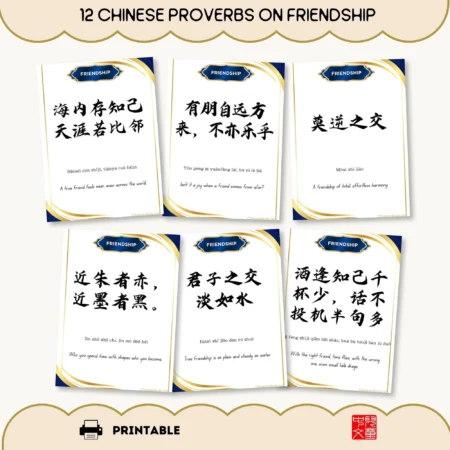 Get the 12 Chinese Proverbs on Friendship Posters in our eShop.
Where These Proverbs Come From
Ten of these twelve can be traced to identifiable classical sources — some to one specific text, others (like 高山流水 and 管鲍之交) preserved across more than one classical source. Two of them — 患难与共 and 人无完人 — are long-standing, widely used Chinese sayings that don’t trace to a single named book, but are genuinely Chinese in origin, not translations of anything else.
患难见真情 is the second half of an older couplet, 岁寒知松柏,患难见真情, whose first half is Confucius’s own words in the Analects, about pine and cypress trees staying green through winter.
管鲍之交 comes from the Records of the Grand Historian (史记), recording the words of the statesman Guan Zhong about his friend Bao Shuya.
君子之交淡如水 and 莫逆之交 both come from Zhuangzi (庄子), a Daoist text from around the 4th century BCE.
有朋自远方来,不亦乐乎 and 道不同,不相为谋 are both direct lines from Confucius in the Analects.
高山流水 comes from a story recorded in both Liezi and the Lüshi Chunqiu.
And 海内存知己,天涯若比邻 is a line from a Tang dynasty poem by Wang Bo (王勃).
The Story Behind 管鲍之交
This one is worth telling in full, because it’s one of the most quoted friendship stories in Chinese history.
The story
Guan Zhong and Bao Shuya were business partners and friends in the state of Qi. Guan Zhong was poor and often took more than his fair share of their profits — but Bao Shuya never called him greedy, because he knew Guan Zhong had a family to support. When Guan Zhong’s plans failed, Bao Shuya never called him foolish, because he understood some things are simply bad luck. When Guan Zhong was captured and disgraced after backing the losing side in a political struggle, Bao Shuya still recommended him — over himself — for the position of prime minister. Guan Zhong later said: “My parents gave me life, but Bao Shuya is the one who truly understands me” (生我者父母,知我者鲍子也).
Guan Zhong and Bao Shuya were business partners and friends in the state of Qi. Guan Zhong was poor and often took more than his fair share of their profits — but Bao Shuya never called him greedy, because he knew Guan Zhong had a family to support. When Guan Zhong’s plans failed, Bao Shuya never called him foolish, because he understood some things are simply bad luck. When Guan Zhong was captured and disgraced after backing the losing side in a political struggle, Bao Shuya still recommended him — over himself — for the position of prime minister. Guan Zhong later said: “My parents gave me life, but Bao Shuya is the one who truly understands me” (生我者父母,知我者鲍子也).
12 Chinese Proverbs on Friendship, Explained
Proverb 01 · Tested by hardship
岁寒知松柏,患难见真情
Suìhán zhī sōngbǎi, huànnàn jiàn zhēnqíng
Only in the cold of winter do you see which trees stay green. Only in hardship do you see who your real friends are.
In one sentence: real friends reveal themselves in hard times, not easy ones.
Origin: the first half is Confucius’s own words in the Analects (论语·子罕): “岁寒,然后知松柏之后凋也.” The second half is a widely quoted folk addition, together forming a common couplet.
Practical tip
When your child’s friend has a hard week, help them think of one small way to show up — a note, sitting together at lunch, sharing a snack.
When your child’s friend has a hard week, help them think of one small way to show up — a note, sitting together at lunch, sharing a snack.
Proverb 02 · Tested by hardship
患难与共
Huànnàn yǔ gòng
To go through hardship side by side. Shared difficulty often builds a friendship faster than shared fun does.
In one sentence: struggling through something together bonds people faster than easy times do.
Origin: a long-standing four-character Chinese idiom (成语), genuinely Chinese in origin even though it isn’t traced to one single ancient book.
Practical tip
Encourage kids to team up on something a little hard — a school project, a tricky level in a game, a group task. Struggling through something together builds a bond faster than just hanging out.
Encourage kids to team up on something a little hard — a school project, a tricky level in a game, a group task. Struggling through something together builds a bond faster than just hanging out.
Proverb 03 · True understanding
管鲍之交
Guǎn Bào zhī jiāo
“The friendship of Guan and Bao” — shorthand for a friend who understands your reasons, not just your results. See the full story above.
In one sentence: a true friend understands your circumstances, not just your outcomes.
Origin: Records of the Grand Historian (史记·管晏列传), Han dynasty; the friendship is also recorded earlier in Liezi (列子·力命).
Practical tip
Tell your child the Guan Zhong and Bao Shuya story, then ask: “who is the friend who ‘gets’ you, even when you mess up?”
Tell your child the Guan Zhong and Bao Shuya story, then ask: “who is the friend who ‘gets’ you, even when you mess up?”
Modern example
A friend who doesn’t tease you for a mistake, but instead asks what happened — and still trusts you next time — is living out 管鲍之交, even without knowing the phrase.
A friend who doesn’t tease you for a mistake, but instead asks what happened — and still trusts you next time — is living out 管鲍之交, even without knowing the phrase.
Proverb 04 · True understanding
酒逢知己千杯少,话不投机半句多
Jiǔ féng zhījǐ qiān bēi shǎo, huà bù tóujī bàn jù duō
With the right friend, even a thousand cups of tea aren’t enough. With the wrong one, even a single sentence feels like too much. Time with the right friend never drags.
In one sentence: time flies with the right friend and drags with the wrong one.
Origin: a classical-style folk couplet, widely quoted since at least the Ming-Qing era. The precise original author is debated, so it’s best described as a long-standing folk couplet rather than a single named text.
Practical tip
For kids, swap “cups” for something they know — “with the right friend, even doing nothing feels fun; with the wrong one, even five minutes feels long.” Ask which friend makes time fly for them.
For kids, swap “cups” for something they know — “with the right friend, even doing nothing feels fun; with the wrong one, even five minutes feels long.” Ask which friend makes time fly for them.
Proverb 05 · Choosing friends
近朱者赤,近墨者黑
Jìn zhū zhě chì, jìn mò zhě hēi
Stay near red ink and you turn red. Stay near black ink and you turn black. Who you spend time with shapes who you become.
In one sentence: the company you keep shapes the person you become.
Origin: Fu Xuan (傅玄), Jin dynasty, from Admonitions for the Crown Prince’s Tutor (太子少傅箴).
Practical tip
Talk with your child about what their friends bring out in them — not to judge other kids, but to help them notice the pattern for themselves.
Talk with your child about what their friends bring out in them — not to judge other kids, but to help them notice the pattern for themselves.
Proverb 06 · Choosing friends
人无完人
Rén wú wán rén
No person is without flaws. No friend will ever be perfect, and that’s completely normal.
In one sentence: no friend is perfect, and expecting one to be sets everyone up to fail.
Origin: a widely used, genuine Chinese saying, not traced to one classical text.
Practical tip
When your child complains a friend did something annoying, ask “what do you still like about them?” It builds tolerance instead of all-or-nothing thinking.
When your child complains a friend did something annoying, ask “what do you still like about them?” It builds tolerance instead of all-or-nothing thinking.
Proverb 07 · Effortless harmony
君子之交淡如水
Jūnzǐ zhī jiāo dàn rú shuǐ
True friendship between good people is as plain and steady as water — it doesn’t need drama or constant gifts to be real.
In one sentence: true friendship is quiet, dependable, and doesn’t need constant attention.
Origin: Zhuangzi (庄子), “Shan Mu” (山木) chapter: “君子之交淡如水,小人之交甘若醴.”
Practical tip
Explain that “plain like water” is a compliment, not a criticism. A steady, undramatic friendship is often the strongest kind.
Explain that “plain like water” is a compliment, not a criticism. A steady, undramatic friendship is often the strongest kind.
Proverb 08 · Effortless harmony
莫逆之交
Mònì zhī jiāo
A friendship of total, effortless harmony — the kind where nothing needs to be forced or explained.
In one sentence: some friendships just work, without effort or explanation.
Origin: Zhuangzi (庄子·大宗师): four characters who “looked at each other and smiled, with nothing in their hearts to resist, and so became friends.”
Practical tip
Use this to describe a friendship that just works, without much effort — and to reassure your child that not every friendship has to be a project.
Use this to describe a friendship that just works, without much effort — and to reassure your child that not every friendship has to be a project.
Proverb 09 · Irreplaceable depth
高山流水
Gāoshān liúshuǐ
“High mountains, flowing water” — a bond so deep that when it’s gone, nothing else can replace it.
In one sentence: some friendships are so understanding that no one else can fill their place.
Origin: recorded in both Liezi (列子·汤问) and the Lüshi Chunqiu (吕氏春秋). The musician Boya played a song evoking high mountains and flowing water, and only his friend Zhong Ziqi, a woodcutter, truly understood it. When Zhong Ziqi died, Boya broke his own instrument and never played again — no one else, he said, could understand his music that way.
Practical tip
A good one for an old friend who’s moved away or grown apart. Use it to talk about how some friendships leave a mark even after they change, rather than being “replaced” by a new friend.
A good one for an old friend who’s moved away or grown apart. Use it to talk about how some friendships leave a mark even after they change, rather than being “replaced” by a new friend.
Modern example
A child who says “no one else gets my jokes like my old friend from my last school did” is describing exactly what 高山流水 means, even without the phrase.
A child who says “no one else gets my jokes like my old friend from my last school did” is describing exactly what 高山流水 means, even without the phrase.
Proverb 10 · When paths diverge
道不同,不相为谋
Dào bù tóng, bù xiāng wéi móu
People walking different paths don’t plan together. Sometimes a friendship fades simply because two people want different things now — not because either one did something wrong.
In one sentence: growing apart isn’t the same as falling out.
Origin: Analects (论语·卫灵公): Confucius.
Practical tip
Useful when a childhood friendship fades because of different interests or a new school. Frame it as “you both grew in different directions,” not as a failure on anyone’s part.
Useful when a childhood friendship fades because of different interests or a new school. Frame it as “you both grew in different directions,” not as a failure on anyone’s part.
Modern example
Two former best friends who drift apart after one joins a sports team and the other joins a coding club — with no fight, no falling-out — are a modern 道不同,不相为谋.
Two former best friends who drift apart after one joins a sports team and the other joins a coding club — with no fight, no falling-out — are a modern 道不同,不相为谋.
Proverb 11 · The joy of friendship
有朋自远方来,不亦乐乎
Yǒu péng zì yuǎnfāng lái, bù yì lè hū
Isn’t it a joy when a friend arrives from afar? One of the most quoted lines in classical Chinese, about the simple happiness of a friend’s visit.
In one sentence: a friend’s visit, however rare, is worth genuine joy.
Origin: Analects (论语·学而) — the opening lines of the entire book.
Practical tip
Say this out loud the next time an old friend visits, or during a video call with someone who moved away — it turns a routine reunion into something worth noticing.
Say this out loud the next time an old friend visits, or during a video call with someone who moved away — it turns a routine reunion into something worth noticing.
Proverb 12 · Distance is no obstacle
海内存知己,天涯若比邻
Hǎinèi cún zhījǐ, tiānyá ruò bǐlín
A true friend feels close, even from the other side of the world. Real friendship doesn’t need geographic closeness — just consistent contact.
In one sentence: a true friend feels close no matter the distance.
Origin: Wang Bo’s (王勃) Tang dynasty poem Farewell to Vice-Prefect Du (送杜少府之任蜀州).
Practical tip
A gentle one for heritage families with friends or grandparents overseas — a regular video call or letter does the same job as living next door.
A gentle one for heritage families with friends or grandparents overseas — a regular video call or letter does the same job as living next door.
Modern example
In our experience with families learning Mandarin outside China, this line often resonates with kids who have grandparents or close friends overseas — it gives them language for a closeness they already feel but haven’t put into words.
In our experience with families learning Mandarin outside China, this line often resonates with kids who have grandparents or close friends overseas — it gives them language for a closeness they already feel but haven’t put into words.
Who Gets the Most Out of These Proverbs
- Parents helping a child through a friendship problem
A proverb gives you a calm, memorable way to talk about a fight, a fading friendship, or a hard week — without a long lecture. - Teachers building classroom character lessons
These pair well with social-emotional or character-education units, in Chinese class or beyond it — 管鲍之交 in particular makes a great full-length story lesson. - Heritage families with friends far away
海内存知己,天涯若比邻 speaks directly to families with loved ones overseas — a message of comfort, not just vocabulary. - Kids working through something right now
Match the proverb to the moment — there’s usually one here that fits exactly what’s going on.
How to Actually Use These Proverbs
Like any proverb, these only help if they leave the page. Here’s where they work best in real family or classroom life.
| Setting | How to use it | Good proverb to start with |
|---|---|---|
| After a friendship fight | Use a proverb to open a calm conversation instead of jumping straight to advice. | 人无完人 |
| Classroom character lesson | Tell the full 管鲍之交 story, then ask students what it means in their own words. | 管鲍之交 |
| A friend moving away, or graduation | Pair with an actual video call or letter — the proverb plus the action, together. | 海内存知己,天涯若比邻 |
| A childhood friendship quietly fading | Use it to frame the change kindly, without blame. | 道不同,不相为谋 |
| A friend visiting or reconnecting | Say it out loud in the moment — it works as a genuine reaction, not just a lesson. | 有朋自远方来,不亦乐乎 |
Which proverb fits the occasion?
| Occasion | Best proverb |
|---|---|
| A friendship card or note | 君子之交淡如水 — a compliment, not a criticism |
| A friend moving far away, or a graduation | 海内存知己,天涯若比邻 |
| Supporting a friend through a hard time | 岁寒知松柏,患难见真情 |
| A friendship that’s quietly fading | 道不同,不相为谋 |
| Helping a child choose friends wisely | 近朱者赤,近墨者黑 |
Tell the full story
管鲍之交 works better as a two-minute story than a one-line quote — the story is what makes it memorable.
Use for repair, not blame
These work best as a gentle way in — not as ammunition in an argument between friends.
Let older kids push back
Ask a teen if they agree with a saying. Disagreeing thoughtfully builds as much understanding as agreeing does.
Pair with real action
海内存知己 means more right after an actual video call to a grandparent or old friend, not just as a quote on its own.
Frequently Asked Questions
What are the most well-known Chinese proverbs about friendship?
The best-known Chinese friendship proverbs include 君子之交淡如水 (“true friendship is as plain as water”), 患难见真情 (“hardship reveals true friends”), and 海内存知己,天涯若比邻 (“a true friend feels close, even across the world”).
Are these authentic Chinese proverbs, or modern sayings?
All 12 are genuinely Chinese. Ten trace to a specific classical source — the Analects, Zhuangzi, the Records of the Grand Historian, a Tang dynasty poem, or a Warring States-era story. The remaining two (患难与共 and 人无完人) are long-standing Chinese sayings without one fixed source, but are genuinely Chinese, not translated from elsewhere.
What’s the story behind 管鲍之交?
It’s the story of Guan Zhong and Bao Shuya, two friends in ancient Qi. Bao Shuya consistently understood Guan Zhong’s circumstances rather than judging his results, and eventually recommended him for prime minister over himself. See the full story above.
Can these proverbs help with a specific falling-out between friends?
Yes — pick the one that matches the situation rather than reading through all 12. 人无完人 works well right after a small conflict; 道不同,不相为谋 works better for a friendship that’s fading over time because two people want different things.
What’s the difference between 朋友 (péngyǒu) and 知己 (zhījǐ)?
朋友 is the general word for friend. 知己 means something closer to “someone who truly understands you” — a deeper, rarer kind of friendship. 海内存知己 and 管鲍之交 both use this idea on purpose.
Are these proverbs relevant for heritage kids growing up outside China?
Very much so. 海内存知己,天涯若比邻 in particular speaks to exactly the situation many heritage families live — friends and family who feel close despite the distance.
Where can I find more Chinese quotes and sayings for kids?
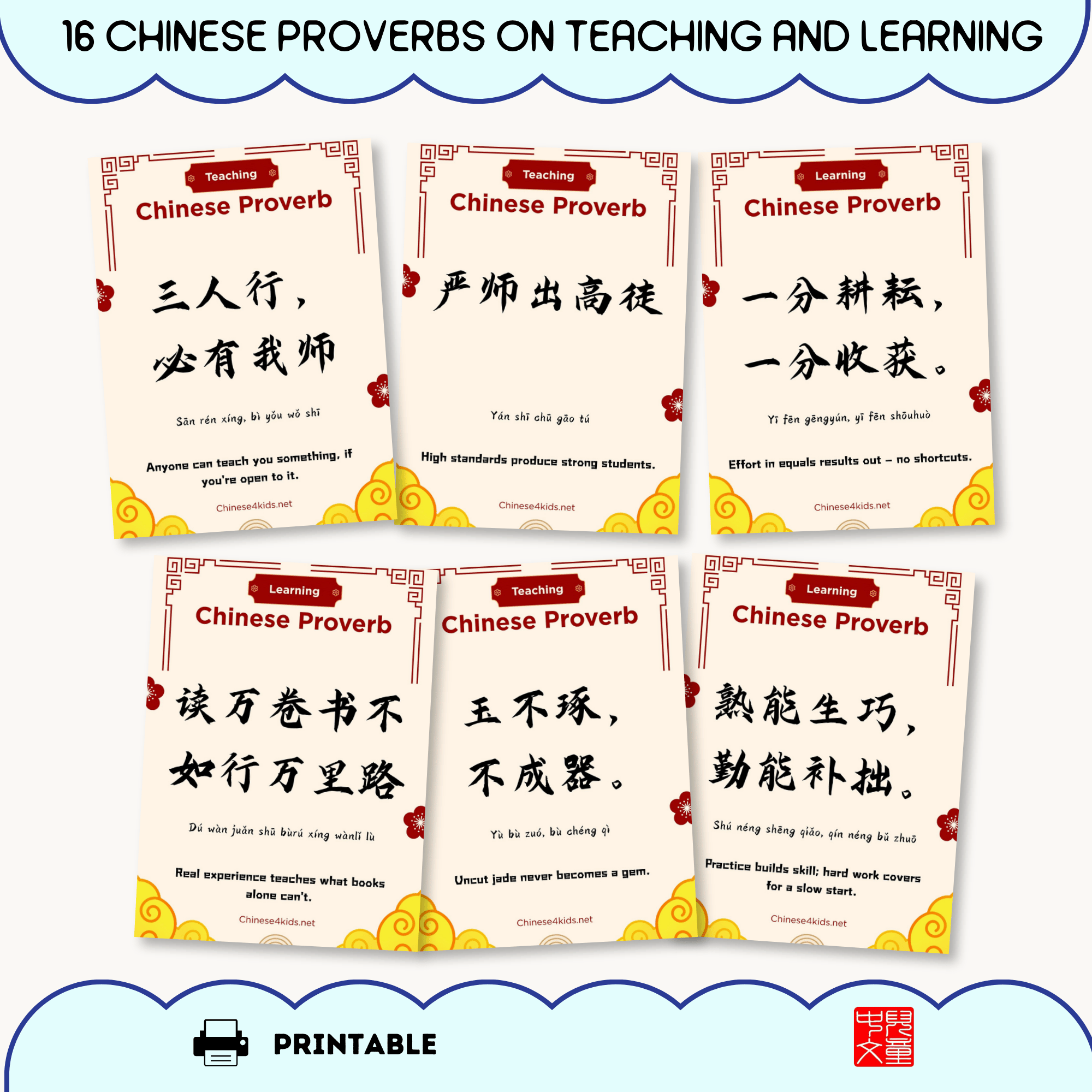
See our full Chinese Quotes collection, including our companion piece on 16 Chinese proverbs on teaching and learning.
Key takeaways
- These 12 proverbs group into 8 themes: hardship, true understanding, choosing friends, effortless harmony, irreplaceable depth, diverging paths, joy, and distance.
- All 12 are genuinely Chinese — 10 trace to one classical text (Analects, Zhuangzi, Shiji, a Tang poem), and 2 are long-standing Chinese sayings without a single fixed source.
- 管鲍之交 (the friendship of Guan Zhong and Bao Shuya) is the richest one here — worth telling as a full story, not just a one-line quote.
- The core message across all 12: real friendship is steady, understanding, and tested by hard times more than good ones.
- 海内存知己,天涯若比邻 is especially useful for heritage families with loved ones overseas.
A note on resources
Friendship and character are natural topics for a classroom, not just a single lesson. Chinese Lesson Plans gives teachers ready-made, theme-based material if you’d like to build a full lesson around 管鲍之交 or another of these proverbs rather than starting from a blank page. And if you’re looking for a simple way to bring more of this kind of language home, our Chinese Teaching Made Easy Membership includes worksheets and lesson material for exactly this kind of character-and-culture topic, alongside core vocabulary.
Explore More on Chinese4kids
- 16 Chinese Proverbs on Teaching and Learning Our companion piece — the same style, focused on classroom and study wisdom instead of friendship.
- 12 Chinese Proverbs on Time – 12 Chinese proverbs on time, grouped into three clear themes
- Chinese Conversation Activities for Kids 15 speaking activities — several work well for pairs or small groups of friends practising together.
- My Child Understands Chinese but Won’t Speak It Useful if a shy child is holding back in front of friends, not just family.
- Chinese Quotes Collection More Chinese sayings and quotes, organised by theme.
- Chinese Lesson Plans for Teachers Ready-to-teach material — a natural next step for building a character-education lesson around friendship.