Quick answer
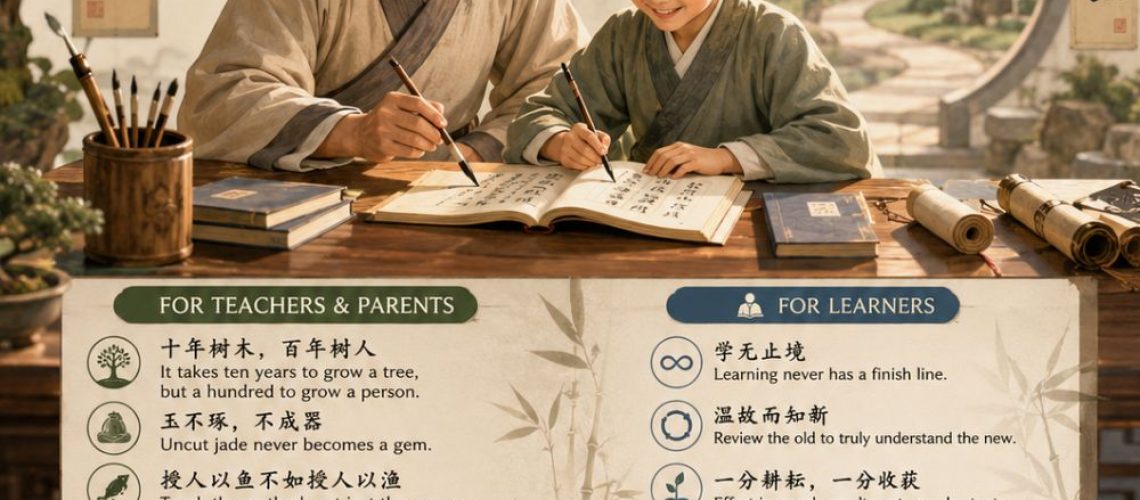
Chinese proverbs on teaching and learning capture centuries of practical wisdom — that growth takes time, that method matters more than answers, and that effort beats talent. Below are 16 of the most quoted, each with the Chinese, pinyin, meaning, and one practical way to use it at home or in class.
Chinese proverbs on teaching and learning capture centuries of practical wisdom — that growth takes time, that method matters more than answers, and that effort beats talent. Below are 16 of the most quoted, each with the Chinese, pinyin, meaning, and one practical way to use it at home or in class.
Phil Collins once said, in learning, you will teach, and in teaching, you will learn. Chinese culture has said something similar for over two thousand years.
Teaching and learning are treated as two sides of one coin in Chinese thought. A good teacher stays a student. A good student ends up teaching someone else. These 16 Chinese sayings about education show exactly how that idea plays out — in the classroom, at the dinner table, and in a child’s own head as they learn.
Each proverb below comes with the Chinese characters, the pinyin, a simple meaning, where it comes from, and one practical idea you can actually use this week. This isn’t just a quote list. It’s a small toolkit for teachers and parents.
What do Chinese proverbs teach about education?
- Learning is lifelong — there is no point at which you’re “done.”
- Effort matters more than raw talent.
- Good teachers guide students toward answers rather than handing answers over.
- Reviewing old material is what makes new material stick.
- Doing and experiencing teaches more deeply than hearing or reading alone.
Quick Reference: All 16 Proverbs at a Glance
| Chinese | Pinyin | Meaning in one line | Category |
|---|---|---|---|
| 十年树木,百年树人 | Shí nián shùmù, bǎinián shù rén | Growing a tree takes 10 years; growing a person takes 100. | Teaching |
| 玉不琢,不成器 | Yù bù zuó, bù chéng qì | Uncut jade never becomes a gem. | Teaching |
| 授人以鱼不如授人以渔 | Shòu rén yǐ yú bùrú shòu rén yǐ yú | Teach the method, not just the answer. | Teaching |
| 子不教,父之过 | Zǐ bù jiào, fù zhī guò | Parents share the blame if a child isn’t taught. | Teaching |
| 青出于蓝而胜于蓝 | Qīng chū yú lán ér shèng yú lán | Good teaching aims for students to surpass the teacher. | Teaching |
| 严师出高徒 | Yán shī chū gāo tú | High standards produce strong students. | Teaching |
| 三人行,必有我师 | Sān rén xíng, bì yǒu wǒ shī | Anyone can teach you something, if you’re open to it. | Teaching |
| 师傅领进门,修行在个人 | Shīfù lǐng jìn mén, xiūxíng zài gèrén | The teacher opens the door; the student walks through it. | Teaching |
| 学无止境 | Xué wú zhǐjìng | Learning never has a finish line. | Learning |
| 温故而知新 | Wēn gù ér zhī xīn | Review the old to truly understand the new. | Learning |
| 一分耕耘,一分收获 | Yī fēn gēngyún, yī fēn shōuhuò | Effort in equals results out — no shortcuts. | Learning |
| 读万卷书不如行万里路 | Dú wàn juǎn shū bùrú xíng wànlǐ lù | Real experience teaches what books alone can’t. | Learning |
| 闻而忘之,见而记之,行而知之 | Wén ér wàng zhī, jiàn ér jì zhī, xíng ér zhī zhī | Hear and forget, see and remember, do and understand. | Learning |
| 学而不思则罔,思而不学则殆 | Xué ér bù sī zé wǎng, sī ér bù xué zé dài | Learning without thinking is wasted; thinking without learning is risky. | Learning |
| 熟能生巧,勤能补拙 | Shú néng shēng qiǎo, qín néng bǔ zhuō | Practice builds skill; hard work covers for a slow start. | Learning |
| 学如逆水行舟,不进则退 | Xué rú nì shuǐ xíng zhōu, bù jìn zé tuì | Learning is like rowing upstream — stop, and you drift back. | Learning |
Where These Proverbs Come From
Chinese proverbs on teaching and learning come from several different places: philosophical texts written over two thousand years ago, agricultural life, and everyday folk wisdom passed down without a single named author.
Some — like 温故而知新 and 学而不思则罔,思而不学则殆 — are word-for-word lines from the Analects (论语), Confucius’s recorded teachings. Others, like 玉不琢,不成器, come from the Book of Rites (礼记). A few, like 一分耕耘,一分收获 and 严师出高徒, are folk sayings with no single classical source — that doesn’t make them less true, just less traceable to one book. We’ve noted the origin under each proverb below, and said plainly where a saying is folk wisdom rather than a classical quote, rather than guessing at a source that isn’t real.
| Teaching proverbs | Learning proverbs | |
|---|---|---|
| Who it speaks to | Teachers and parents | The learner themselves |
| Time frame | Long-term growth, over years | Daily habits and repetition |
| Core idea | Guide the process; don’t just hand over answers | Show up consistently; effort compounds |
| Where it shows up | Lesson planning, feedback, classroom culture | Homework routines, review habits, motivation |
8 Chinese Proverbs and Quotes About Teaching
These proverbs speak to teachers, but they matter just as much for parents running a home classroom. Every one below comes with a practical way to put it to use.
Key lesson: good teaching is about patience and guidance — helping a student become someone who no longer needs you, not proving how much you know.
Proverb 01
十年树木,百年树人
Shí nián shùmù, bǎinián shù rén
It takes ten years to grow a tree, but a hundred years to grow a person. Education is slow work. Real results show up over years, not weeks.
Origin: traced to Guanzi (管子), a Warring States-era text on statecraft and long-term planning.
Practical tip
Set goals by term or by year, not by week. If your child’s Chinese looks the same as last month, that’s normal. Measure progress every few months instead.
Set goals by term or by year, not by week. If your child’s Chinese looks the same as last month, that’s normal. Measure progress every few months instead.
Proverb 02
玉不琢,不成器
Yù bù zuó, bù chéng qì
Jade has to be cut and polished before it becomes a gem. Raw talent alone isn’t enough — it needs shaping through practice and correction.
Origin: from the Book of Rites (礼记), specifically the “Xue Ji” (学记) chapter on education.
Practical tip
Praise the polishing, not just the gift. Say “you kept practising that tone” instead of “you’re so good at Chinese.” Effort-praise builds a child who keeps trying.
Praise the polishing, not just the gift. Say “you kept practising that tone” instead of “you’re so good at Chinese.” Effort-praise builds a child who keeps trying.
Proverb 03
授人以鱼,只解一时之急;授人以渔,则解一生所需
Shòu rén yǐ yú, zhǐ jiě yīshí zhī jí; shòu rén yǐ yú, zé jiě yīshēng suǒ xū
Give a person a fish and they eat for a day. Teach them to fish and they eat for life. Teach the method, not just the answer.
Note the two characters here sound identical but mean different things: the first 鱼 (yú) means “fish,” and the second 渔 (yú) means “to fish” — a true homophone pair, not a typo.
Origin: a widely used folk saying, often loosely linked to Daoist thought. No single classical text states it in this exact wording.
Practical tip
When your child asks what a word means, ask them to guess from the picture or sentence first. Confirm the answer after. You’re teaching a reading strategy, not just one word.
When your child asks what a word means, ask them to guess from the picture or sentence first. Confirm the answer after. You’re teaching a reading strategy, not just one word.
Proverb 04
子不教,父之过
Zǐ bù jiào, fù zhī guò
If a child isn’t taught, the fault lies with the parent. In Chinese culture, a parent is a child’s first and most important teacher.
Origin: a common paraphrase of a line from the Three Character Classic (三字经): “养不教,父之过” — “to raise without teaching is the parent’s fault.”
A modern note
This isn’t about guilt. Most overseas parents are already doing more than they realise. Read it as encouragement to keep showing up, not as blame for what hasn’t happened yet.
This isn’t about guilt. Most overseas parents are already doing more than they realise. Read it as encouragement to keep showing up, not as blame for what hasn’t happened yet.
Practical tip
You don’t need to be fluent to be your child’s Chinese teacher at home. Even ten minutes a day makes a difference — see our guide on Chinese conversation activities for kids for easy ways to start.
You don’t need to be fluent to be your child’s Chinese teacher at home. Even ten minutes a day makes a difference — see our guide on Chinese conversation activities for kids for easy ways to start.
Proverb 05
青出于蓝而胜于蓝
Qīng chū yú lán ér shèng yú lán
Indigo dye comes from the indigo plant, but ends up bluer than the plant itself. Good teaching aims for students to go further than their teacher.
Origin: from Xunzi (荀子), “Quan Xue” (劝学) chapter — “青,取之于蓝,而青于蓝.”
Practical tip
Let your child “teach” you a word or phrase they just learned. Let him/her be the expert, even for one sentence, that helps build real confidence.
Let your child “teach” you a word or phrase they just learned. Let him/her be the expert, even for one sentence, that helps build real confidence.
Proverb 06
严师出高徒
Yán shī chū gāo tú
Strict teachers produce skilled students. High expectations push learners further than low ones do.
Origin: a folk saying with no single classical source — widely circulated in Chinese pedagogical culture rather than traced to one text.
A modern note
“Strict” here doesn’t mean harsh. Modern research on motivation backs high expectations paired with warmth and encouragement — not pressure alone. Read this proverb as “hold the standard,” not “raise your voice.”
“Strict” here doesn’t mean harsh. Modern research on motivation backs high expectations paired with warmth and encouragement — not pressure alone. Read this proverb as “hold the standard,” not “raise your voice.”
Practical tip
At home, swap “strict” for “consistent.” Clear, steady expectations — the same practice time each day — work better for young learners than pressure or harsh correction.
At home, swap “strict” for “consistent.” Clear, steady expectations — the same practice time each day — work better for young learners than pressure or harsh correction.
Proverb 07
三人行,必有我师
Sān rén xíng, bì yǒu wǒ shī
Among any three people walking together, one can always teach me something. Everyone has something to offer, if you stay humble enough to notice.
Origin: from the Analects (论语), “Shu Er” (述而) chapter — one of Confucius’s most quoted lines on humility.
Practical tip
Pair siblings or classmates for peer teaching. Ask an older or more confident learner to teach a younger one a phrase — it reinforces the lesson for both.
Pair siblings or classmates for peer teaching. Ask an older or more confident learner to teach a younger one a phrase — it reinforces the lesson for both.
Proverb 08
师傅领进门,修行在个人
Shīfù lǐng jìn mén, xiūxíng zài gèrén
The master leads you through the door. What you do once inside is up to you. A teacher can only open the door — the learner has to walk through it.
Origin: a folk saying rooted in traditional craft and martial arts apprenticeship culture, not a single classical text.
Practical tip
Give your child ownership over one small daily practice — a set of phrases, a page of reading, a song. Speak Chinese with Kids works well here: it opens the door with ready-made scripts, and your child walks through it every day.
Give your child ownership over one small daily practice — a set of phrases, a page of reading, a song. Speak Chinese with Kids works well here: it opens the door with ready-made scripts, and your child walks through it every day.
8 Chinese Proverbs and Quotes About Learning and Studying
These proverbs speak directly to the learner — the mindset, habits, and small daily choices that make Chinese actually stick.
💡 Key lesson: consistent daily habits — reviewing, doing, and showing up — build a language far more reliably than talent or a strong start ever will.
Proverb 09
学无止境
Xué wú zhǐjìng
Learning has no limit. There’s no finish line where you know “enough” — not for a child, and not for an adult either.
Origin: a general folk expression, often paired with the related saying “学海无涯” (“the sea of learning has no shore”).
Practical tip
Model this out loud. Mention a Chinese word or fact you just learned yourself. Kids copy what they see valued at home.
Model this out loud. Mention a Chinese word or fact you just learned yourself. Kids copy what they see valued at home.
Proverb 10
温故而知新
Wēn gù ér zhī xīn
Review the old to understand the new. Going back over what you already know is what makes new material make sense.
Origin: from the Analects (论语), “Wei Zheng” (为政) chapter — “温故而知新,可以为师矣.”
Practical tip
Spend five minutes reviewing last week’s words before teaching new ones. Our Vocabulary Made Easy course is built around this exact idea — steady review of the 300 most common words, so nothing gets forgotten before it’s secure.
Spend five minutes reviewing last week’s words before teaching new ones. Our Vocabulary Made Easy course is built around this exact idea — steady review of the 300 most common words, so nothing gets forgotten before it’s secure.
Proverb 11
一分耕耘,一分收获
Yī fēn gēngyún, yī fēn shōuhuò
One part effort, one part harvest. Results are directly tied to the work put in. There is no shortcut around that.
Origin: a folk saying rooted in agricultural life, with no single classical text of origin.
Practical tip
Use a visible tracker — a sticker chart, a reading log, a small calendar with checkmarks. Seeing small, steady effort adds up keeps motivation alive.
Use a visible tracker — a sticker chart, a reading log, a small calendar with checkmarks. Seeing small, steady effort adds up keeps motivation alive.
Proverb 12
读万卷书不如行万里路
Dú wàn juǎn shū bùrú xíng wànlǐ lù
Reading ten thousand books is not as good as travelling ten thousand miles. Real experience teaches things that books alone can’t.
Origin: a saying popular since the Ming dynasty, often linked to travelling scholars; the exact wording varies across sources, so treat it as folk wisdom rather than a fixed classical quote.
Practical tip
Pair a vocabulary theme with a real outing. Learn food words, then use them at a Chinese restaurant. Learn colour words, then name them at the market.
Pair a vocabulary theme with a real outing. Learn food words, then use them at a Chinese restaurant. Learn colour words, then name them at the market.
Proverb 13
闻而忘之,见而记之,行而知之
Wén ér wàng zhī, jiàn ér jì zhī, xíng ér zhī zhī
Hear it and you forget it. See it and you remember it. Do it and you understand it. Doing beats watching, and watching beats just listening.
Origin: echoes a passage in Xunzi (荀子), “Ru Xiao” (儒效) chapter, on hearing, seeing, knowing, and doing — though the folk phrasing used today isn’t a verbatim quote.
Practical tip
Favour hands-on practice over passive listening — games, role play, cooking, or crafts done in Chinese. See our list of Chinese conversation activities for kids for 15 ready-to-use ideas.
Favour hands-on practice over passive listening — games, role play, cooking, or crafts done in Chinese. See our list of Chinese conversation activities for kids for 15 ready-to-use ideas.
Proverb 14
学而不思则罔,思而不学则殆
Xué ér bù sī zé wǎng, sī ér bù xué zé dài
Learning without thinking is wasted effort. Thinking without learning is dangerous. Input and reflection need each other.
Origin: from the Analects (论语), “Wei Zheng” (为政) chapter — the same chapter as 温故而知新 above.
Practical tip
After a lesson, ask one “why” question, not just “what.” “Why do you think that word means happy?” does more than testing recall alone.
After a lesson, ask one “why” question, not just “what.” “Why do you think that word means happy?” does more than testing recall alone.
Proverb 15
熟能生巧,勤能补拙
Shú néng shēng qiǎo, qín néng bǔ zhuō
Practice builds skill. Hard work makes up for a slow start. Neither talent nor a fast start is required — showing up regularly is.
Origin: two paired folk idioms commonly used together, with no single classical source.
Practical tip
Short daily practice beats one long weekly session, every time. Ten minutes a day adds up to far more than an hour once a week.
Short daily practice beats one long weekly session, every time. Ten minutes a day adds up to far more than an hour once a week.
Proverb 16
学如逆水行舟,不进则退
Xué rú nì shuǐ xíng zhōu, bù jìn zé tuì
Studying is like rowing a boat against the current. Stop rowing, and the boat drifts backwards. A language that isn’t used starts to fade.
Origin: commonly traced to the Zengguang Xianwen (增广贤文), a Ming-Qing era folk wisdom collection — though like much of that text, the exact original attribution is debated.
Practical tip
Keep a light routine going even during school holidays — a short chat, a song, a page of reading. It’s far easier to maintain Chinese than to rebuild it after a long break.
Keep a light routine going even during school holidays — a short chat, a song, a page of reading. It’s far easier to maintain Chinese than to rebuild it after a long break.
Who Gets the Most Out of These Proverbs
Teachers building a classroom culture
Open a lesson with one proverb a week. It gives a class a shared language for effort, patience, and respect for the process.
Parents running a home classroomThese proverbs double as gentle reminders for you, not just your child — especially the ones about patience and long-term growth.
Kids who need motivation
A proverb like “practice makes perfect” lands better coming from an old Chinese saying than from a parent repeating it for the tenth time.
Heritage families passing down values
Proverbs carry culture as well as language. Teaching them alongside vocabulary keeps both alive at the same time.
How to Actually Use These Proverbs
A proverb only helps if it leaves the page. Here’s where these lines work best in real family or classroom life.
| Setting | How to use it | Good proverb to start with |
|---|---|---|
| Classroom opener | Write one proverb on the board each Monday. Ask students to guess the meaning before you explain it. | 三人行,必有我师 |
| Family wall art | Print one proverb with pinyin and meaning, and hang it near the homework table. | 一分耕耘,一分收获 |
| Bedtime conversation | Ask your child what the proverb means to them, in their own words, before bed. | 学如逆水行舟,不进则退 |
| Report card comment | Reference a proverb instead of a generic phrase — it personalises feedback and ties it to something memorable. | 玉不琢,不成器 |
| Motivational reset after a slump | Use it to reframe a hard week without making a big deal of it. | 熟能生巧,勤能补拙 |
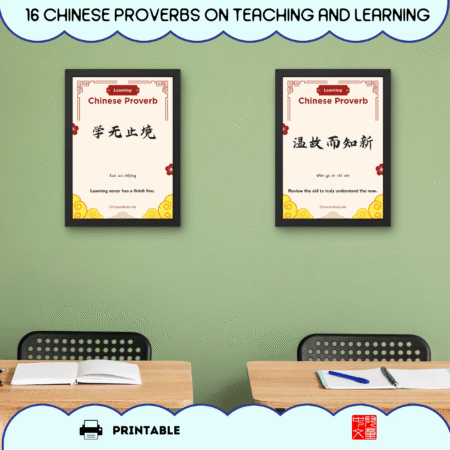
16 Chinese Proverbs on Teaching and Learning Posters is available in our eShop.
Proverb of the month Pick one proverb each month. Revisit it in different contexts — a lesson, a chat, a piece of art — so it actually sinks in.
Match proverb to moment Keep this list handy. When your child is frustrated or a class loses momentum, there’s usually a proverb that fits the moment exactly.
Let kids illustrate one Ask your child to draw what a proverb means to them. It turns an abstract saying into something personal and memorable.Use them beyond Chinese class These proverbs apply to any subject or skill. A proverb about effort works just as well for piano practice as for Chinese vocabulary.
Frequently Asked Questions
What are the most famous Chinese proverbs about teaching and learning?
Some of the most quoted are 十年树木,百年树人 (it takes a hundred years to grow a person), 授人以渔 (teach a person to fish), and 学而不思则罔,思而不学则殆 (learning without thinking is wasted). All 16 are listed above with pinyin and meaning.
Are Chinese proverbs suitable for young children?
Yes, with simple explanation. Younger children respond well to proverbs framed as short stories or pictures — a tree growing slowly, a boat rowing upstream — rather than the literal wording alone.
How do I explain a Chinese proverb to a child who doesn’t speak fluent Chinese?
Use the English meaning first, then introduce the Chinese phrase alongside it. Repetition over time — not one long explanation — is what makes it stick.
Can proverbs actually help with motivation, or are they just quotes?
Used consistently, they work as shared shorthand. A family or class that already knows “effort in equals results out” doesn’t need a long pep talk — the proverb does the reminding.
What’s the difference between a Chinese proverb and a Chinese idiom (chengyu)?
Chinese proverbs (谚语) are complete, plain-spoken sentences expressing folk wisdom. Chengyu (成语) are four-character idioms usually drawn from a specific classical story.
Do these proverbs work for teenagers, not just younger kids?
Yes — arguably better. Older learners can discuss the deeper meaning and even disagree with a proverb, which builds critical thinking alongside language skills.
Where can I find more Chinese quotes and sayings for kids?
See our full Chinese Quotes collection for more sayings, categorised by theme. You can also find quote posters for your classroom or homeschooling space.
Key takeaways
- These 16 proverbs split evenly into two groups: 8 about teaching, 8 about learning.
- The core teaching message: growth is slow, method matters more than answers, and good teaching aims to be surpassed.
- The core learning message: review before adding new material, do rather than just watch, and consistency beats intensity.
- A proverb works best when it’s used, not just read — on a wall, at bedtime, or as a lesson opener.
- Older kids and teens can engage with proverbs on a deeper level than younger children, but both benefit.
- Pairing a proverb with a real routine — daily practice, weekly review — turns wisdom into habit.
A note on resources
Many of these proverbs point to the same idea: consistency beats a strong start. Chinese Teaching Made Easy Membership gives teachers and home-classroom parents ready-made, systematic lesson plans and worksheets — so 十年树木,百年树人 (slow, steady growth) becomes something you can actually plan for, not just hope for. And if 师傅领进门,修行在个人 (the teacher opens the door) resonates with you as a parent, Speak Chinese with Kids gives you 30 ready-to-use daily phrases so opening that door doesn’t require fluent Chinese of your own.
Explore More on Chinese4kids
- 12 Chinese Proverbs on Time – 12 Chinese proverbs on time, grouped into three clear themes
- 16 Chinese Proverbs on Teaching and Learning Posters
- Chinese Conversation Activities for Kids –15 speaking activities that put the “do and understand” proverb into daily practice.
- My Child Understands Chinese but Won’t Speak It – What to do when a child hits a quiet phase — useful alongside the “strict teacher” and “effort” proverbs.
- Chinese Quotes Collection – More Chinese sayings and quotes, organised by theme.
- Chinese Lesson Plans for Teachers- Ready-to-teach, theme-based lesson plans — a practical way to apply “teach the method, not the answer.”
- Chinese Leveled Readers (aa–C) – Graded readers for the “see and remember, do and understand” proverb — reading builds what listening alone can’t.
- Chinese Thematic Words Bundle – ready-made way to put “practice makes perfect, diligence makes up for a slow start” into action this month.
If you like this article, share it