Quick Answer
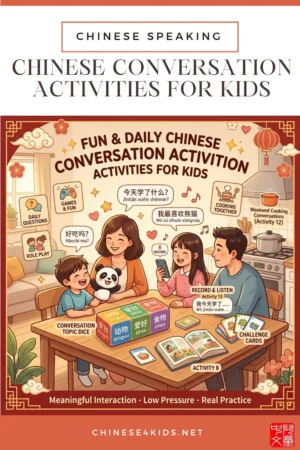
The most effective Chinese conversation activities for kids use familiar topics, short formats, and real interaction — games, role play, mealtime questions, and storytelling give children meaningful reasons to speak, which builds confidence faster than drills or formal lessons.
Many children learning Mandarin can recognise words and read simple Chinese books. But when it comes to holding a conversation, they freeze.
The problem is not vocabulary. It is lack of speaking practice.
Children learn to speak by speaking. They need meaningful interaction, repetition, and fun — not grammar charts. The 15 activities below give children regular, low-pressure reasons to use Chinese every day.
Why Conversation Practice Matters So Much
Language acquisition research consistently shows that children learn to speak through meaningful communication, not memorisation. For families raising children outside of China, creating conversation opportunities at home is especially important — a weekly lesson alone is rarely enough.
Regular speaking practice helps children:
- Build real speaking confidence
- Improve pronunciation and tones naturally
- Internalise sentence patterns through repetition
- Retain vocabulary more effectively
- Begin thinking in Chinese instead of translating
Small daily interactions — even five minutes — can have a bigger impact than one long weekly lesson. See our guide on building a Chinese immersion environment at home for more on how daily exposure works.
15 Chinese Conversation Activities for Kids
Activity 01 Daily Question of the Day
Ask one simple question every day. Over time, encourage longer answers. This builds a speaking habit without pressure.
Examples
你今天开心吗? Nǐ jīntiān kāixīn ma? — Were you happy today?
你最喜欢什么动物? Nǐ zuì xǐhuān shénme dòngwù? — What is your favourite animal?
今天学校怎么样? Jīntiān xuéxiào zěnmeyàng? — How was school today?
Best for: All ages. Start with yes/no questions for beginners, then build to open-ended ones.
Activity 02 Role Play Real-Life Situations
Children love pretending. Role play gives them an authentic reason to speak and repeat useful sentence patterns.
Scene ideas
Ordering food at a restaurant · Buying toys in a shop · Visiting the doctor · Going to the zoo · Taking a train
Best for: Ages 5–12. Rotate scenes regularly to keep it fresh.
Activity 03 Chinese Puppet Conversations
Puppets reduce speaking anxiety. Children often speak more freely through a puppet than when speaking directly.
Starter questions
你叫什么名字? · 你几岁? · 你喜欢什么颜色?
Best for: Ages 3–8. Especially useful for shy or reluctant speakers.
Activity 04 Family Mealtime Conversations
Mealtimes are one of the richest natural opportunities for Chinese conversation. Topics arise organically: food, preferences, daily events, weekend plans.
Conversation starters
好吃吗? (Is it good?) · 你今天学了什么? (What did you learn today?) · 你明天想做什么? (What do you want to do tomorrow?)
Even 5–10 minutes of Chinese at dinner can make a significant difference over weeks and months. For ready-to-use mealtime phrases with audio, see Speak Chinese with Kids.
Activity 05 Picture Talk
Show a picture — from a book, a card, or a photo — and ask questions. This develops vocabulary, observation skills, and storytelling.
Question prompts
你看到了什么? (What do you see?)
他在做什么? (What is he doing?)
你觉得接下来会发生什么? (What do you think happens next?)
Best for: All ages. Use flashcard sets or illustrated books as your image source.
Activity 06 Chinese Scavenger Hunt
Create a scavenger hunt around a vocabulary theme. Combine movement and language — this keeps energy high and language natural.
Colours theme — find something that is:
红色的 · 蓝色的 · 绿色的 · 黄色的After finding each item, practise: 我找到一个红色的苹果。 (I found a red apple.)
Best for: Ages 4–10. Run themed hunts — colours, shapes, animals, numbers.
Activity 07 Show and Tell in Chinese
Ask your child to bring a toy, a book, or a favourite object — then describe it in Chinese. This builds presentation skills and vocabulary at the same time.
Sentence frames
这是我的…… · 我喜欢它因为…… · 它是……颜色的。
Best for: Ages 5–12. Works well in small group settings and weekend Chinese school classes.
Activity 08 Story Retelling
Read a simple Chinese story together. Then ask the child to retell it. This moves children from passive understanding to active speaking.
Retelling prompts
谁来了? (Who appeared?) · 发生了什么? (What happened?) · 结局怎么样? (How did it end?)
The Chinese4kids Leveled Readers are designed for exactly this — with four graduated levels (aa, A, B, C) so the story is always at the right difficulty. See our guide on graded reading for children learning Mandarin for how to pick the right level.
Activity 09 Conversation Topic Dice
Create a dice (or use a random number generator) with six conversation topics. Roll and speak about the topic for one minute. Children love the element of chance.
Topic ideas for the dice
Family · Food · Animals · School · Sports · Holidays
Best for: Ages 7–14. Scale the time limit and depth of response to your child’s level.
Activity 10 Interview a Family Member
Turn your child into a reporter. They prepare questions and interview a parent, grandparent, or sibling in Chinese. This gives children a real purpose for asking questions.
Sample interview questions
你最喜欢什么食物? · 你小时候喜欢玩什么? · 你最喜欢哪个季节?
Best for: Ages 8–14. Record the interview for playback — children love hearing themselves.
Activity 11 Chinese Guessing Games
One person describes an object in Chinese. Others guess. This encourages descriptive language and active listening at the same time.
Example clue
它是黄色的。它很长。猴子喜欢吃它。
It is yellow. It is long. Monkeys like to eat it. Answer: 香蕉 (banana)
Rock, Scissors, Paper (剪刀石头布)
Rock, Scissors, Paper is a traditional Chinese game children use to make decisions. It reinforces vocabulary while building natural, repeated speaking patterns — and children love it because the game feels like play, not practice.
How to play:
Both players count down together: 一、二、三 (1, 2, 3). On 三, each player makes one of three gestures:
剪刀 (jiǎndāo) — Scissors: Extend index and middle fingers
石头 (shítóu) — Rock: Close your fist
布 (bù) — Fabric: Open your hand flat
Winning rules:
- Rock smashes scissors → 石头赢 (Rock wins)
- Fabric covers rock → 布赢 (Fabric wins)
- Scissors cut fabric → 剪刀赢 (Scissors wins)
- Same gesture = tie, play again

Speaking practice built in:
Before or after each round, add a sentence:
我出了布。(I played fabric.)
你赢了!(You won!)
我们再来一次。(Let’s play again.)
Why this works:
Children repeat the same three words (剪刀、石头、布) dozens of times in authentic gameplay. The winning rules create natural, repeated sentences. And because the game decides the outcome, there’s no pressure — just play.
Best for: Ages 5–12. Use this when you need to make a quick decision (who goes first, whose turn to pick the activity). Children will beg to play repeatedly, and each round is speaking practice in disguise.
Activity 12
Weekend Cooking Conversations
Cooking introduces vocabulary naturally — ingredients, colours, shapes, quantities, and preferences. The kitchen is one of the most naturally immersive spaces for Chinese at home.
Conversation in the kitchen
我喜欢饺子。 · 这个好吃! · 我们需要多少面粉?
For more ideas on using everyday routines as Chinese practice, see our guide on building a Chinese immersion environment at home.
Activity 13 Record and Listen
Have your child read a story, give a short talk, or describe their day — then record it and listen together. Many children become more aware of pronunciation and fluency when they hear themselves.
This activity also creates a natural record of progress over months.
Best for: Ages 6–14. Short recordings of 1–3 minutes work best.
Activity 14 Chinese Conversation Challenge Cards
Write prompts on index cards. Pull one card and speak for 30–60 seconds. This simple activity grows with your child’s language level.
Example prompts
- Describe your favourite animal
- Talk about your family
- Tell us what you did yesterday
- Describe your dream holiday
- Explain how to make your favourite food
Best for: Ages 7–14. Rotate cards regularly and make new ones as vocabulary grows.
Activity 15 Video Call with Chinese-Speaking Relatives
Authentic conversation with real people is the most powerful input a child can get. Even a 15-minute call once a week — talking about simple things like food, school, or what they are looking forward to — provides Chinese in a real relationship.
No classroom resource can replicate this. Prioritise it.
Best for: All ages. Even very young children benefit from hearing grandparents speak naturally.
Choosing the Right Activity for Your Child’s Age
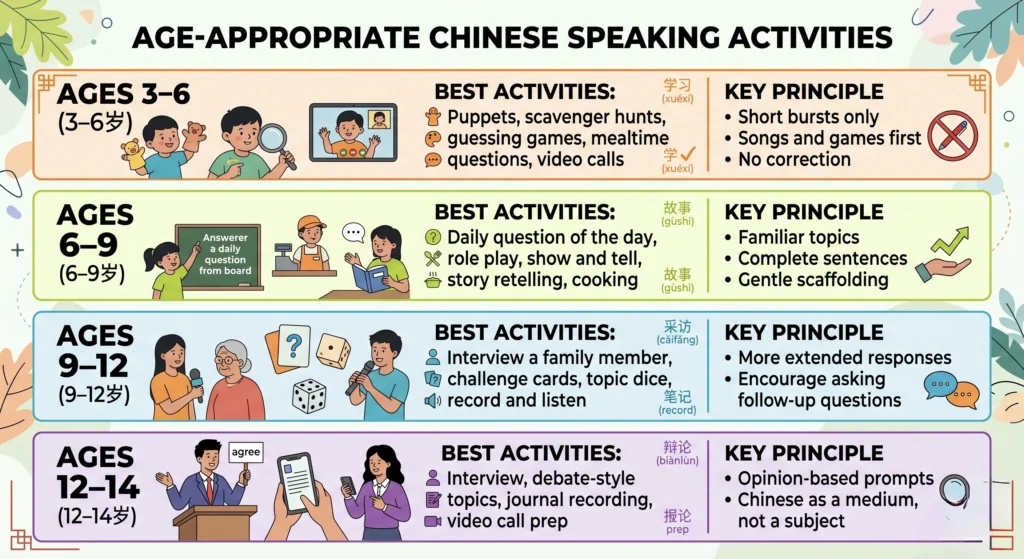
| Age group | Best activities | Key principle |
|---|---|---|
| Ages 3–6 | Puppets, scavenger hunts, guessing games, mealtime questions, video calls | Short bursts only. Songs and games first. No correction. |
| Ages 6–9 | Daily question of the day, role play, show and tell, story retelling, cooking | Familiar topics. Complete sentences. Gentle scaffolding. |
| Ages 9–12 | Interview a family member, challenge cards, topic dice, record and listen | More extended responses. Encourage asking follow-up questions. |
| Ages 12–14 | Interview, debate-style topics, journal recording, video call prep | Opinion-based prompts. Chinese as a medium, not a subject. |
Common Problems — and What to Do
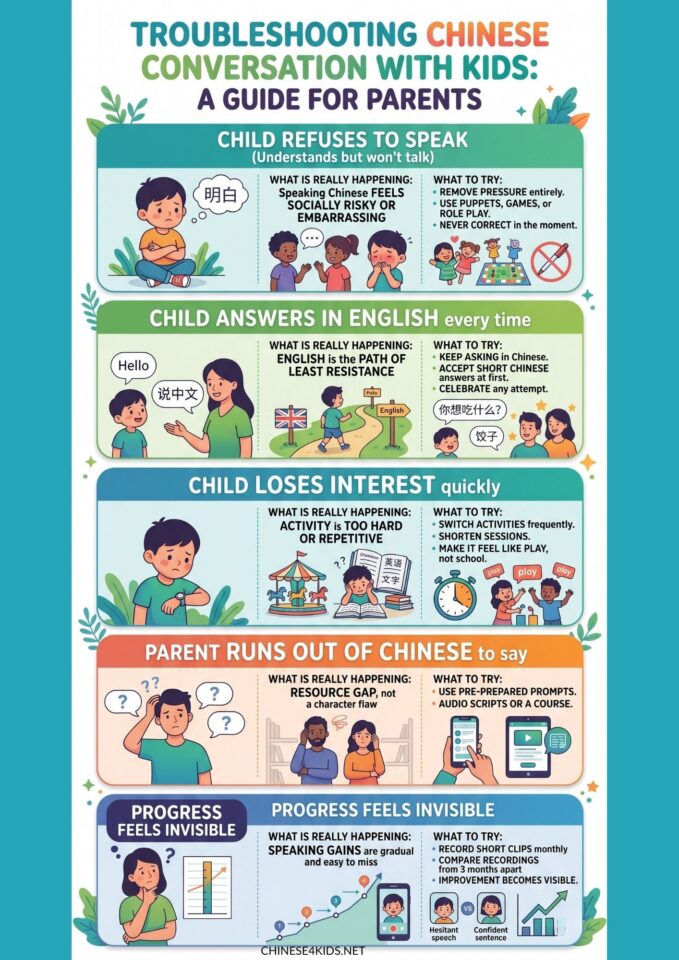
| Problem | What is really happening | What to try |
|---|---|---|
| Child understands but refuses to speak | Speaking Chinese feels socially risky or embarrassing | Remove pressure entirely. Use puppets, games, or role play. Never correct in the moment. |
| Child answers in English every time | English is the path of least resistance | Keep asking in Chinese. Accept short Chinese answers at first. Celebrate any attempt. |
| Child loses interest quickly | Activity is too hard or too repetitive | Switch activities frequently. Shorten sessions. Make it feel like play, not school. |
| Parent runs out of Chinese to say | Resource gap, not a character flaw | Use pre-prepared prompts, audio scripts, or a course. See the endnote below. |
| Progress feels invisible | Speaking gains are gradual and easy to miss | Record short clips monthly. Compare recordings from 3 months apart — improvement becomes visible. |
Best-For Summary
Best activity for shy children
Puppet conversations. The puppet speaks — not the child. Anxiety disappears.
Best activity for busy families
Daily question of the day. One question. One answer. 60 seconds. Done.
Best activity for teachers
Show and tell and topic dice. Both scale to any class size and require no prep materials.
Best activity for tracking progress
Record and listen. Monthly recordings show parents and children exactly how far they’ve come.
Tips for Consistent Conversation Practice
- Keep it short
5–10 minutes daily beats one long session each week. Consistency matters more than duration. - Focus on communication first
Do not correct every mistake. Confidence now, accuracy later. See our guide on correcting Chinese pronunciation for when and how to address errors. - Use familiar topics
Children speak more when discussing things they already know and care about — pets, food, friends, hobbies. - Repeat the same patterns often
Repetition builds fluency. The same sentence frames used in different contexts help children internalise structures naturally. - Pair speaking with listening
Good speaking comes from lots of listening. Read aloud. Play audio. Let Chinese be heard before it is spoken. See our guide on listening input strategies for children learning Mandarin. - Celebrate attempts, not perfection
Any attempt to speak Chinese deserves a positive response. The child who speaks imperfectly will improve. The child who stops speaking won’t.
Frequently Asked Questions
How much Chinese conversation practice does a child need each day?
Consistency matters more than length. Even 10 minutes of daily conversation can significantly improve speaking confidence over time. Short daily practice outperforms a single long weekly session.
My child understands Chinese but refuses to speak. What should I do?
Reduce all pressure immediately. Use puppets, games, and role play instead of direct questions. Never correct in the moment — even well-intentioned correction makes speaking feel risky. Accept one-word answers gladly. Build up slowly.
What if I am not confident in my own Chinese?
You do not need to be fluent to support your child’s speaking. Use prepared scripts, audio resources, and pre-written question prompts. Your consistency and encouragement matter far more than your accent. A clean audio model alongside you fills any gap.
What topics are easiest for beginner Chinese conversations?
Start with family, food, animals, colours, and daily routines. These topics are familiar, emotionally relevant, and covered by the first 300 high-frequency words children need. See our guide on building Chinese vocabulary for kids for word-learning strategies that make conversation easier.
Should I correct my child’s tones during conversation practice?
In most cases, no — especially not out loud in the moment. Recast instead: repeat the correct form back naturally in your reply, without stopping the conversation. Tones improve through listening, not correction. Read more in our guide on Chinese pronunciation correction for kids.
How do I know if my child is making progress in speaking?
Record short clips monthly and compare them three months apart. Look for longer sentences, fewer pauses, and more confident delivery — not just accuracy. See our guide on assessing Chinese progress at home for a fuller framework.
Can these activities work in a Chinese weekend school classroom?
Yes. Guessing games, topic dice, show and tell, and role play all adapt naturally to group settings. Story retelling and interview activities also work well with pairs or small groups.
Key takeaways
- Children learn to speak by speaking — not by memorising vocabulary lists.
- Short daily practice (5–10 min) consistently beats one long weekly session.
- Familiar topics — food, family, animals, school — produce the most natural conversations.
- Never correct in the moment. Recast the correct form naturally and keep going.
- Puppets, games, and role play reduce speaking anxiety more effectively than direct questioning.
- Recording monthly clips is the best way to see progress that feels invisible week to week.
- Parents do not need to be fluent — consistency and encouragement drive outcomes more than accuracy.
A note on resources
Many parents find that running out of things to say in Chinese is the biggest barrier — not motivation, and not the child. Speak Chinese with Kids gives parents 30 ready-to-use phrases for every everyday scene — mealtimes, bath time, bedtime, getting dressed, going out — with native-speaker audio, scene videos, and printable scripts. You do not need to be fluent. You need something to say. For children ready to move from speaking practice into reading, the Chinese4kids Leveled Readers (aa–C levels) pair naturally with the story retelling and record-and-listen activities above.
Further Reading on Chinese4kids
- Building a Chinese Immersion Environment at Home – How to make Chinese part of everyday life — not just lesson time.
- My Child Understands Chinese but Won’t Speak It: 5 Reasons and What Parents Can Do
- Chinese Pronunciation Correction for Kids – When to act, when to wait, and why recasting beats direct correction.
- Listening Input Strategies for Children Learning Mandarin – Why listening comes before speaking — and how to maximise input at home.
- Graded Reading for Children Learning Chinese – How to pick the right level reader and use it to build both reading and speaking confidence.
- How to Assess Your Child’s Chinese Progress at Home – Simple, low-pressure ways to track speaking, reading, and vocabulary development.
- Chinese Vocabulary for Kids: Building the First 300 Words – The vocabulary foundation that makes conversation natural and reading possible.
If you like this article, share it