

Quick Answer
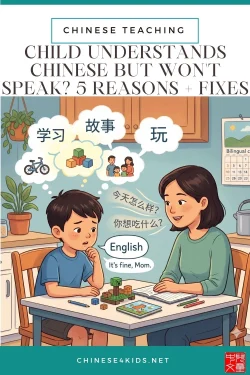
If your child understands Chinese but won’t speak it, the problem is usually not language ability. Most heritage-language children have enough Chinese comprehension — what they lack is confidence, motivation, and meaningful reasons to use Chinese actively. Research on bilingual development shows that reducing correction, creating real communication opportunities, and making Chinese emotionally positive can significantly increase a child’s willingness to speak.
Is It Normal for a Child to Understand Chinese but Not Speak It?
Yes. Many bilingual and heritage-language children go through a stage called passive bilingualism. During this stage, listening comprehension develops much faster than speaking ability. Children can follow conversations, instructions, stories, and media in Chinese while responding mostly in English.
This pattern is especially common among children growing up in English-speaking countries, where school, friends, and most of daily life happen in English.
📌 If you’re just starting out raising a bilingual child, our Parent’s Roadmap to Teaching Kids Chinese is a free starting point.
Why Does My Child Understand Chinese but Not Speak It? 5 Real Reasons
Speaking refusal usually isn’t about not knowing. Five deeper causes tend to happen at once.
Reason 1: The child’s brain has filed Chinese as a “high-pressure language”
If Chinese only shows up during Chinese school, character drills, corrections, homework, and parental nagging, the brain builds the association Chinese = being made to do something. English, meanwhile, maps to games, friends, fun, and belonging. Given the choice, the child picks English.
Reason 2: The child is afraid of getting it wrong
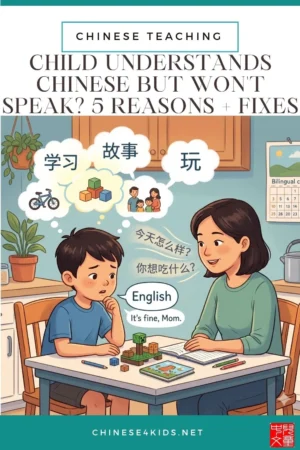
Many kids actually want to speak. But the moment they try — “I want that spoon…” — a parent jumps in with “It’s not spoon, it’s sháozi.” What the child receives isn’t “I learned a new word.” It’s “I didn’t say it well enough.” Over time they slip into risk-avoidance: don’t speak, can’t be wrong.
Reason 3: The child has no real need to use Chinese
This is the core issue. For many kids, Chinese only exists as input — no real context, no communication need, no emotional reason to use it. As applied linguists put it: language grows through need, not exposure alone.
Reason 4: English has become the child’s “identity language”
From elementary school on, children realize English means I’m part of school, while Chinese can feel like being different, being noticed, or seeming foreign. Avoiding Chinese output is partly a way of protecting their social safety.
Reason 5: Parents focus too much on results
Daily testing, checking, and watching for progress turns the home into “an exam that can happen anytime.” Nothing kills speech production faster than the feeling of being constantly evaluated.
Passive Bilingualism vs Active Bilingualism
| Passive Bilingualism | Active Bilingualism | |
|---|---|---|
| Understands Chinese | Yes | Yes |
| Speaks Chinese | Rarely | Frequently |
| Default response language | English | Both languages |
| Confidence speaking | Low | Strong |
| Common among | Heritage learners | Kids with active practice |
| Reversible? | Yes, with the right approach | — |
The good news: a child in the passive-bilingual stage already has a strong foundation. The work isn’t teaching them Chinese from scratch — it’s helping them unlock the Chinese they already have.
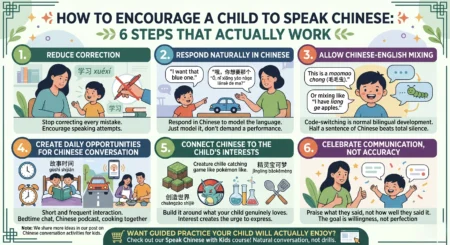
How to Encourage a Child to Speak Chinese: 6 Steps That Actually Work
Step 1: Reduce correction
Stop correcting every mistake. Constant correction tells the child “you’re not good enough” and shuts down speaking attempts.
Step 2: Respond naturally in Chinese
When your child says “I want that blue one,” don’t demand a Chinese version. Just respond in Chinese: “Oh, you want the blue one?” You modeled it without making them perform.
Step 3: Allow Chinese–English mixing
Code-switching is normal bilingual development, not a failure. Half a sentence of Chinese always beats total silence.
Step 4: Create daily opportunities for Chinese conversation
Short and frequent beats long and intense. Ten minutes of Chinese chat before bed, a Chinese podcast on the school run, a Chinese cooking session on Sunday. (We share more ideas in our post on Chinese conversation activities for kids.)
Step 5: Connect Chinese to the child’s interests
Don’t build it around “learning Chinese.” Build it around what your child genuinely loves — Minecraft, Pokémon, science experiments, mysteries, cooking. Interest creates the urge to express.
Step 6: Celebrate communication, not accuracy
Praise what they said, not how well they said it. The goal at this stage is willingness, not perfection.
🛒 If you want guided practice your child will actually enjoy, our Speak Chinese with Kids course is built specifically around natural conversation, not drills.
Will My Child Eventually Start Speaking Chinese?
Many heritage-language children begin speaking more Chinese later, especially when:
- they build stronger family relationships
- the kids gain confidence in their language ability
- they discover a sense of cultural identity (often in the teen years)
- the children encounter real situations where they need Chinese
The key is maintaining positive Chinese input while reducing pressure. The input is never wasted — even during long silent periods, the language is being stored.
Should Parents Force Children to Speak Chinese?
Generally, no.
Research on bilingual development suggests that forcing output often increases language anxiety and reduces willingness to communicate. A better approach: create situations where Chinese is useful, meaningful, and enjoyable — and let the child choose to use it.
There’s a difference between expecting Chinese and demanding it. The first is a household norm; the second feels like a test.
What Research Says About Heritage Language Development
Research on heritage-language learners consistently finds:
- Comprehension develops well before speaking ability.
- Emotional connection to a language strongly influences whether it’s maintained.
- Frequent correction reduces a child’s willingness to communicate.
- Meaningful interaction is more effective than memorization alone.
- Children are more likely to keep speaking Chinese when it’s tied to family relationships and positive experiences.
For a longer overview, see our guide on raising bilingual children at home.
Case Study: A 7-Year-Old Heritage Chinese Learner
Challenge. Mia, age 7, from California, understood about 90% of the Chinese spoken at home but always answered in English. She became irritable whenever she was asked to speak Chinese and grew increasingly resistant to Chinese school.
Parent Actions. Mia’s mother made three changes:
- Stopped correcting mistakes and allowed Chinese–English mixing.
- Set aside a fixed 15-minute “Chinese game time” each day — no teaching, just play.
- Stopped asking “How do you say this in Chinese?” and started asking “What do you think this might be called in Chinese?”
Results. Within three months, Mia began slipping Chinese words into her English on her own, joking in Chinese, imitating Chinese cartoons, and choosing to talk in Chinese before bed.
Key insight. Before her Chinese ability grew, what came back first was her sense of safety in Chinese.
Key Takeaways
- Understanding Chinese but not speaking it is common among heritage-language children — it’s called passive bilingualism.
- The issue is usually emotional and motivational, not linguistic.
- Constant correction reduces willingness to speak.
- Meaningful, interest-driven interaction works better than pressure.
- Children need reasons, opportunities, and confidence to use Chinese.
- Building positive associations with Chinese is the foundation of long-term language maintenance.
Frequently Asked Questions
Why does my child understand Chinese but not speak it?
Many bilingual children develop listening skills before speaking skills. Your child likely understands Chinese well but chooses English because it feels easier, faster, and socially safer. This is called passive bilingualism and is very common in heritage-language families.
Is passive bilingualism a problem?
Not necessarily — it’s a developmental stage, not a disorder. However, without opportunities to actively use Chinese, speaking ability may continue to lag far behind comprehension. The goal is to gradually move the child from passive to active bilingualism.
Should I correct my child’s Chinese mistakes?
Occasional natural modeling works far better than constant correction. Excessive correction reduces confidence and the willingness to communicate. Instead of correcting, simply respond using the correct phrasing — the child absorbs the model without being made to perform.
What age is best for encouraging Chinese speaking?
The earlier the better, but it is never too late. Older children and teenagers can also strengthen their Chinese, especially when they feel a personal connection to family, culture, or identity.
Can a child become fluent if they mostly understand Chinese now?
Yes. Strong listening comprehension is an excellent foundation for future speaking development. Many heritage learners go from receptive to expressive bilingualism once they have enough motivation and opportunity to use the language.
How long does the “silent period” usually last?
It varies — from a few months to several years. What matters most is keeping Chinese input consistent and low-pressure during this time. The language is being stored even when it’s not being spoken.
Related Resources on Chinese4kids.net
Speaking and conversation
- How to Encourage Kids to Speak Chinese
- Chinese Conversation Activities for Kids
- Speak Chinese with Kids — Online Course
Characters and reading
- Top 100 Most Common Chinese Characters (Free PDF)
- Chinese Reading Books for Kids
- A Parent’s Guide to Chinese Radicals
Parents raising bilingual kids
- Parent’s Roadmap to Teaching Kids Chinese (Free Guide)
- How to Maintain Chinese as a Heritage Language
- The Benefits of Bilingual Education: Learning Mandarin for Child Development
- How to Teach a Toddler Chinese
- Chinese conversation activities for kids
If you like this article, share it