The moment that breaks every overseas Chinese parent’s heart
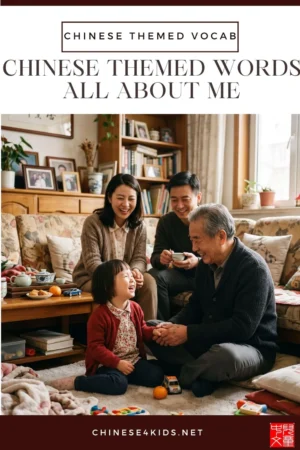
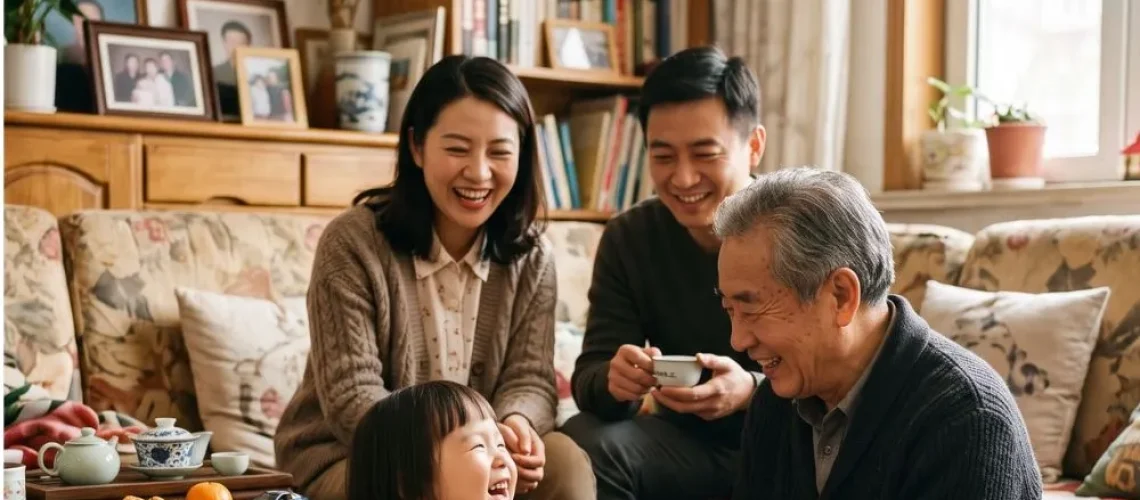
Grandma opens her arms on the video call and says, “来,给奶奶抱抱” (lái, gěi nǎinai bào bào — come give grandma a hug).
Your child pauses. Looks up at you. Asks in English: “What did she say?”
In that one second, three generations feel something sink.
If you’re raising a kid overseas — or teaching kids whose families are — you’ve seen versions of this. We worry our kids will lose Mandarin, but what does that worry actually look like? It’s almost always these three things:
- The child can’t introduce themselves in Chinese — not even a basic “我叫…” (wǒ jiào… — my name is…)
- He/she can’t name family members properly — confuses 爷爷 (yéye) with 外公 (wàigōng), or just defaults to “grandpa”
- The child can’t express how they feel in Chinese — “happy,” “sad,” “scared,” “tired” all come out in English
These three gaps aren’t random. They are the foundation of language identity. In nearly a decade of supporting overseas families and Chinese teachers, I’ve watched curriculum after curriculum start with “你好” (nǐ hǎo — hello) and jump straight to colors, numbers, fruits, animals. That sequence isn’t wrong, but it misses the most important starting point for overseas kids: before learning to describe the world, a child needs the words to describe themselves.
A child who can talk about me in Mandarin starts to feel that this language belongs to them. That’s the difference between a kid who tolerates Chinese class and a kid who actually owns the language.
This post gives you a clear starting point: 4 themes, 40 essential words, each with pinyin and a usable sentence. Once your child or student masters this set, they can answer the three most fundamental questions:
- Who am I?
- Who am I connected to?
- How do I feel?
Why these 4 themes belong together
The most common reason overseas kids quit Mandarin halfway is that the words they learn don’t seem to go anywhere. They learn 苹果 (píngguǒ — apple), 香蕉 (xiāngjiāo — banana), and… so what? Knowing fruit names doesn’t make a kid start using Chinese.
But once a child has these 4 themes, they can say something like:
我是 Lily,我 7 岁,我有一个弟弟,他是我哥哥,我今天很开心。
Wǒ shì Lily, wǒ 7 suì, wǒ yǒu yí ge dìdi, tā shì wǒ gēge, wǒ jīntiān hěn kāixīn.
I’m Lily, I’m 7, I have a younger brother, he is my older brother, I’m very happy today.
That single sentence uses all four themes at once:
personal pronouns + family + emotions + a key verb.
That’s why these themes belong together — they form a complete self-expression module, not four separate weeks.
Below is each theme with its 10 core words, teaching tips, and the mistakes overseas parents and CFL teachers most commonly make. Each theme also includes a short YouTube video so you (or your child) can hear native pronunciation directly.
Theme 1: Family Members 家人 (jiārén)
Chinese family terms are famously specific. English wraps everything into “grandma” and “uncle”; Chinese distinguishes mother’s side from father’s side, older from younger, blood from in-law. This is the area where overseas kids slip up most.
The 10 core words to start with:
| Chinese | Pinyin | English |
|---|---|---|
| 爸爸 | bàba | dad |
| 妈妈 | māma | mom |
| 爷爷 | yéye | grandpa (paternal) |
| 奶奶 | nǎinai | grandma (paternal) |
| 哥哥 | gēge | older brother |
| 姐姐 | jiějie | older sister |
| 弟弟 | dìdi | younger brother |
| 妹妹 | mèimei | younger sister |
| 儿子 | érzi | son |
| 女儿 | nǚ’ér | daughter |
🎯 Why these 10, and not “uncle, aunt, cousin”? This set covers the immediate household plus one generation up (paternal grandparents) and one generation down (children). It’s the smallest viable set that lets a child describe their own family and talk about other people’s families (“She has a daughter,” “He is my son”). Once these are solid, expanding to maternal grandparents (外婆 wàipó, 外公 wàigōng), uncles, aunts, and cousins becomes natural — but starting with 10 is the right call for a 4–8 year old. Cognitive load matters.
🎯 The mistake to avoid: Letting your child call all four grandparents simply “grandma” or “grandpa.” Even if your flashcards focus on the paternal pair (爷爷 / 奶奶), use 外婆 (wàipó) or 姥姥 (lǎolao) and 外公 (wàigōng) or 姥爷 (lǎoye) for the maternal grandparents in actual conversation from day one. Kids absorb this easily when it’s consistent. The distinction isn’t a grammar drill — it’s how Chinese family identity works, and it’s a beautiful piece of culture to pass on.
Useful sentences (these are the actual sentences from the Family Members theme):
| Sentence | Pinyin | English |
|---|---|---|
| 我爸爸很高。 | Wǒ bàba hěn gāo. | My dad is very tall. |
| 我爱我的妈妈。 | Wǒ ài wǒ de māma. | I love my mom. |
| 我爷爷喜欢喝茶。 | Wǒ yéye xǐhuan hē chá. | My grandpa likes to drink tea. |
| 我奶奶会做饭。 | Wǒ nǎinai huì zuò fàn. | My grandma can cook. |
| 他是我的哥哥。 | Tā shì wǒ de gēge. | He is my older brother. |
| 我姐姐是大学生。 | Wǒ jiějie shì dàxuéshēng. | My older sister is a university student. |
| 我有一个弟弟。 | Wǒ yǒu yí ge dìdi. | I have a younger brother. |
| 我妹妹很可爱。 | Wǒ mèimei hěn kě’ài. | My younger sister is very cute. |
| 他是我的儿子。 | Tā shì wǒ de érzi. | He is my son. |
| 她有一个女儿。 | Tā yǒu yí ge nǚ’ér. | She has a daughter. |
Notice how these 10 sentences quietly teach 5 essential sentence patterns:
我 + [family] + 很 + [adjective] (description)
我爱… (emotion)
我 + [family] + 喜欢/会 + [verb] (preference/ability)
他/她是我的… (identification)
我/她有 + [number] + [classifier] + [family] (possession)
One theme, ten words, but the grammatical mileage is enormous.
🃏 Get the Family Members Flashcard Set — €5 → Montessori 3-part cards + sentence cards + audio. Instant download.
Theme 2: Body Parts 身体部位 (shēntǐ bùwèi)
Body parts are one of the easiest themes for kids — they can literally point as they learn. That’s why preschool language programs across every culture start here.
The 10 core words:
| Chinese | Pinyin | English |
|---|---|---|
| 头 | tóu | head |
| 眼睛 | yǎnjing | eyes |
| 鼻子 | bízi | nose |
| 嘴巴 | zuǐba | mouth |
| 耳朵 | ěrduo | ears |
| 手 | shǒu | hand |
| 脚 | jiǎo | foot |
| 肚子 | dùzi | belly |
| 头发 | tóufa | hair |
| 牙齿 | yáchǐ | teeth |
🎯 Best teaching trick: Sing the Mandarin version of Head, Shoulders, Knees and Toes while your child points to each part. Half the words stick within five minutes. For a child who already knows the English version, the melody acts like a memory hook — they hear the new word in the same slot the English word used to occupy.
Useful sentences:
我的头疼。
Wǒ de tóu téng.
My head hurts.我有两只手。
Wǒ yǒu liǎng zhī shǒu.
I have two hands.张开嘴巴。
Zhāngkāi zuǐba.
Open your mouth.
🃏 Get the Body Parts Flashcard Set — €5 → Montessori 3-part cards + sentence cards + audio. Instant download.
Theme 3: Personal Pronouns 人称代词 (rénchēng dàicí)
Mandarin pronouns are simpler than English in one way — there’s no he/him/his case change. But Mandarin has two concepts English doesn’t: an “inclusive we” (咱们 zánmen, you and I) versus a regular “we” (我们 wǒmen, possibly excluding the listener), and a gender-neutral 它 (tā) for animals and objects.
The 10 core words:
| Chinese | Pinyin | English |
|---|---|---|
| 我 | wǒ | I, me |
| 你 | nǐ | you |
| 他 | tā | he, him |
| 她 | tā | she, her |
| 它 | tā | it (animals/objects) |
| 我们 | wǒmen | we, us |
| 你们 | nǐmen | you (plural) |
| 他们 | tāmen | they |
| 自己 | zìjǐ | self |
| 大家 | dàjiā | everyone |
🎯 Common parent question: “他, 她, 它 all sound the same — won’t my kid get confused?” In speech, no — they all pronounce as tā, so a child can never say the wrong one. The distinction matters only in writing, which is a school-age concern. For preschool and early-elementary kids, just teach the spoken form. The written distinction comes later, naturally.
Useful sentences:
我是 Lily。
Wǒ shì Lily.
I am Lily.你好吗?
Nǐ hǎo ma?
How are you?我们一起去。
Wǒmen yìqǐ qù.
Let’s go together.
🃏 Get the Pronouns Flashcard Set — €5 → Montessori 3-part cards + sentence cards + audio. Instant download.
Theme 4: Emotions 情绪 (qíngxù)
This is the most underrated of the four themes — and the one with the highest emotional stakes. After learning fruits and animals, many overseas kids still cannot say “I’m sad” or “I’m scared” in Mandarin. When a child can only express emotions in English, they quietly file Mandarin into the “language for everyday tasks” category — and English into the “language of my real self” category. That split is one of the earliest warning signs of language loss.
Teaching emotion words isn’t just vocabulary work. It’s wiring Mandarin into a child’s inner life.
The 10 core words:
| Chinese | Pinyin | English |
|---|---|---|
| 高兴 / 开心 | gāoxìng / kāixīn | happy |
| 难过 | nánguò | sad |
| 生气 | shēngqì | angry |
| 害怕 | hàipà | scared |
| 累 | lèi | tired |
| 紧张 | jǐnzhāng | nervous |
| 兴奋 | xīngfèn | excited |
| 无聊 | wúliáo | bored |
| 喜欢 | xǐhuan | like |
| 爱 | ài | love |
🎯 The single most powerful habit: Ask your child every night, in Chinese, “今天你开心吗?” (Jīntiān nǐ kāixīn ma? — Were you happy today?) and “有什么让你难过的事吗?” (Yǒu shénme ràng nǐ nánguò de shì ma? — Was there anything that made you sad?). Three months of this nightly ritual and your child will start defaulting to Chinese for emotion talk. This is one of the highest-leverage parenting moves I know for protecting Mandarin.
Useful sentences:
我今天很高兴。
Wǒ jīntiān hěn gāoxìng.
I’m very happy today.)你害怕吗?
Nǐ hàipà ma?
Are you scared?我喜欢你。
Wǒ xǐhuan nǐ.
I like you.
🃏 Get the Emotions Flashcard Set — €5 → Montessori 3-part cards + sentence cards + audio. Instant download.
What can your child do with these 40 words?
Not fluent conversation — that’s unrealistic. But after this set, your child or student can:
✅ Give a basic self-introduction in Chinese (我叫…我有…我喜欢…)
✅ Recognize and use proper terms for immediate family — and start grasping the “father’s side / mother’s side” distinction
✅ Express at least 5 emotions in Chinese
✅ Answer “today how do you feel?” in Mandarin
✅ Have a foundation of subject + verb sentence patterns to build on for every later theme — food, home, school, the world outside
These 40 words are the soil. Without them, every fruit-name and animal-name your child learns later sits on top of nothing.
How to actually get these 40 words to stick
Many parents and teachers think “show the word, say the word, done.” But getting words to the point where a child spontaneously uses them takes three layers:
- Input layer — daily exposure. 5–10 minutes a day of these words in conversation, songs, picture books, or flashcards.
- Interaction layer — the parent or teacher asks using these words, and the child responds. Even a one-word answer counts. “今天开心吗?” → “开心” is enough. Don’t demand full sentences yet.
- Application layer — the child uses the words unprompted. This is the real “knows it” benchmark.
Most overseas families get stuck at layer 2 — the kid is asked in Chinese but answers in English. This isn’t the child’s failure; it’s a missing tool. Below are two tools designed exactly for this gap.
The teaching tool: Themed Mandarin Chinese Words Pack
I’ve packaged these 4 themes — plus the other 26 high-frequency themes — into a complete 30-Theme Mandarin Flashcard Sentence Audio Pack. Each theme follows the same proven design:
📦 What’s in each theme:
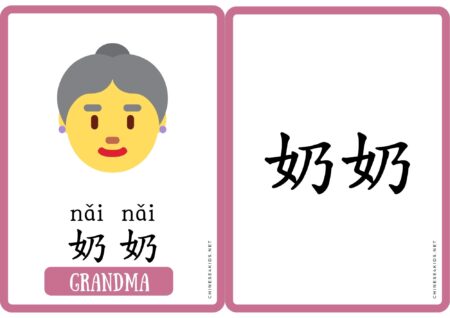
1. Vocabulary flashcards — 10 Montessori 3-part word-cards per theme:
Control Card: friendly emoji-style illustration + pinyin + Chinese characters + English label (color-coded by theme)
Matching Cards large bold Chinese characters only — for teacher pointing, child reading practice, or memory testing
2. Sentence flashcards — one carefully chosen sentence per word, three-panel design:
Top panel: the sentence in Chinese characters, with the target word highlighted in red
Middle panel: full pinyin + English translation
Bottom panel: a real-life photograph + the sentence with character-by-character pinyin underneath
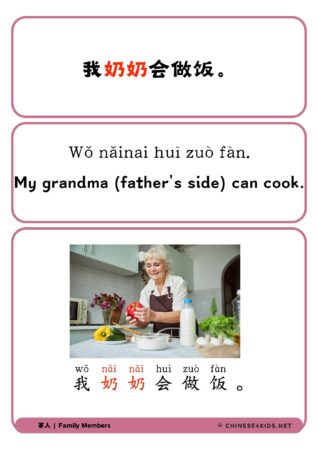
The sentence cards are not random examples — they’re designed to teach 5 core sentence patterns per theme (description, possession, identification, preference, ability), so a child who masters the family pack walks away with 10 words and the foundational grammar to build hundreds more sentences.
3. Audio files
native pronunciation for every word and every sentence, so non-Mandarin-speaking parents can teach with confidence even if they’ve never spoken a word of Chinese.
📌 Who it’s for:
- Overseas Chinese parents — even if your own Mandarin is rusty, the audio lets you teach with native pronunciation
- CFL teachers — ready-to-use teaching tool, no design or prep needed
- Homeschooling families — structured theme-based teaching kit
- Non-Chinese-background parents — clear pinyin and English makes it usable even if you don’t read characters
For parents who don’t speak Mandarin themselves
If you’re a parent who wants your child to learn Mandarin but doesn’t speak it fluently yourself: don’t give up on this. I built [Speak Chinese with Kids] for exactly this situation. Each daily-life scenario comes with 30 of the most useful Mandarin sentences, complete with audio and video. You don’t need to know any Chinese to use it — you read along with the audio. Combined with the 4 themes above, you and your child can start learning together at home.
Learn more about Speak Chinese with Kids →
Get the complete bundle
These 4 themes are part of the 30-Theme Montessori Mandarin Flashcard Bundle — all 300 words, 900 vocabulary cards, 300 sentence cards, and 30 audio files in one download.
Get the Full Bundle — €79 → Or browse all 30 individual themes from €5 each.
→ Cluster 1: All About Me (family members, body parts, personal pronouns, emotions)
→ Cluster 2: Building Blocks (numbers, colors, action verbs)
→ Cluster 3: Food & Meals — the most natural Mandarin context for overseas Chinese families
→ Cluster 4: Home & Daily Life — wiring Mandarin into the daily routine
→ Cluster 5: School Life — words your child can use today
→ Cluster 6: The World Outside — animals, transportation, places, nature
Each cluster has its own complete guide with vocabulary, sentences, and teaching tips.
One last thing for overseas Chinese families
After almost a decade of running Chinese4kids, the deepest pattern I’ve seen is this: overseas Mandarin teaching isn’t really about how many words a child learns. It’s about whether Chinese ever becomes the language a child uses to express themselves.
These 40 words are the first step in making that happen.
Take it slow. But start.
If you like this article, share it