Quick answer
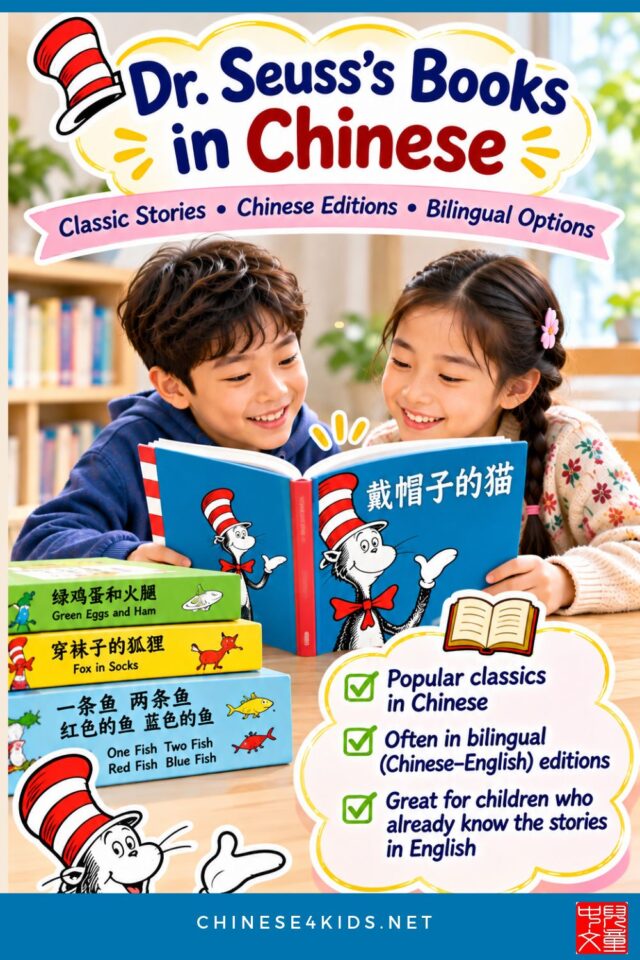
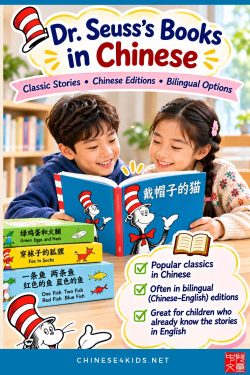
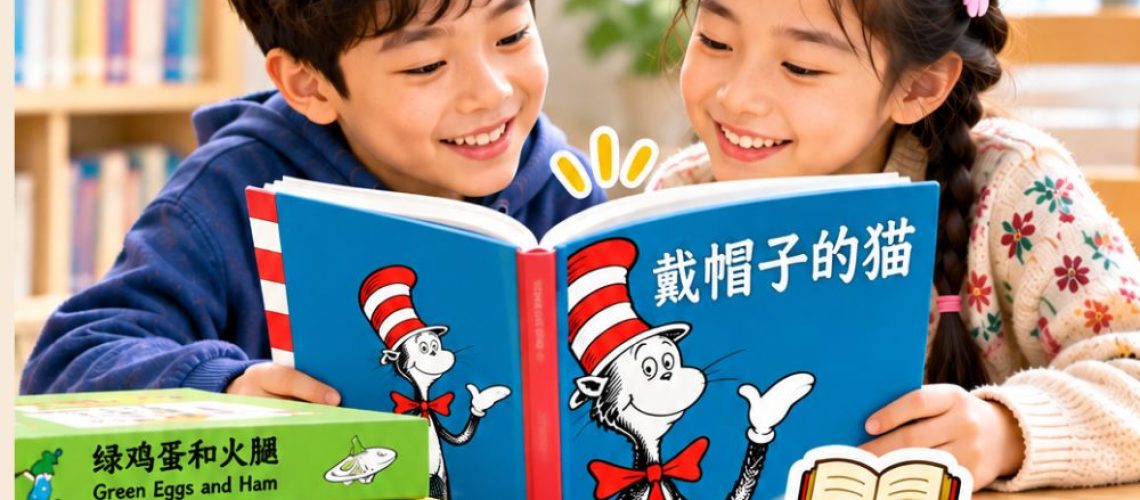
Several Dr. Seuss classics, including The Cat in the Hat, Green Eggs and Ham, Fox in Socks and One Fish, Two Fish, Red Fish, Blue Fish, have Chinese and English bilingual editions. Most editions commonly found in international bookshops use Simplified Chinese. Taiwan publishers have also produced Traditional Chinese editions. They work best as a bridge for children who already know the English stories, not as first Chinese readers.
Dr. Seuss is a favourite in English-speaking homes, so it is natural to wonder whether your child can enjoy these stories in Chinese too. They can, with a few things to know first. The books were written with English sounds and rhymes in mind, and that shapes what a Chinese edition can do.
What Are Chinese Editions of Dr. Seuss Like?
Most editions available to international buyers are bilingual, with English and Chinese in the same book. The layout varies from edition to edition, so look at sample pages before you buy.
- Simplified Chinese and English: Commonly published in mainland China and sold abroad. Several describe themselves as helping children learn English, so the English side may be the main focus.
- Traditional Chinese and English: Taiwan publishers, including Yuan Liu and Commonwealth Publishing (遠見天下文化), have produced bilingual editions. Some older titles are out of print, so you may need to look for second-hand copies.
- Chinese-only editions: These are less common in the international listings I found. Check the language details and sample pages before buying.
How Dr. Seuss’s Rhymes and Wordplay Change in Chinese
Dr. Seuss builds his books on rhyme, rhythm, repetition and invented words. These features are closely tied to the sounds of English, so a Chinese translation cannot reproduce every joke or rhyme in exactly the same way.
However, translators can create new rhythms, rhymes and playful expressions in Chinese. The result may feel different from the English original, but it can still be fun to read aloud. Think of the Chinese as a retelling, and enjoy the differences with your child.
Dr. Seuss Books Available in Chinese
Chinese titles vary by publisher and region, and Simplified and Traditional titles are not always simple character conversions. Match the cover rather than the title alone, and check that the edition is still in print.
| English title | Chinese title (varies by edition) |
|---|---|
| The Cat in the Hat | 戴帽子的猫 (Simplified) / 戴帽子的貓 (Traditional) |
| Green Eggs and Ham | 绿鸡蛋和火腿 (Simplified) / 綠火腿加蛋 (Traditional, Taiwan) |
| Fox in Socks | 穿袜子的狐狸 (Simplified) / 狐狸穿襪子 (Traditional, Taiwan) |
| One Fish, Two Fish, Red Fish, Blue Fish | 一条鱼两条鱼红色的鱼蓝色的鱼 (Simplified) / 一條魚,二條魚,紅的魚,藍的魚 (Traditional, Taiwan) |
Other bilingual editions have been listed for Dr. Seuss’s ABC, Hop on Pop, I Can Read With My Eyes Shut!, Yertle the Turtle and Other Stories, Horton Hatches the Egg and If I Ran the Circus. Availability changes, and a listing does not mean a book is in stock.
The Cat in the Hat
A rainy day, a mischievous cat and a very messy house make this a good first Dr. Seuss book. The story is full of action, so children can follow it from the pictures even when the Chinese is new. Use the illustrations to talk about everyday objects and actions in Chinese. It suits children who already know the English story, but check the Chinese level on a sample page. See the bilingual edition.
Green Eggs and Ham
One character keeps refusing to try green eggs and ham, until he finally does. The repeated questions and answers make it easy to follow, and children quickly recognise the familiar lines. Notice which Chinese phrases come back again and again, then let your child join in on those. It is a good choice for children who
enjoy repetition and predictable stories. See the bilingual edition.

Fox in Socks
Fox in Socks is full of tongue twisters, sound patterns and silly word combinations, which makes it one of Dr. Seuss’s most entertaining read-aloud books.
The Chinese translation cannot reproduce all the English sound games, so don’t expect it to work as a Mandarin tongue-twister book. Instead, notice how the translator plays with Chinese words, then try some genuine Mandarin tongue twisters with your child. Here are some Chinese tongue twisters for children. See the bilingual edition.

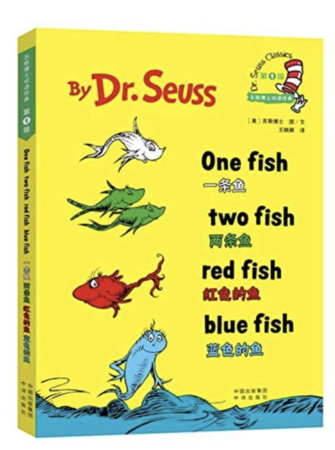
One Fish, Two Fish, Red Fish, Blue Fish
A gentle, silly book about colours, numbers, animals and imaginary creatures. Use the pictures to talk about what your child sees, and pick out colour and number words in Chinese as you go. It is a good match for young learners who are already working on these topics. See the bilingual edition.
How to Choose a Chinese Dr. Seuss Book
- Check the characters. Simplified or Traditional? Match what your child is learning.
- Check the Chinese level. Don’t assume that a picture book for preschoolers will be easy to read in Chinese. Look at a few sample pages and see how much of the Chinese your child can understand.
- Don’t expect pinyin. Not every edition has it, so these books should not be treated like graded Chinese readers. Check the description or sample pages if your child needs pinyin.
- Look at the layout. Some editions put the two languages together, others arrange them differently.
- Check availability. Some editions are out of print, so confirm the exact edition before you order.
How to Read Dr. Seuss in Chinese With Your Child
- Read the English first. A familiar story makes the Chinese easier to follow.
- Read the Chinese aloud together. Your child can listen first, then join in with familiar words or repeated phrases.
- Pick one page, not the whole book. Choose a favourite spread and learn two or three words from it.
- Talk about the differences. Did the Chinese version use a different word or expression? Which version do you like better?
- Record and replay. Reading a page aloud and recording it is a lovely speaking exercise. See our guide to recording your child’s Chinese speaking.
Are Dr. Seuss Books Good for Learning Chinese?
Bilingual Dr. Seuss books can be a fun way to bring familiar stories into your child’s Chinese learning. They work especially well for children who already know the English versions and feel more confident reading in English. However, they are not a structured Chinese reading programme, and the bilingual format can make it tempting to rely on the English. For books written specifically to help children develop Chinese reading skills, explore our Chinese reading books for kids.
Frequently Asked Questions
Are there Dr. Seuss books in Chinese?
Yes. Several popular Dr. Seuss books have Chinese-English bilingual editions, including The Cat in the Hat, Green Eggs and Ham, Fox in Socks and One Fish, Two Fish, Red Fish, Blue Fish. Most editions available internationally use Simplified Chinese, although Traditional Chinese editions have also been published in Taiwan. Availability varies by title and publisher.
Do the Chinese editions rhyme?
Some Chinese translations use rhyme, rhythm and playful language, but they cannot reproduce every English rhyme or sound joke. The Chinese version may use different expressions to create its own rhythm and humour. Read it as a Chinese retelling rather than expecting an exact match with the English original.
Can my child learn to read Chinese from these books?
They can pick up some vocabulary and become more familiar with characters, but these books are not designed as a structured Chinese reading programme. The Chinese may be too difficult for beginners, and the bilingual format can encourage children to rely on the English. Use them for shared reading and enjoyment, then add books written specifically for Chinese learners.
Which Dr. Seuss book should we try first?
The Cat in the Hat is a good starting point if your child already knows the English story. Green Eggs and Ham is another good choice because its repeated sentences make it easy to follow. If your child enjoys wordplay, try Fox in Socks.
Do these editions have pinyin?
Not all of them. Pinyin depends on the publisher and edition. Check the sample pages or book description before buying if your child needs pinyin support.
Disclosure: some links on this page are affiliate links. If you buy through them, we may earn a small commission at no extra cost to you.
If you like this article, share it