Quick answer:
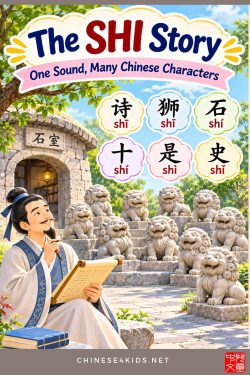
Lion-Eating Poet in the Stone Den (施氏食狮史, Shī shì shí shī shǐ) is the best-known Chinese story with one sound. It is a short story written in Classical Chinese in the 1930s by the linguist Yuen Ren Chao (赵元任). It has about 90 characters, and in modern Mandarin every one of them is pronounced shi. Only the tones change. It is a clever language demonstration, not a children’s story, and it works best as a fun way to show older children how much tones matter.
Try saying shi out loud. Then say it with a rising tone, then a falling one. You have just said three different Chinese words. This tiny experiment is the idea behind one of the most famous pieces of Chinese wordplay: a whole story in which every character sounds like shi.
What Is “Lion-Eating Poet in the Stone Den”?
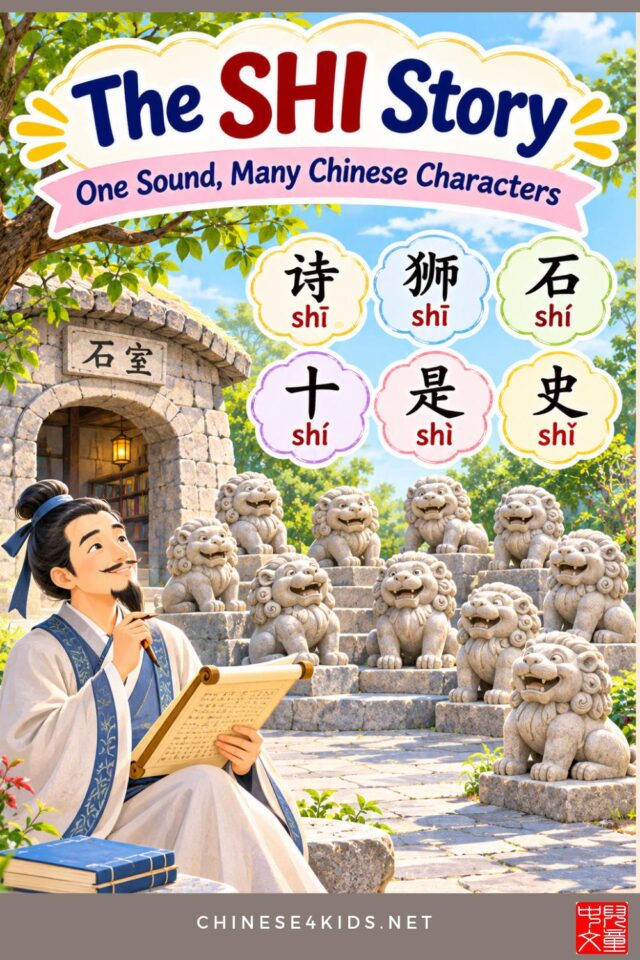
The story is about a poet named Shi who lives in a stone den and loves lions. It was written in Classical Chinese, the compact written language of earlier centuries, not in everyday spoken Mandarin. Chao, who was a respected linguist, wrote it to show what the sounds and tones of Chinese can and cannot do. He also wrote other one-sound pieces.
The story in brief: the poet vows to eat ten lions. One day he goes to the market, shoots ten lions and takes them home. He has his stone den cleaned, then sits down to eat. Only then does he see that the lions are made of stone. The story ends by asking the reader to explain it all.
Let’s try to read:
施(shī)氏(shì)食(shí)狮(shī)史(shǐ)
石(shí)室(shì)诗(shī)士(shì)施(shī)氏(shì),嗜(shì)狮(shī),誓(shì)食(shí)十(shí)狮(shī)。
氏(shì)时(shí)时(shí)适(shì)市(shì)视(shì)狮(shī)。
十(shí)时(shí),适(shì)十(shí)狮(shī)适(shì)市(shì)。
是(shì)时(shí),适(shì)施(shī)氏(shì)适(shì)市(shì)。
氏(shì)视(shì)是(shì)十(shí)狮(shī),恃(shì)矢(shǐ)势(shì),使(shǐ)是(shì)十(shí)狮(shī)逝(shì)世(shì)。
氏(shì)拾(shí)是(shì)十(shí)狮(shī)尸(shī),适(shì)石(shí)室(shì)。
石(shí)室(shì)湿(shī),氏(shì)使(shǐ)侍(shì)拭(shì)石(shí)室(shì)。
石(shí)室(shì)拭(shì),氏(shì)始(shǐ)试(shì)食(shí)是(shì)十(shí)狮(shī)。
食(shí)时(shí),始(shǐ)识(shí)是(shì)十(shí)狮(shī)尸(shī),实(shí)十(shí)石(shí)狮(shī)。
试(shì)释(shì)是(shì)事(shì)。
The translation of this story, according to wikipedia is as follows:
“Lion-Eating Poet in the Stone Den”
In a stone den was a poet Shi, who was a lion addict, and had resolved to eat ten.
He often went to the market to look for lions.
At ten o’clock, ten lions had just arrived at the market.
At that time, Shi had just arrived at the market.
He saw those ten lions, and using his trusty arrows, caused the ten lions to die.
He brought the corpses of the ten lions to the stone den.
The stone den was damp. He asked his servants to wipe it.
After the stone den was wiped, he tried to eat those ten lions.
When he ate, he realized that those ten lions were in fact ten stone lion corpses.
Try to explain this matter.
Why Every Word Can Sound the Same
Mandarin has only a little over 400 syllables, not counting tones. English has thousands. With so few sounds to go around, many different characters share the same syllable. Tones then split each syllable into four main sounds.
The syllable shi shows how much work tones do. Here are some everyday words that all use it:
| Tone | Characters and meanings |
|---|---|
| First tone (shī) | 诗 poem, 狮 lion, 师 teacher, 湿 wet |
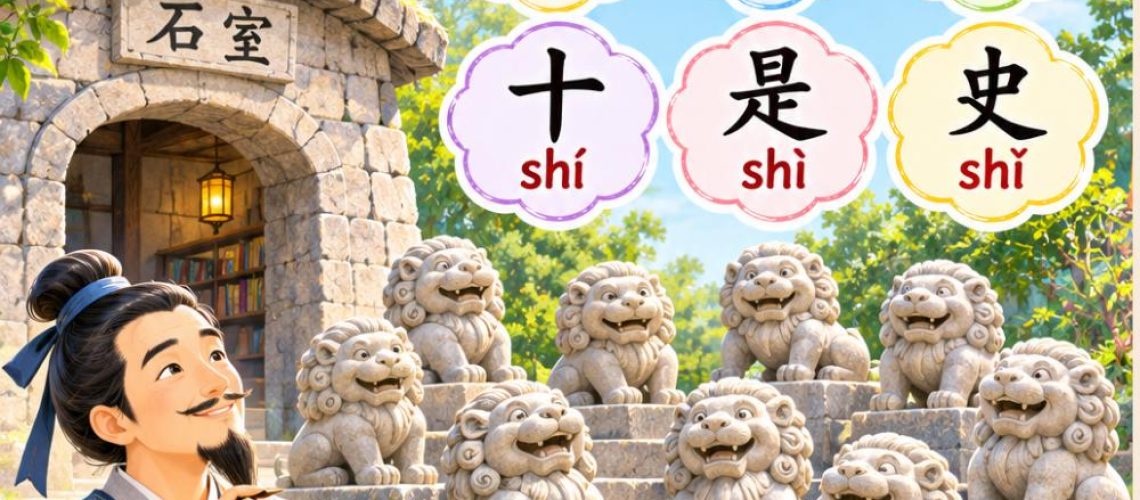
| Second tone (shí) | 十 ten, 食 eat, 石 stone, 时 time |
| Third tone (shǐ) | 史 history, 使 make, 始 begin |
| Fourth tone (shì) | 是 is, 市 market, 事 matter, 室 room |
Written down, each of these looks completely different. Said aloud without tones, they would blur together. That is why tones are not a detail you can add later. They are part of the word.
It Is Meant to Be Read, Not Heard
Here is the surprise: if you read the story aloud, even a fluent Mandarin speaker will struggle to follow it. Their eyes can follow the characters, but their ears cannot tell the words apart. The story only makes sense on the page.
That is the point of the demonstration. It shows how much a Chinese reader relies on characters and context. It also shows why Classical Chinese, which uses very short words, is much harder to understand by ear than modern spoken Mandarin. Scholars have offered different explanations for why Chao wrote it. What everyone agrees on is that it is a clever test of how far Chinese sounds can be pushed.
The trick works only in Mandarin. In Cantonese and other varieties of Chinese, the same characters are not all pronounced alike, so the story does not sound like one repeated syllable.
Is It Good for Children?
Honestly, not as a story. Classical Chinese is far beyond a beginner, and the vocabulary is unusual. Please don’t expect your child to read or understand it, and don’t worry if you cannot either. You are not meant to.
It is a good conversation starter, though. For older children, teenagers and teachers, it makes tones feel like a puzzle instead of a rule to memorise. Use it for a few minutes, then move on to simple practice.
Five Fun Ways to Use It
- Say it four ways. Say shi in all four tones. Ask your child to point at a picture for each: a poem, ten, history, a market.
- Play “Which shi?” Say one word from the table and let your child pick the right character or picture. Start with just two tones, then add the others.
- Compare pinyin and characters. Show the story in characters, then in pinyin without tone marks. Ask which is easier to read. It is a memorable way to explain why tone marks matter.
- Try a real Mandarin tongue twister. The traditional twister 十是十,四是四,十四是十四,四十是四十 (Shí shì shí, sì shì sì, shísì shì shísì, sìshí shì sìshí) gives children the same shi and si contrast in a form they can actually say. For more, see our Chinese tongue twisters for children.
- Record and listen back. Have your child record the four shi words, then listen for the tone differences. Our guide to recording Chinese speaking practice shows how.
Where to Go Next
If the story made you curious about tones and sounds, these are good next steps:
- Chinese tones for kids: simple ways to hear and practise the four tones.
- An introduction to Hanyu Pinyin: how the sound system fits together.
- Hanyu Pinyin Syllables Table Poster: a chart that lets children see shi alongside the other syllables.
- Speak Chinese with Kids: a course that builds clear speaking from the start.
- Chinese Vocabulary Made Easy: a course that helps children grow their vocabulary.
Curious about the full background? The Wikipedia article on the Lion-Eating Poet in the Stone Den has more on the text and its history.
Frequently Asked Questions
What is the Chinese story where every word is “shi”?
It is Lion-Eating Poet in the Stone Den (施氏食狮史), a short narrative poem in Classical Chinese. Every character is pronounced shi in modern Mandarin, with only the tones differing.
Who wrote it, and when?
The linguist Yuen Ren Chao (赵元任) wrote it in the 1930s as a demonstration of how homophones work in Chinese.
Can a Mandarin speaker understand it when they hear it?
Not easily. Even native speakers need to see the characters, because the spoken syllables are nearly identical. That is exactly what the story is designed to show.
Does it work in Cantonese?
No. The effect depends on modern Standard Mandarin. In Cantonese and other varieties, the characters are not all pronounced the same.
Is it suitable for children learning Chinese?
Not as a reading text. The language is too advanced. It is useful as a short activity to help older children notice how tones change meaning. For everyday practice, use simple words, songs and tongue twisters.
Why do tones matter so much in Chinese?
Because Mandarin has relatively few syllables, tones help tell words apart. Changing the tone on shi can turn “ten” into “history” or “is” into “poem”. Learning each word with its tone from the start makes speaking and listening much clearer.
If you like this post, share it