Dates in Chinese follow a simple, predictable pattern. The year comes first, followed by the month and date. Each part uses a number and a short word.
If your child already knows the numbers from the Chinese numbers guide, they can learn to say many dates with this short lesson.
Contents
hide
Quick answer: how to say a date in Chinese
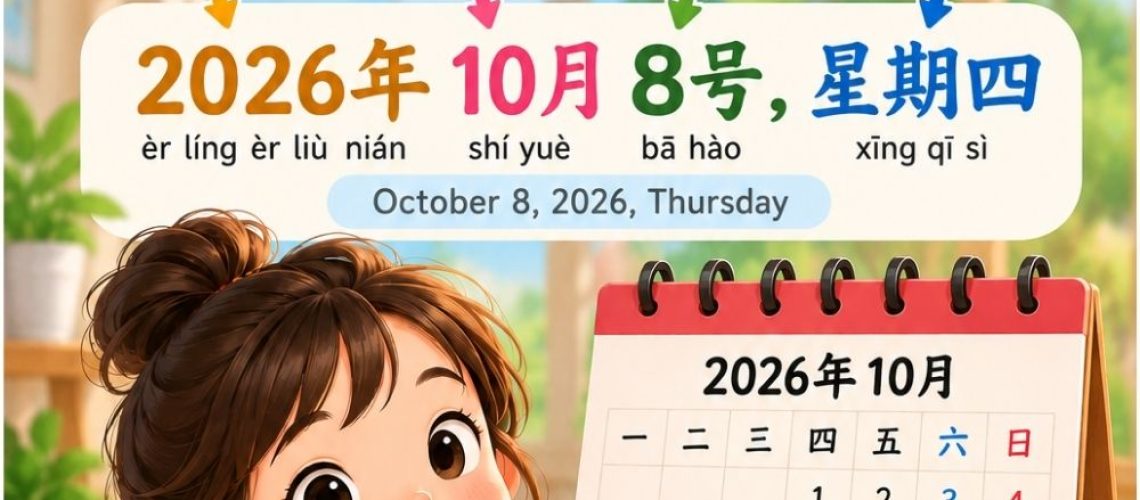
Year + 年 · Month + 月 · Date + 号 · Weekday (optional)
2026年10月10号,星期六
èr líng èr liù nián shí yuè shí hào, xīng qī liù
October 10, 2026, Saturday
Read the year digit by digit. Name the month with a number plus 月. Add 号 after the date. The weekday is optional. Add it at the end with 星期 plus a number.
The five words you need
| Chinese | Pinyin | Meaning | Note |
|---|---|---|---|
| 年 | nián | year | Goes after the year digits |
| 月 | yuè | month (also “moon”) | Goes after the month number |
| 号 | hào | date (everyday) | Very common in conversation |
| 日 | rì | date (formal) | Often in written dates and calendars |
| 星期 | xīng qī | week | Goes before the weekday number |
号 is very common when saying a date in everyday conversation. 日 is often used in written dates, calendars, and formal contexts. For beginners, learning to say 三月八号 (March 8) is a good starting point.
How to say the year in Chinese
Read each digit of the year separately, then add 年 (nián), meaning “year.” For example, 2026 is 二零二六 (èr líng èr liù), followed by 年. Zero is 零 (líng).
- 1999年 — yī jiǔ jiǔ jiǔ nián
- 2000年 — èr líng líng líng nián
- 2008年 — èr líng líng bā nián
- 2016年 — èr líng yī liù nián
- 2026年 — èr líng èr liù nián
You can write the digits as numbers (2026年) or as characters (二零二六年). Both are normal.
Months in Chinese: number + 月
In Mandarin Chinese, months are numbered. January is 一月 (the first month), February is 二月 (the second month), and December is 十二月 (the twelfth month). Once kids know 1 to 12, they know all twelve months.
| Month | Chinese | Pinyin |
|---|---|---|
| January | 一月 | yī yuè |
| February | 二月 | èr yuè |
| March | 三月 | sān yuè |
| April | 四月 | sì yuè |
| May | 五月 | wǔ yuè |
| June | 六月 | liù yuè |
| July | 七月 | qī yuè |
| August | 八月 | bā yuè |
| September | 九月 | jiǔ yuè |
| October | 十月 | shí yuè |
| November | 十一月 | shí yī yuè |
| December | 十二月 | shí èr yuè |
Dates in Chinese: number + 号
To say a date in everyday conversation, put 号 after the number. For example, 十五号 (shí wǔ hào) means the 15th day of the month. The numbers 1 to 31 follow the same pattern as all Chinese numbers.
| Dates | Pattern | Example |
|---|---|---|
| 1–10 | number + 号 | 五号 (wǔ hào) — the 5th |
| 11–19 | 十 + number + 号 | 十五号 (shí wǔ hào) — the 15th |
| 20 and 30 | tens + 号 | 二十号 (èr shí hào) — the 20th |
| 21–29 and 31 | tens + number + 号 | 二十三号 (èr shí sān hào) — the 23rd |
Weekdays in Chinese: 星期 + number
Weekdays use 星期 plus a number, starting with Monday as “week one.”
| Day | Chinese | Pinyin |
|---|---|---|
| Monday | 星期一 | xīng qī yī |
| Tuesday | 星期二 | xīng qī èr |
| Wednesday | 星期三 | xīng qī sān |
| Thursday | 星期四 | xīng qī sì |
| Friday | 星期五 | xīng qī wǔ |
| Saturday | 星期六 | xīng qī liù |
| Sunday | 星期天 / 星期日 | xīng qī tiān / xīng qī rì |
Sunday is different. Say 星期天 or 星期日, not 星期七. You will also hear 周 and 礼拜 for “week.” Our full days of the week guide explains all three, plus how to count weeks.
Put it all together: full dates
Dates without a year
| Date | Chinese | Pinyin |
|---|---|---|
| Jan 1 | 一月一号 | yī yuè yī hào |
| Mar 8 | 三月八号 | sān yuè bā hào |
| Sep 20 | 九月二十号 | jiǔ yuè èr shí hào |
| Dec 31 | 十二月三十一号 | shí èr yuè sān shí yī hào |
Dates with a year (and a weekday)
| Date | Chinese | Pinyin |
|---|---|---|
| May 13, 2001 | 二零零一年五月十三号 | èr líng líng yī nián wǔ yuè shí sān hào |
| Oct 2, 1998 | 一九九八年十月二号 | yī jiǔ jiǔ bā nián shí yuè èr hào |
| Oct 10, 2026, Saturday | 二零二六年十月十号,星期六 | èr líng èr liù nián shí yuè shí hào, xīng qī liù |
English often puts the year last (Nov 21, 2012). Chinese usually goes in the order year, month, date: 2012年11月21号. The weekday can be added at the end.
Read a Chinese date step by step
| Part | Chinese | Pinyin | Meaning |
|---|---|---|---|
| Year | 2026年 | èr líng èr liù nián | Year 2026 |
| Month | 10月 | shí yuè | October |
| Date | 10号 | shí hào | The 10th |
| Weekday | 星期六 | xīng qī liù | Saturday |
Put the parts together: 2026年10月10号,星期六。
Everyday sentences kids can use today
- 今天几月几号? Jīn tiān jǐ yuè jǐ hào? — What’s the date today?
- 今天十月十号。 Jīn tiān shí yuè shí hào. — Today is October 10.
- 今天星期几? Jīn tiān xīng qī jǐ? — What day is it today?
- 今天星期六。 Jīn tiān xīng qī liù. — Today is Saturday.
- 你的生日是几月几号? Nǐ de shēng rì shì jǐ yuè jǐ hào? — When is your birthday?
- 我的生日是三月八号。 Wǒ de shēng rì shì sān yuè bā hào. — My birthday is March 8.
- 八月是我最喜欢的月份。 Bā yuè shì wǒ zuì xǐ huan de yuè fèn. — August is my favorite month.
Looking for birthday phrases? See Happy Birthday in Chinese.
Yesterday, today, tomorrow, and more
| Before | Now | After |
|---|---|---|
| 昨天 zuó tiān — yesterday | 今天 jīn tiān — today | 明天 míng tiān — tomorrow |
| 上个月 shàng gè yuè — last month | 这个月 zhè gè yuè — this month | 下个月 xià gè yuè — next month |
| 去年 qù nián — last year | 今年 jīn nián — this year | 明年 míng nián — next year |
Naming a month vs. counting time
Chinese uses different patterns for naming a month and for saying how long something lasts.
- 二月 (èr yuè) — February
- 两个月 (liǎng gè yuè) — two months
- 三个月 (sān gè yuè) — three months
- 两年 (liǎng nián) — two years
- 三年 (sān nián) — three years
- 两个星期 (liǎng gè xīng qī) or 两周 (liǎng zhōu) — two weeks
Teaching tip:Remember:
二月 means February, while 两个月 means a period of two months. When you talk about years, say 两年, without 个.
二月 means February, while 两个月 means a period of two months. When you talk about years, say 两年, without 个.
Where to start
For parents
Ask one question at breakfast: 今天几月几号? Say the answer together. You don’t need fluent Chinese.
For teachers
Open each class with a two-minute date routine. Ask for the date, the weekday, and yesterday. Get a ready-made lesson plan on Month of the Year if you want to teach it.
For kids 6–14
Younger children can start with months and weekdays. Older children can practise complete dates, including the year.
A two-minute daily practice
A little practice every day is more helpful than one long lesson now and then. Try this every morning:
- Ask 今天几月几号? and let your child answer.
- Ask 今天星期几?
- Ask 明天星期几? to stretch them a little.
Common mistakes
- Using English order. Chinese goes big to small: year, month, date, weekday.
- Reading the year as one large number. In Chinese, read each digit separately: 二零二六年 (èr líng èr liù nián).
- Saying 星期七 for Sunday. Use 星期天 or 星期日.
- Mixing 二月 and 两个月. February is 二月. Two months is 两个月.
- Adding 个 to 年. Say 三年, not 三个年.
Frequently asked questions
How do you say the date in Chinese?
Say the month number plus 月, then the date plus 号. For example, March 8 is 三月八号 (sān yuè bā hào). Add the year first if you need it.
What are the months in Chinese?
Months are numbered. Use the numbers 1–12 plus 月: 一月, 二月, up to 十二月.
How do you say the year in Chinese?
Read each digit, then add 年. The year 2026 is 二零二六年 (èr líng èr liù nián).
What is the difference between 号 and 日?
Both mean “date.” 号 is very common in everyday conversation. 日 is often used in written dates, calendars, and formal contexts.
How do you say the days of the week in Chinese?
Say 星期 plus a number, from 一 (Monday) to 六 (Saturday). Sunday is 星期天 or 星期日. See the full weekday guide for more.
Keep learning
- Chinese Numbers for Kids: 1–100, Counting, and Everyday Uses
- Days of the Week in Chinese
- How to Tell Time in Chinese — the natural next step
Want ready-made practice? The Months-Weekdays Montessori 3-Part Chinese Flashcards give you printable cards for all 12 months and 7 weekdays. For a daily routine, the Chinese Visual Calendar for Kids lets children fill in the year, month, date, weekday, season, and weather in Chinese.
If you like this article, share it