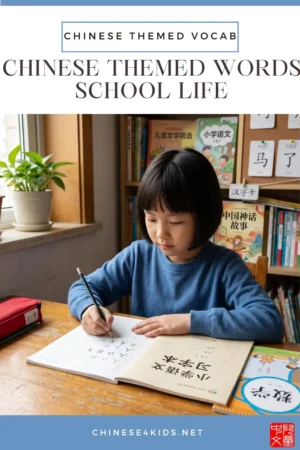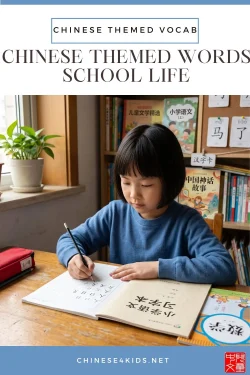

School is where children spend most of their waking hours. It’s also one of the domains where heritage language learners most commonly feel their Mandarin is useless — because English is the language of school, and Chinese doesn’t seem to fit.
This cluster directly addresses that. Thirty words across three themes — classroom objects, people in school, school subjects — give children a Chinese vocabulary for the environment they already know best.
Contents
hide
Why these themes belong together
These three themes cover the three fundamental categories of school experience: the objects around you (铅笔, 黑板), the people you interact with (老师, 同学), and what you study (数学, 科学). Together they form a complete school world in Chinese.
我的老师在黑板上写数学题。我的同学用铅笔做笔记。
Wǒ de lǎoshī zài hēibǎn shàng xiě shùxué tí. Wǒ de tóngxué yòng qiānbǐ zuò bǐjì.
My teacher writes math problems on the blackboard. My classmate takes notes with a pencil.
People (老师, 同学), objects (黑板, 铅笔), and subjects (数学) — all three themes in two sentences describing a normal school moment.
教室物品 | Classroom Objects
Classroom objects give children a Chinese vocabulary for the environment they already know best. A pencil is 铅笔, the blackboard is 黑板, the notebook is 笔记本 — words they can use immediately in Chinese class or when describing their school day.
▶️ Watch: hear all 10 words in native Mandarin
The 10 words:
| Chinese | Pinyin | English |
|---|---|---|
| 书 | shū | Book |
| 笔 | bǐ | Pen / Writing instrument |
| 本子 | běnzi | Notebook |
| 桌子 | zhuōzi | Table / Desk |
| 椅子 | yǐzi | Chair |
| 黑板 | hēibǎn | Blackboard |
| 剪刀 | jiǎndāo | scissors |
| 胶水 | jiāoshuǐ | glue |
| 纸 | zhǐ | Paper |
| 窗户 | chuānghu | Window |
Example sentences:
| Sentence | Pinyin | English |
|---|---|---|
| 我喜欢看书。 | Wǒ xǐhuān kàn shū. | I like to read books. |
| 请坐在这把椅子上。 | Qǐng zuò zài zhè bǎ yǐzi shàng. | Please sit on this chair. |
| 请打开窗户。 | Qǐng dǎkāi chuānghu. | Please open the window. |
🃏 Get the 教室物品 | Classroom Objects Flashcard Set — €5 → Montessori 3-part cards + sentence cards + audio. Instant download, €5.
学校人员 | People in the School
School community vocabulary helps children talk about the people in their school life in Mandarin — teachers, classmates, the principal. These are the relationships that shape a child’s day, and having Chinese words for them matters.
▶️ Watch: hear all 10 words in native Mandarin
The 10 words:
| Chinese | Pinyin | English |
|---|---|---|
| 老师 | lǎoshī | Teacher |
| 学生 | xuéshēng | Student |
| 同学 | tóngxué | Classmate |
| 校长 | xiàozhǎng | Principal / Headmaster |
| 门卫 | ménwèi | Gatekeeper / Security Guard |
| 图书管理员 | túshū guǎnlǐ yuán | Librarian |
| 护士 | hùshi | Nurse (School Nurse) |
| 办公室秘书 | bàngōngshì mìshū | Office Secretary |
| 清洁工 | qīngjié gōng | Cleaner / Janitor |
| 餐厅服务员 | cāntīng fúwùyuán | Cafeteria Server / Dining Staff |
Example sentences:
| Sentence | Pinyin | English |
|---|---|---|
| 老师教我们汉语。 | Lǎoshī jiāo wǒmen Hànyǔ. | The teacher teaches us Chinese. |
| 门卫叔叔人很好。 | Ménwèi shūshu rén hěn hǎo. | The gatekeeper (uncle) is very nice. |
| 餐厅服务员给我们打饭。 | Cāntīng fúwùyuán gěi wǒmen dǎ fàn. | The cafeteria server serves us food. |
🃏 Get the 学校人员 | People in the School Flashcard Set — €5 → Montessori 3-part cards + sentence cards + audio. Instant download, €5.
学校科目 | School Subjects
School subject vocabulary is highly practical for children attending Chinese school or tutoring sessions. Knowing how to say 数学, 科学, and 美术 in Mandarin lets children talk about their timetable and their favourite lessons.
▶️ Watch: hear all 10 words in native Mandarin
The 10 words:
| Chinese | Pinyin | English |
|---|---|---|
| 课 | kè | Class / Lesson |
| 汉语 / 中文 | Hànyǔ / Zhōngwén | Chinese language |
| 英语 | Yīngyǔ | English language |
| 数学 | shùxué | Mathematics |
| 科学 | kēxué | Science |
| 历史 | lìshǐ | History |
| 地理 | dìlǐ | Geography |
| 音乐 | yīnyuè | Music |
| 美术 | měishù | Art |
| 体育 | tǐyù | Physical Education (PE) |
Example sentences:
| Sentence | Pinyin | English |
|---|---|---|
| 我们现在上课。 | Wǒmen xiànzài shàng kè. | We are having class now. |
| 科学很有意思。 | Kēxué hěn yǒu yìsi. | Science is very interesting. |
| 我们下午有体育课。 | Wǒmen xiàwǔ yǒu tǐyù kè. | We have PE class in the afternoon. |
🃏 Get the 学校科目 | School Subjects Flashcard Set — €5 → Montessori 3-part cards + sentence cards + audio. Instant download, €5.
What can your child do with these 30 words?
Not fluent conversation — that’s unrealistic at this stage. But after this cluster, your child or student can:
✅ Name their classroom objects in Chinese — pencil, blackboard, notebook, ruler
✅ Talk about the people in their school in Mandarin — teacher, classmate, principal
✅ Name their school subjects in Chinese and say which ones they like
✅ Describe a school moment entirely in Mandarin (我的老师在黑板上写数学题)
✅ Feel that Chinese is a language that works at school, not just at home
Thirty words seems small. But the shift it creates — Chinese belonging at school, not just at home — is significant.
How to actually get these words to stick
Many parents and teachers think “show the word, say the word, done.” But getting words to the point where a child spontaneously uses them takes three layers:
Input layer — daily exposure. 5–10 minutes a day of these words in conversation, songs, picture books, or flashcards.
Interaction layer — the parent or teacher asks using these words, and the child responds. Even a one-word answer counts. Don’t demand full sentences yet.
Application layer — the child uses the words unprompted. This is the real “knows it” benchmark.
Most overseas families get stuck at layer 2 — the child is asked in Chinese but answers in English. This isn’t the child’s failure; it’s a missing tool.
For parents who don’t speak Mandarin themselves
If you want your child to learn Mandarin but don’t speak it fluently yourself: don’t give up. Speak Chinese with Kids was built for exactly this situation. Each daily-life scenario comes with 30 of the most useful Mandarin sentences, complete with audio and video. You don’t need to know any Chinese to use it — you read along with the audio. Combined with these flashcard themes, you and your child can start learning together at home.
Learn more about Speak Chinese with Kids →
Putting it all together
Home is where language lives or dies for overseas children. Not in the classroom, not in the textbook — at home, in the morning, in the evening, in the small moments that happen every day without planning. These 60 words turn those moments into Mandarin.
Get the Full Bundle — €79 → Or browse all 30 individual themes from €5 each.
→ Cluster 1: All About Me (family members, body parts, personal pronouns, emotions)
→ Cluster 2: Building Blocks (numbers, colors, action verbs)
→ Cluster 3: Food & Meals — the most natural Mandarin context for overseas Chinese families
→ Cluster 4: Home & Daily Life — wiring Mandarin into the daily routine
→ Cluster 5: School Life — words your child can use today
→ Cluster 6: The World Outside — animals, transportation, places, nature
Each cluster has its own complete guide with vocabulary, sentences, and teaching tips.
If you like this post, share it