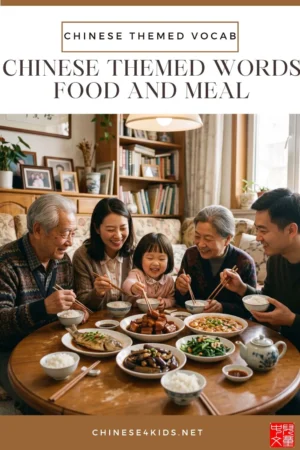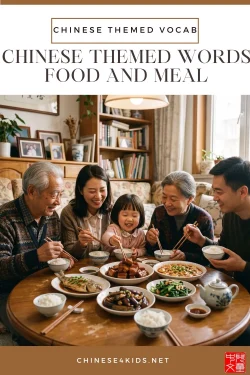
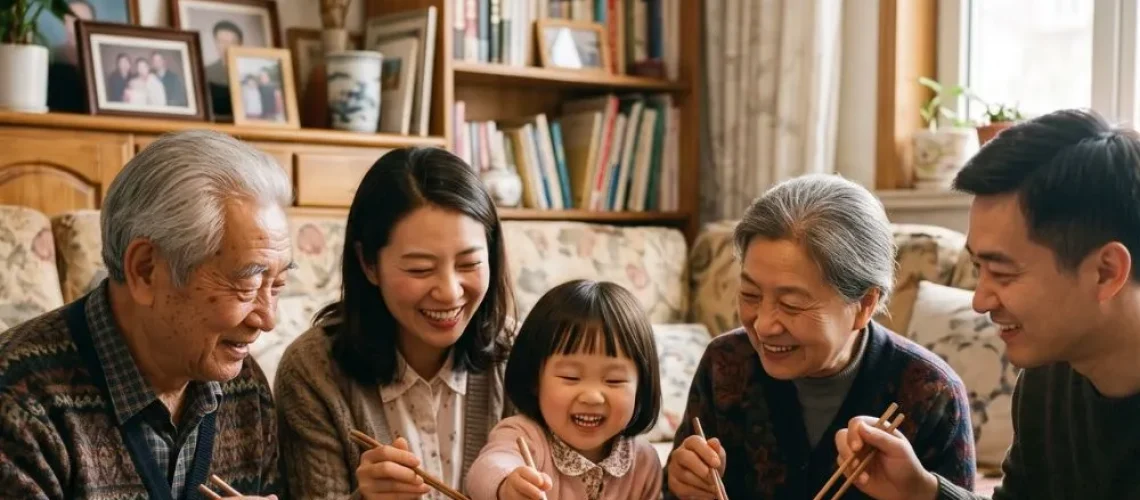
Three times a day, your family sits down to eat. If Chinese is spoken in your home, those three moments are among the most natural opportunities to use Mandarin that exist — because the objects are right there, the routines are already in place, and the emotional associations with food and family are among the strongest in any culture.
This cluster covers 50 words across 5 food themes. Every single word can be used at the dinner table tonight.
Contents
hide
Why these themes belong together
Food vocabulary doesn’t work in isolation. You can learn 苹果 (apple) in Week 1 and 筷子 (chopsticks) in Week 8 and they’ll feel like unrelated facts. But when you learn food, fruit, vegetables, mealtime words, and tableware together, something clicks: a child can now describe a full mealtime scene in Chinese.
我想吃红色的苹果和炒饭。请把筷子递给我。
Wǒ xiǎng chī hóngsè de píngguǒ hé chǎofàn. Qǐng bǎ kuàizi dì gěi wǒ.
I want to eat red apples and fried rice. Please pass me the chopsticks.
Fruit (苹果), food (炒饭), and tableware (筷子) — three themes in two sentences. Add colors from Cluster 2 (红色的苹果) and a child can describe the whole table.
食物和饮料 | Food and Drinks
Food and drink words are the most immediately usable vocabulary for overseas Chinese families because the context is already there: three times a day, every day. These 10 words can all be used at the dinner table tonight.
▶️ Watch: hear all 10 words in native Mandarin
The 10 words:
| Chinese | Pinyin | English |
|---|---|---|
| 水 | shuǐ | Water |
| 米饭 | mǐfàn | Cooked rice |
| 面条 | miàntiáo | Noodles |
| 苹果 | píngguǒ | Apple |
| 菜 | cài | Vegetable / Dish |
| 肉 | ròu | Meat |
| 鸡蛋 | jīdàn | Egg (chicken egg) |
| 面包 | miànbāo | Bread |
| 茶 | chá | Tea |
| 牛奶 | niúnǎi | Milk (cow’s milk) |
Example sentences:
| Sentence | Pinyin | English |
|---|---|---|
| 我要喝水。 | Wǒ yào hē shuǐ. | I want to drink water. |
| 你喜欢吃什么菜? | Nǐ xǐhuān chī shénme cài? | What vegetables/dishes do you like to eat? |
| 妹妹每天喝牛奶。 | Mèimei měitiān hē niúnǎi. | Little sister drinks milk every day. |
🃏 Get the 食物和饮料 | Food and Drinks Flashcard Set — €5 → Montessori 3-part cards + sentence cards + audio. Instant download, €5.
水果 | Fruit
Fruit vocabulary is a favourite for young learners — colourful, familiar, and easy to point at. Each word in this theme connects to real objects children see at the supermarket, on the table, and in their lunchbox.
▶️ Watch: hear all 10 words in native Mandarin
The 10 words:
| Chinese | Pinyin | English |
|---|---|---|
| 苹果 | píngguǒ | Apple |
| 香蕉 | xiāngjiāo | Banana |
| 葡萄 | pútao | Grape(s) |
| 西瓜 | xīguā | Watermelon |
| 草莓 | cǎoméi | Strawberry |
| 橙子 | chéngzi | Orange |
| 梨 | lí | Pear |
| 桃子 | táozi | Peach |
| 芒果 | mángguǒ | Mango |
| 柠檬 | níngméng | Lemon |
Example sentences:
| Sentence | Pinyin | English |
|---|---|---|
| 我喜欢吃苹果。 | Wǒ xǐhuān chī píngguǒ. | I like to eat apples. |
| 草莓是红色的。 | Cǎoméi shì hóngsè de. | Strawberries are red. |
| 柠檬很酸。 | Níngméng hěn suān. | Lemons are very sour. |
🃏 Get the 水果 | Fruit Flashcard Set — €5 → Montessori 3-part cards + sentence cards + audio. Instant download, €5.
蔬菜 | Vegetables
Vegetables extend the food vocabulary set into cooking, shopping, and mealtimes — contexts where Mandarin can be used naturally every day. Each word is shown in a sentence that puts it in a real kitchen or dining context.
▶️ Watch: hear all 10 words in native Mandarin
The 10 words:
| Chinese | Pinyin | English |
|---|---|---|
| 白菜 | báicài | Chinese Cabbage / Bok Choy |
| 胡萝卜 | húluóbo | Carrot |
| 土豆 | tǔdòu | Potato |
| 番茄 | fānqié | Tomato |
| 黄瓜 | huángguā | Cucumber |
| 菠菜 | bōcài | Spinach |
| 茄子 | qiézi | Eggplant / Aubergine |
| 青椒 | qīngjiāo | Green Pepper |
| 洋葱 | yángcōng | Onion |
| 南瓜 | nánguā | Pumpkin / Squash |
Example sentences:
| Sentence | Pinyin | English |
|---|---|---|
| 我喜欢吃炒白菜。 | Wǒ xǐhuān chī chǎo báicài. | I like to eat stir-fried Chinese cabbage. |
| 黄瓜很爽口。 | Huángguā hěn shuǎngkǒu. | Cucumbers are very refreshing/crisp. |
| 秋天有南瓜。 | Qiūtiān yǒu nánguā. | There are pumpkins in autumn. |
🃏 Get the 蔬菜 | Vegetables Flashcard Set — €5 → Montessori 3-part cards + sentence cards + audio. Instant download, €5.
用餐和用餐时间 | Meals and Meal Times
Meal and mealtime words are among the highest-frequency words in any Chinese household. 早饭, 午饭, 晚饭 — these three alone anchor the entire daily routine in Mandarin if used consistently.
▶️ Watch: hear all 10 words in native Mandarin
The 10 words:
| Chinese | Pinyin | English |
|---|---|---|
| 饭 | fàn | Meal / Cooked rice |
| 早饭 | zǎofàn | Breakfast |
| 午饭 | wǔfàn | Lunch |
| 晚饭 | wǎnfàn | Dinner |
| 吃 | chī | To eat |
| 喝 | hē | To drink |
| 早上 | zǎoshang | Morning |
| 中午 | zhōngwǔ | Noon / Midday |
| 晚上 | wǎnshang | Evening / Night |
| 点心 | diǎnxin | Snack / Dim Sum |
Example sentences:
| Sentence | Pinyin | English |
|---|---|---|
| 你吃饭了吗? | Nǐ chī fàn le ma? | Have you eaten? |
| 我喜欢吃苹果。 | Wǒ xǐhuān chī píngguǒ. | I like to eat apples. |
| 我喜欢点心。 | Wǒ xǐhuān diǎnxin. | I like snacks / dim sum. |
🃏 Get the 用餐和用餐时间 | Meals and Meal Times Flashcard Set — €5 → Montessori 3-part cards + sentence cards + audio. Instant download, €5.
餐具 |Tableware
Tableware vocabulary connects directly to Chinese cultural practice — chopsticks, tea sets, rice bowls. Teaching these words alongside food vocabulary gives children a complete picture of the Chinese table.
▶️ Watch: hear all 10 words in native Mandarin
The 10 words:
| Chinese | Pinyin | English |
|---|---|---|
| 碗 | wǎn | Bowl |
| 盘子 | pánzi | Plate |
| 筷子 | kuàizi | Chopsticks |
| 勺子 | sháozi | Spoon / Ladle |
| 叉子 | chāzi | Fork |
| 刀子 | dāozi | Knife |
| 杯子 | bēizi | Cup / Glass |
| 餐巾 | cānjīn | Napkin (table) |
| 茶壶 | cháhú | Teapot |
| 碟子 | diézi | Small plate / Saucer |
Example sentences:
| Sentence | Pinyin | English |
|---|---|---|
| 我用碗吃饭。 | Wǒ yòng wǎn chī fàn. | I use a bowl to eat (rice/meal). |
| 这是叉子。 | Zhè shì chāzi. | This is a fork. |
| 我需要一个小碟子。 | Wǒ xūyào yí ge xiǎo diézi. | I need a small plate/saucer. |
🃏 Get the 餐具 |Tableware Flashcard Set — €5 → Montessori 3-part cards + sentence cards + audio. Instant download, €5.
What can your child do with these 50 words?
Not fluent conversation — that’s unrealistic at this stage. But after this cluster, your child or student can:
✅ Name the foods, fruit, and vegetables on the table in Chinese
✅ Use mealtime words (早饭, 午饭, 晚饭) to structure the daily routine in Mandarin
✅ Ask and answer basic food questions: 你想吃什么?我想吃…
✅ Name the tableware on the table — chopsticks, bowls, teapot — connecting language to Chinese cultural practice
✅ Describe a full mealtime scene in Chinese, combining words from multiple themes
The dinner table already exists. These 50 words just give it a Chinese voice.
How to actually get these words to stick
Many parents and teachers think “show the word, say the word, done.” But getting words to the point where a child spontaneously uses them takes three layers:
Input layer — daily exposure. 5–10 minutes a day of these words in conversation, songs, picture books, or flashcards.
Interaction layer — the parent or teacher asks using these words, and the child responds. Even a one-word answer counts. Don’t demand full sentences yet.
Application layer — the child uses the words unprompted. This is the real “knows it” benchmark.
Most overseas families get stuck at layer 2 — the child is asked in Chinese but answers in English. This isn’t the child’s failure; it’s a missing tool.
For parents who don’t speak Mandarin themselves
If you want your child to learn Mandarin but don’t speak it fluently yourself: don’t give up. Speak Chinese with Kids was built for exactly this situation. Each daily-life scenario comes with 30 of the most useful Mandarin sentences, complete with audio and video. You don’t need to know any Chinese to use it — you read along with the audio. Combined with these flashcard themes, you and your child can start learning together at home.
Learn more about Speak Chinese with Kids →
Putting it all together
The dinner table is the oldest and most reliable Chinese classroom overseas families have. Three meals a day, every day, for years — if the words are there, the language follows. These 50 words are the ones to start with.
Get the Full Bundle — €79 → Or browse all 30 individual themes from €5 each.
→ Cluster 1: All About Me (family members, body parts, personal pronouns, emotions)
→ Cluster 2: Building Blocks (numbers, colors, action verbs)
→ Cluster 3: Food & Meals — the most natural Mandarin context for overseas Chinese families
→ Cluster 4: Home & Daily Life — wiring Mandarin into the daily routine
→ Cluster 5: School Life — words your child can use today
→ Cluster 6: The World Outside — animals, transportation, places, nature
Each cluster has its own complete guide with vocabulary, sentences, and teaching tips.
If you like this article, share it