Quick Answer: What Chinese Sayings Teach Us About Effort
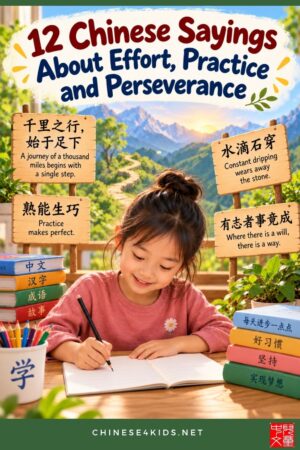
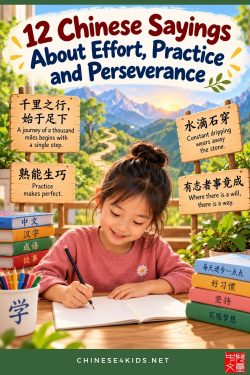
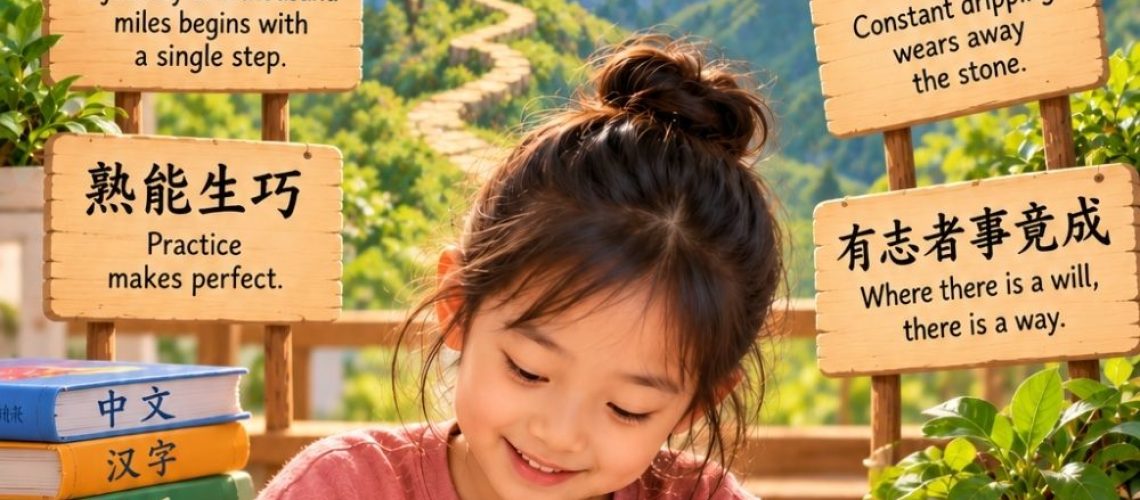
Chinese sayings offer short, memorable lessons about learning, working hard and building good habits. Expressions such as 熟能生巧 (shú néng shēng qiǎo), meaning “practice makes perfect,” and 水滴石穿 (shuǐ dī shí chuān), meaning “constant dripping wears away the stone,” remind us that progress often comes from small, repeated efforts. Others, like 勤能补拙 (qín néng bǔ zhuō), show that diligence can make up for a lack of skill.
Chinese sayings offer short, memorable lessons about learning, working hard and building good habits. Expressions such as 熟能生巧 (shú néng shēng qiǎo), meaning “practice makes perfect,” and 水滴石穿 (shuǐ dī shí chuān), meaning “constant dripping wears away the stone,” remind us that progress often comes from small, repeated efforts. Others, like 勤能补拙 (qín néng bǔ zhuō), show that diligence can make up for a lack of skill.
For children learning Mandarin, these sayings are useful for building vocabulary, talking about everyday experiences and understanding traditional Chinese wisdom. Parents and teachers can bring them to life through simple stories, classroom conversations and hands-on activities.
1. 千里之行,始于足下
Pinyin: Qiān lǐ zhī xíng, shǐ yú zú xià
Meaning: A journey of a thousand miles begins with a single step.
Key lesson: Start small and keep going.
This famous saying comes from the Dao De Jing (道德经), a classical Chinese text traditionally attributed to Laozi. It reminds us that even a big goal begins with one small action.
A child who wants to learn Chinese may feel overwhelmed by all the characters and vocabulary. Reading one short story, learning five new words or practicing for ten minutes is a good place to start.
Example: A student wants to learn to play the piano. Instead of worrying about playing a whole song, she begins by practicing a few notes each day.
Ask your child: What is one small step you can take today toward something you want to learn?
Chinese learning activity: Ask children to draw a large mountain. At the bottom, write their goal in Chinese, such as 学中文 (xué Zhōngwén), “learn Chinese.” Along the path to the top, let them add small steps, such as 学五个生词 (xué wǔ ge shēngcí), “learn five new words,” and 读一本书 (dú yì běn shū), “read a book.”
2. 熟能生巧
Pinyin: Shú néng shēng qiǎo
Meaning: Practice makes perfect.
Key lesson: Repeated practice helps us develop skill.
The more we practice something, the more familiar it becomes. Eventually, we can do it more quickly, smoothly and confidently.
Think about learning to ride a bicycle, write Chinese characters or pronounce a difficult Mandarin word. The first attempts may feel awkward. With practice, the movements and sounds become easier.
This saying is associated with the story of an oil seller in Ouyang Xiu’s Records of Returning to the Fields (《归田录》). The seller demonstrates his skill through long experience, showing that practice matters more than special tricks.
Example: A child struggles to write the character 木 (mù), meaning “tree.” After writing it several times and paying attention to the stroke order, the character becomes easier to remember.
Ask your child: What can you do now that was difficult when you first tried it?
Chinese learning activity: Choose five Chinese characters. Let children write each character three times, saying its pronunciation and meaning aloud. Compare their first and last attempts. The goal is to notice progress, not to produce perfect handwriting right away.
3. 水滴石穿
Pinyin: Shuǐ dī shí chuān
Meaning: Constant dripping wears away the stone.
Key lesson: Small, consistent efforts can make a big difference.
Imagine a drop of water falling on the same spot on a stone, again and again. One drop seems insignificant. Over time, repeated drops can wear the stone away.
The saying teaches us that persistence matters. Progress may be difficult to see from one day to the next, yet small efforts can add up to meaningful results.
Example: A child reads one Chinese sentence every evening. At first, reading takes a long time. After several weeks, the child recognizes more characters and reads with greater confidence.
Ask your child: What is something you could practice for five minutes every day?
Chinese learning activity: Create a seven-day Chinese learning chart. Children earn a mark each day they complete a short task, such as reading a sentence, reviewing flashcards or practicing a character. At the end of the week, discuss what they have learned.
4. 世上无难事,只怕有心人
Pinyin: Shì shàng wú nán shì, zhǐ pà yǒu xīn rén
Meaning: Nothing is too difficult for someone who is determined.
Key lesson: Face challenges with determination.
This widely used Chinese saying encourages people to approach difficulties with patience and commitment. It does not mean every task will be easy or that success is guaranteed. Rather, it reminds us that determination can help us find ways forward.
Children often run into challenges when learning a new language. They may forget words, confuse similar characters or struggle to understand a sentence. Encouraging them to try another approach can be more helpful than expecting immediate success.
Example: A student finds Chinese tones difficult. Instead of giving up, she listens to recordings, repeats short phrases and asks her teacher for feedback.
Ask your child: What could you try when something feels too difficult?
Chinese learning activity: Give children a simple challenge, such as remembering five new Chinese words. Let them choose their own strategy: drawing pictures, making flashcards, acting out the words or using them in sentences. Afterward, discuss which strategy helped most.
5. 有志者事竟成
Pinyin: Yǒu zhì zhě shì jìng chéng
Meaning: Where there is a will, there is a way.
Key lesson: Keep a clear goal in sight.
This saying comes from the Book of the Later Han (《后汉书》), a historical record of the Eastern Han dynasty. It appears in the account of the general Geng Yan (耿弇), whose determination eventually led to success. The saying expresses confidence in purposeful action and encourages people to stay focused on what they hope to achieve, even when the path takes longer than expected.
A goal becomes more manageable when we break it into smaller tasks and make a realistic plan.
Example: A child wants to read a simple Chinese story independently. She starts by learning the key vocabulary, then reads one paragraph at a time. Eventually, she can read the whole story.
Ask your child: What is one goal you would like to achieve this month? What steps could help you reach it?
Chinese learning activity: Let each child create a mini goal poster. Include the goal in English and Chinese, three small steps, and a date to review progress. Useful vocabulary includes 目标 (mùbiāo), “goal,” and 努力 (nǔlì), “to make an effort.”
6. 习惯成自然
Pinyin: Xí guàn chéng zì rán
Meaning: Habits become second nature.
Key lesson: Repeated actions can become part of our daily routine.
Some activities take considerable effort at first. Once they become habits, we often do them with less thought.
Reading before bed, putting away toys after playing or reviewing Chinese vocabulary after breakfast are examples of routines children can gradually develop.
The important point is to begin with something manageable. A short routine that a child can maintain is often more useful than an ambitious plan that quickly becomes exhausting.
Example: A family spends five minutes speaking Mandarin during dinner each evening. After a few weeks, asking and answering simple questions in Chinese feels more natural.
Ask your child: Which daily habit helps you learn or stay organized?
Chinese learning activity: Make a habit tracker with one simple Chinese task for each day. Children can color a square whenever they complete the task. At the end of the week, ask them which part of the routine felt easiest to maintain.
7. 欲速则不达
Pinyin: Yù sù zé bù dá
Meaning: Haste makes waste.
Key lesson: Rushing can prevent us from doing something well.
When we try to finish too quickly, we may overlook details, make avoidable mistakes or need to start again.
This saying is especially useful when teaching children to slow down, check their work and give themselves enough time to learn.
It does not mean we should always work slowly. It reminds us to choose a pace that allows us to do the task properly.
Example: A student rushes through a Chinese worksheet and makes several mistakes. The next time, she reads each question carefully and checks her answers before handing in the work.
Ask your child: Have you ever made a mistake because you were in too much of a hurry?
Chinese learning activity: Give children two minutes to copy a Chinese sentence, then give them another opportunity to copy it carefully without a strict time limit. Compare the results and discuss the difference between speed and accuracy.
8. 种瓜得瓜,种豆得豆
Pinyin: Zhòng guā dé guā, zhòng dòu dé dòu
Meaning: You reap what you sow.
Key lesson: The effort we put in shapes what we get out.
If you plant melon seeds, you expect melons to grow. If you plant bean seeds, you expect beans. The saying uses this familiar idea to show how our actions lead to results.
For children, it introduces the idea that preparation and steady effort usually make a difference. It is also worth explaining that results depend on circumstances, too. People can work hard and still face difficulties beyond their control.
Example: A student reviews vocabulary regularly before a Chinese test. She is better prepared to recognize the words than she would have been without reviewing them.
Ask your child: What might happen if you practice a little every day instead of waiting until the last minute?
Chinese learning activity: Let children plant fast-growing seeds in small pots. Ask them to observe what happens when the plants receive water and light. Use the experience to introduce Chinese words such as 种子 (zhǒngzi), “seed,” and 植物 (zhíwù), “plant.”
9. 智者千虑,必有一失
Pinyin: Zhì zhě qiān lǜ, bì yǒu yī shī
Meaning: Even a wise person can make a mistake.
Key lesson: Everyone makes mistakes, and mistakes can help us learn.
This saying reminds us that intelligence and experience do not make anyone perfect. Even someone who thinks carefully can overlook something or make a poor decision.
For children, this is a valuable message. A mistake does not mean they are incapable of learning. What matters is noticing what went wrong, understanding why and deciding what to do differently next time.
Example: A child writes the wrong Chinese character in a sentence. After checking the correct character, she notices the difference and remembers it more easily the next time.
Ask your child: What is something you learned after making a mistake?
Chinese learning activity: Create a “Mistakes Help Us Learn” board. Children can write or draw one mistake they made and one thing they learned from it. Keep the focus on learning and improvement rather than embarrassment.
10. 笨鸟先飞
Pinyin: Bèn niǎo xiān fēi
Meaning: The slow bird flies first.
Key lesson: Preparing early and putting in extra effort can help us reach our goals.
This saying uses the image of a bird that cannot fly as quickly as others. By starting earlier, it has a better chance of reaching its destination.
When explaining this saying to children, avoid using it to label anyone as slow or less intelligent. Its practical message is about preparation, planning and finding a strategy that works for you.
Example: A student knows that Chinese characters take her longer to remember. She begins reviewing a few days before a quiz instead of waiting until the night before.
Ask your child: What could you prepare in advance to make tomorrow easier?
Chinese learning activity: Give children a small task to complete, such as learning six new words. Ask them to make a two-day study plan. On the second day, let them review the words and reflect on how the early preparation helped.
<h2″>11. 勤能补拙
Pinyin: Qín néng bǔ zhuō
Meaning: Diligence makes up for a lack of skill.
Key lesson: Steady, hard work can close the gap when something doesn’t come easily.
The word 勤 (qín) means diligent, and 拙 (zhuō) means clumsy or lacking skill. Together, the saying tells us that regular effort can make up for what we don’t yet do well. It pairs naturally with 笨鸟先飞: one says to start early, the other says to keep working.
Every child finds some things harder than others. Instead of treating this as a weakness, the saying shows a practical way forward: keep going, a little at a time.
Example: A student finds Chinese tones harder than her classmates do. She practices ten minutes every day, and over several weeks her tones become clearer and more confident.
Ask your child: What is something that feels hard right now? What could you do each day to improve?
Chinese learning activity: Make an “effort jar.” Each time children practice something in Chinese, they write the task on a paper slip, such as 读书 (dú shū), “read,” or 写字 (xiě zì), “write characters,” and drop it in the jar. At the end of the week, read the slips together and notice how much effort has added up. You can also introduce 勤奋 (qínfèn), “diligent.”
12. 精诚所至,金石为开
Pinyin: Jīng chéng suǒ zhì, jīn shí wéi kāi
Meaning: Sincere dedication can move even metal and stone.
Key lesson: Deep commitment and persistent effort can help overcome obstacles.
The imagery is striking: even something as hard as metal or stone can be moved by genuine determination. The saying emphasizes wholehearted effort and sincerity.
In everyday life, this can mean taking a goal seriously, giving it sustained attention and continuing to work when progress is slow.
It is also worth reminding children that persistence sometimes means changing strategies or asking for help. Repeating the same unsuccessful action indefinitely is rarely the best solution.
Example: A child wants to improve her Chinese pronunciation. She listens carefully to a teacher, practices difficult sounds and asks for feedback until she feels more confident.
Ask your child: When you find something difficult, what helps you keep trying?
Chinese learning activity: Invite children to choose one Chinese word or phrase they find challenging. Let them practice it in several ways: listening, repeating, recording themselves and using it in a sentence. Ask them to identify which method helped most.
How to Teach Chinese Sayings About Effort and Perseverance
Chinese sayings are most meaningful when children can connect them to real experiences. Simply memorizing a Chinese expression and its English translation may help with vocabulary, but discussion and practical activities help children understand the message.
Here are four ways to use these sayings in a Chinese lesson or at home.
1. Start with a familiar situation
Describe something children have experienced, such as learning to ride a bicycle, practicing a musical instrument or trying to remember Chinese characters.
Ask what made the task difficult and what helped them improve. Then introduce a relevant saying, such as 熟能生巧 or 水滴石穿.
2. Connect the saying to a story
Read a short story about a character who faces a challenge. Pause at an important moment and ask children which Chinese saying might describe the situation.
Older learners can explain their choices in Mandarin or English.
3. Encourage children to use the sayings
Choose one saying each week. Write it on a classroom board, discuss its meaning and invite children to look for examples in their own lives.
They can also use the saying in a short dialogue, a journal entry or a simple comic strip.
4. Make a Chinese wisdom booklet
Let each child choose three or four favorite sayings. For each one, include the Chinese characters, pinyin, English meaning, an illustration and a personal example.
This creates a useful review resource and gives children a chance to practice reading, writing and speaking.
Frequently Asked Questions
What is a famous Chinese saying about hard work?
熟能生巧 (shú néng shēng qiǎo), meaning “practice makes perfect,” is a widely recognized Chinese expression about developing skill through practice. Another useful saying is 水滴石穿 (shuǐ dī shí chuān), which emphasizes the power of persistent effort over time.
What Chinese saying means never give up?
世上无难事,只怕有心人 (shì shàng wú nán shì, zhǐ pà yǒu xīn rén) encourages people to approach difficulties with determination. 有志者事竟成 (yǒu zhì zhě shì jìng chéng), meaning “where there is a will, there is a way,” also expresses confidence in purposeful effort.
Neither saying promises that every goal will be achieved. Both encourage people to keep trying and look for ways forward.
What Chinese saying means hard work makes up for lack of talent?
勤能补拙 (qín néng bǔ zhuō) means that diligence can make up for a lack of skill. 笨鸟先飞 (bèn niǎo xiān fēi), “the slow bird flies first,” carries a similar message about starting early and putting in extra effort.
How can parents teach Chinese sayings to children?
Start with one saying that relates to something your child is experiencing. Explain it in simple language, give a familiar example and ask an open-ended question. Drawing, storytelling, role-play and short writing activities can help children remember both the Chinese expression and its meaning.
Are Chinese sayings and Chinese proverbs the same?
The terms overlap. Some Chinese sayings are traditional folk proverbs, while others come from classical literature, historical stories or philosophical texts. Many are still used in everyday conversation, while others appear more often in writing or formal advice.
Should children memorize Chinese sayings?
Memorization can help children recognize Chinese characters, remember useful expressions and improve pronunciation. However, understanding the meaning and knowing when to use a saying are equally important. A child who can explain an expression in their own words has made a deeper connection with the language.
Final Thoughts
Learning Chinese sayings gives children more than a collection of memorable phrases. It introduces them to traditional Chinese ways of expressing ideas about effort, patience, habits and personal growth.
You do not need to teach all twelve sayings at once. Choose one that fits a child’s current experience, talk about its meaning and find a simple way to put it into practice.
A small step today can lead to a valuable lesson tomorrow.
Explore more Chinese learning resources:
- 16 Chinese Proverbs on Teaching and Learning
- 10 Motivational Quotes in Chinese
- Use Chinese Inspirational Posters in a Classroom to Create a Positive Chinese Learning Environment
For teachers and parents who want more ready-to-use Chinese learning materials, explore the Chinese4kids learning resources.
If you like this article, share it