School’s out! Summer is a time for fun, relaxation, and a break from schoolwork. But for kids learning Mandarin, a long break can mean they forget a lot of what they’ve learned. This is often called the “summer slide” (暑期滑坡).
summer slide
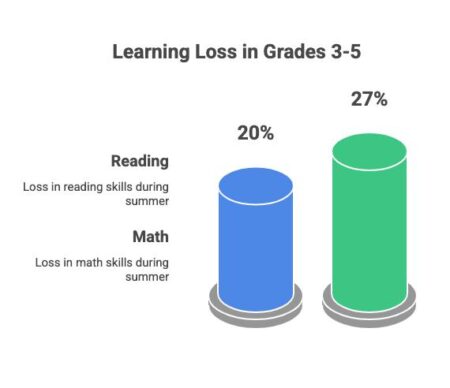
The summer slide is real, and it hits language learners hardest. Research shows that students can lose, on average, about a month’s worth of academic learning over the summer holidays — and for foreign-language learners, the loss is sharper. Mandarin relies on consistent exposure and practice. Without it, vocabulary fades, fluency dips, and confidence drops. When school starts again, children can feel frustrated trying to remember words and phrases that used to be easy.
The good news? You don’t have to turn summer into a boring boot camp to fix this. The goal isn’t to copy school with endless worksheets — that just leads to arguments. Instead, you can keep Mandarin fun this summer by weaving it into everyday life in playful, easy ways.
This guide is packed with practical tips that don’t need much supervision. You don’t even need to speak Mandarin yourself. Your job isn’t to be a teacher — it’s to create a fun environment where your child can naturally keep learning.
In this guide, you’ll find:
- A simple 3-step plan for your summer
- How to make your home a Chinese funhouse
- Screen-time tricks that turn cartoons into Chinese class
- Easy games and crafts that sneak in Mandarin
- Kitchen Chinese, outings, and “virtual trips” to China
- Structured options when you want to go deeper
- Quick answers to common parent questions
💡 Looking for what summer Chinese your child can learn? This guide focuses on how to keep Chinese going day to day. For what vocabulary, poems, songs, and festivals to teach, see our companion guide: Learn Chinese in Summer — A Complete Guide for Parents and Teachers.
Let’s turn this summer into a Mandarin adventure!
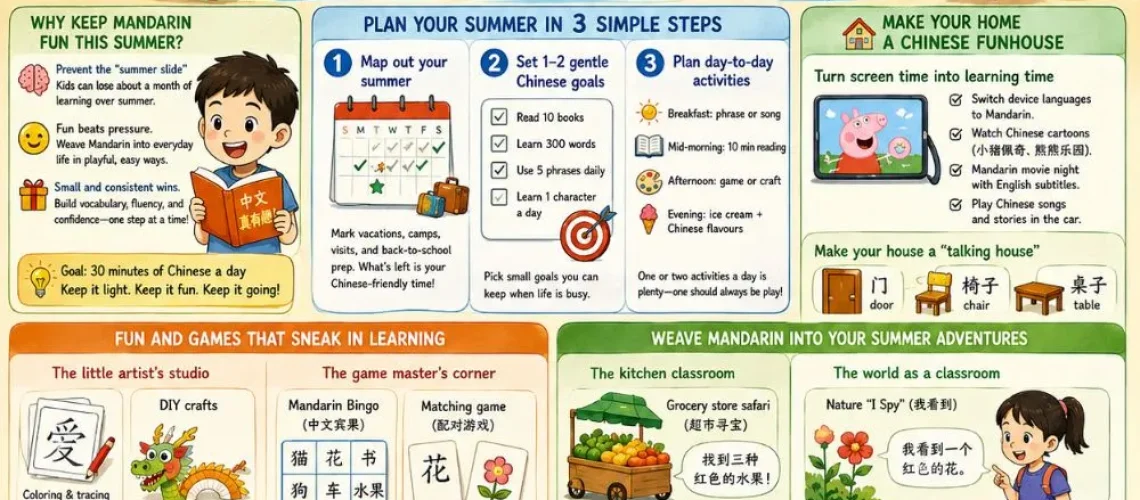
Plan Your Summer in 3 Simple Steps
Before the activities, a quick plan helps. Summer can feel long and unstructured. A loose plan gives you confidence — and your child a gentle rhythm.
Step 1: Map out your summer week by week
Get a calendar. Mark the school-free weeks. Block out family vacations, visits from grandparents, summer camps, and the “back to school prep” week at the very end. What’s left is your Chinese-friendly time — usually 4 to 8 weeks.
This single step usually brings a sense of control. You’ll see at a glance how much real time you have.
Step 2: Set 1–2 gentle Chinese goals
Don’t try to do everything. Pick one or two small goals for the summer:
A reading goal — read 10 levelled Chinese books or 10 minutes of Chinese reading every day
- A vocabulary goal — learn the 300 most common Chinese words through a course
- A speaking goal — use 5 new Chinese phrases at meals every day
- A character goal — learn one new character a day for 60 days
Pick goals you can keep when life is busy. Small and consistent beats big and abandoned.
Step 3: Plan day-to-day activities
Don’t overschedule. One or two Chinese activities a day is plenty — and one of them should always feel like play, not work.
A workable summer day might look like:
- 🍳 Breakfast: one new Chinese phrase or song
- 📖 Mid-morning: 10 minutes of Chinese reading
- 🎨 Afternoon: a craft, game, or scavenger hunt
- 🍦 Evening: ice cream + Chinese flavour names
That’s it. 30 minutes total. Easy.
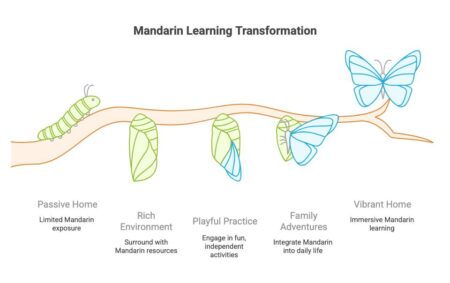
Make Your Home a Chinese Funhouse (打造沉浸式中文环境 )
The easiest way to keep Mandarin alive is to make it a part of your child’s surroundings. These simple tricks help your child absorb the language without even trying.
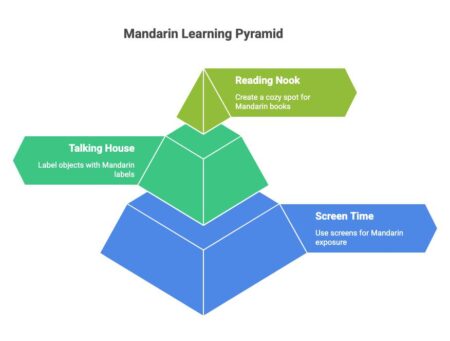
Turn Screen Time into Learning Time (数字保姆)
Let’s be real—kids love their screen time. Instead of fighting it, let’s use it for good!A few small changes can turn screens into a free language tutor.
- Switch device languages to Mandarin. Change the language settings on your child’s tablet, phone, or favourite apps. A super-simple way to expose them to useful, everyday words.
- Build a Chinese cartoon playlist. Start with shows they already love — Peppa Pig (小猪佩奇), PJ Masks (睡衣小英雄). Familiar stories make new language easier to understand. Try Chinese-original shows like Boonie Cubs (熊熊乐园), or learner-friendly channels like Miaomiao Kidz and Little Fox Chinese.
- Mandarin movie night. When you watch a family movie on Netflix or DVD, switch the audio to Mandarin. Keep English subtitles on to help with understanding.
- Background Chinese music and stories. Play Chinese children’s songs (儿歌) and audio stories during playtime or in the car. Your child gets used to the sounds and tones of Mandarin without any effort.
Make your house a “talking house” (会说话的房子)
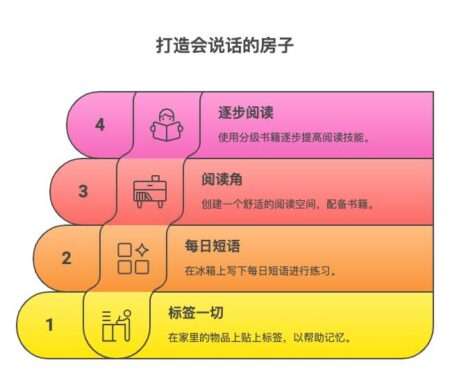
Turn your home into a living dictionary. When kids see Chinese characters next to real objects, the words stick naturally.
-
- Label everything. Use printable labels on objects around the house. Start with one room — the bedroom (卧室). Label the door (门), the table (桌子), the chair (椅子). Seeing these every day makes them stick.
- Phrase of the day. A small whiteboard on the fridge with one new phrase a day — I’m hungry (我饿了), Thank you (谢谢). Just 30 seconds to write and read.
- Build a cozy reading nook (阅读角). A comfy spot with pillows and a small bookshelf of Mandarin picture books. For beginners, our My First Chinese Reading series is perfect — levelled books that build confidence:
- Level aa: just 1–3 words per page with lots of repetition — perfect for the very first step
- Level A: simple, complete sentences about familiar topics
- Levels B and C: more words, varied sentences
Step-by-step reading makes reading feel like a fun achievement, not a chore.
Create a Cartoon Playlist:
On YouTube, make a playlist of cartoons in Mandarin. Start with shows they already love, like Peppa Pig (小猪佩奇) or PJ Masks (睡衣小英雄). The familiar stories make it easier to understand the new language. You can also add popular Chinese shows like Boonie Cubs (熊熊乐园) or channels made for learners, like Miaomiao Kidz and Little Fox Chinese.
Mandarin Movie Night:
When you watch a family movie on Netflix or DVD, switch the audio to Mandarin. You can keep the English subtitles on to help with understanding.
Listen to Chinese Music and Stories: Use Spotify or other music apps to play Chinese children’s songs (儿歌) and stories in the background during playtime or in the car. This helps your child get used to the sounds and tones of Mandarin without any effort.
Fun and Games That Sneak in Learning (玩中学,学中玩)
These activities feel like pure fun — but they’re secretly packed with language practice.
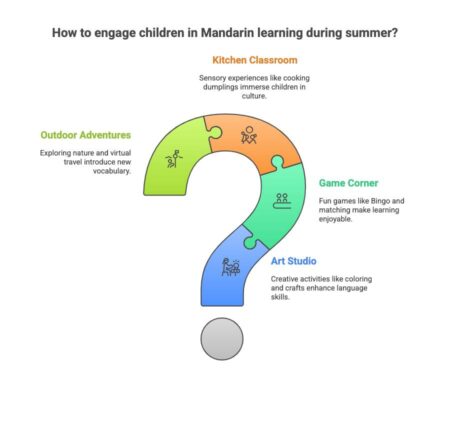
The Little Artist’s Studio (小艺术家工作室 )
Art is a quiet and creative way to practice Mandarin.
Coloring and Tracing:
Print coloring pages of Chinese characters for words like “love” (爱) or “friendship” (友谊) . You can also find “color-by-character” sheets where kids have to recognize the word for red (红) to color the picture correctly.Tracing worksheets teach character writing painlessly.
Easy DIY Crafts:
Prepare a few craft kits in bags so they’re ready to go.
- Paper Plate Dragon (纸盘龙): With a paper plate, colored paper, and googly eyes, kids can make a festive dragon, a lucky symbol in Chinese culture.
- Red Paper Lanterns (灯笼): This is a classic craft that just needs red paper, scissors, and a stapler. They make beautiful decorations!.
- Chinese Zodiac Wheel (十二生肖转盘): Find a printable zodiac wheel template. Kids can color the 12 animals (like the tiger 虎 or rabbit 兔), learn their names, and then spin the wheel to find their own sign .
The Game Master’s Corner (游戏大师的角落)
Games make learning feel like an adventure, not a chore.
- Mandarin Bingo (中文宾果):Use printable Bingo cards with Chinese characters or pictures. Call out the word in Mandarin and have kids find it on their card. This is great for listening skills.
- Matching Game (配对游戏):Make your own memory game with cards. Put a Chinese character on one card and a picture on another. Kids lay them face down and try to find the pairs. You can use online flashcard makers to create your own sets.
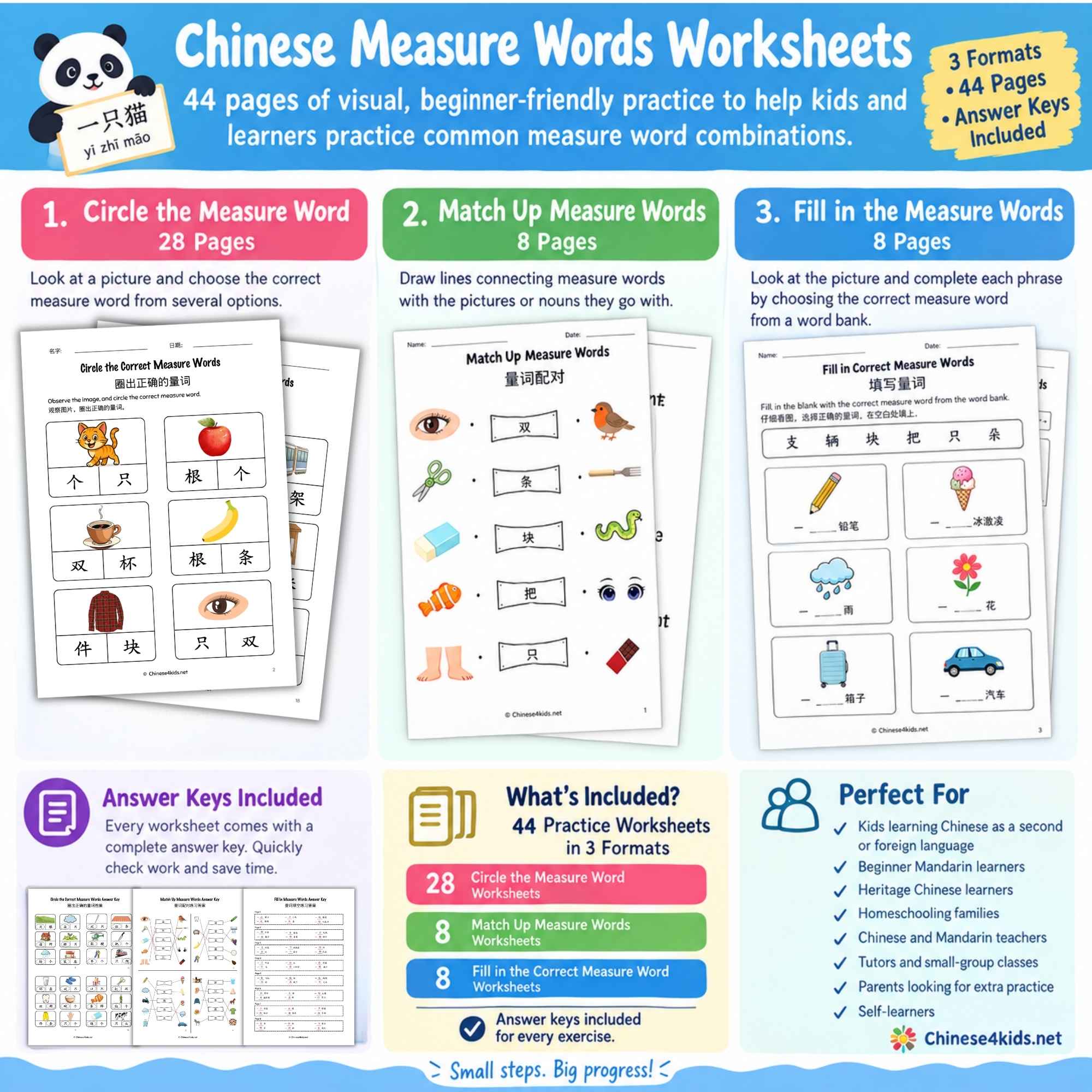
- Themed worksheets. Use themed vocabulary packs on seasons, animals, clothing, food. The Chinese4kids.net worksheets and printables library is perfect for busy parents who want fun materials with no prep work.
Weaving Mandarin into Your Summer Adventures (生活中的中文)
The best learning happens during everyday activities. Turn your summer outings into easy language lessons.
The Kitchen Classroom (美食课堂)
The kitchen is a fantastic place to learn. It uses all the senses!
- Grocery Store Safari (超市寻宝): Make your grocery trip a game. Ask your child, “Can you find three red fruits?” (找到三种红色的水果). This makes them actively search and use their vocabulary.
- Let’s Make Dumplings! (我们来包饺子吧!): Making dumplings (饺子) is a perfect family activity. It’s fun, hands-on, and a great way to learn about Chinese culture . Kids can help mix the filling and fold the wrappers. They’ll learn words for ingredients like pork (猪肉) and actions like fold (折) while making a delicious meal and a happy memory .
The World as a Classroom (世界大课堂)
Get outside! New places mean new words and new adventures.
Nature “I Spy” (我看到): On a walk, play “I Spy” in Mandarin. “我看到一个红色的花” ( I see a red flower). Simple sentences, real-world objects.
Take a Virtual Vacation (云游中国): Can’t fly to China? No problem! Take a virtual trip. Use Google Arts & Culture to explore the Great Wall (长城) . You can also watch short, animated videos about Chinese culture, like Chinese cuisine .
When You Want to Go Deeper — Structured Options
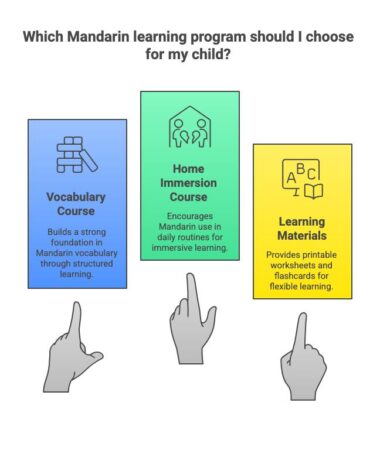
If you’re looking for more structured ways to boost your child’s Mandarin, Chinese4kids.net has some great programs designed to make learning systematic and fun.
Build Vocabulary from the Ground Up:
For kids who are ready to move beyond just picking up words, the Chinese Vocabulary Made Easy course is a great next step. This online course guides children through learning characters, then combining them into words, and finally using them in sentences.It’s a structured way to build a strong foundation.
Speak More Chinese at Home:
For parents who want to use more Mandarin in daily routines, the Speak Chinese with Kids course is a fantastic resource. It gives you hundreds of common sentences for everyday situations, helping you create a more immersive home environment even if you’re a beginner yourself.
A Library of Learning Materials:
Beyond courses, the site offers:
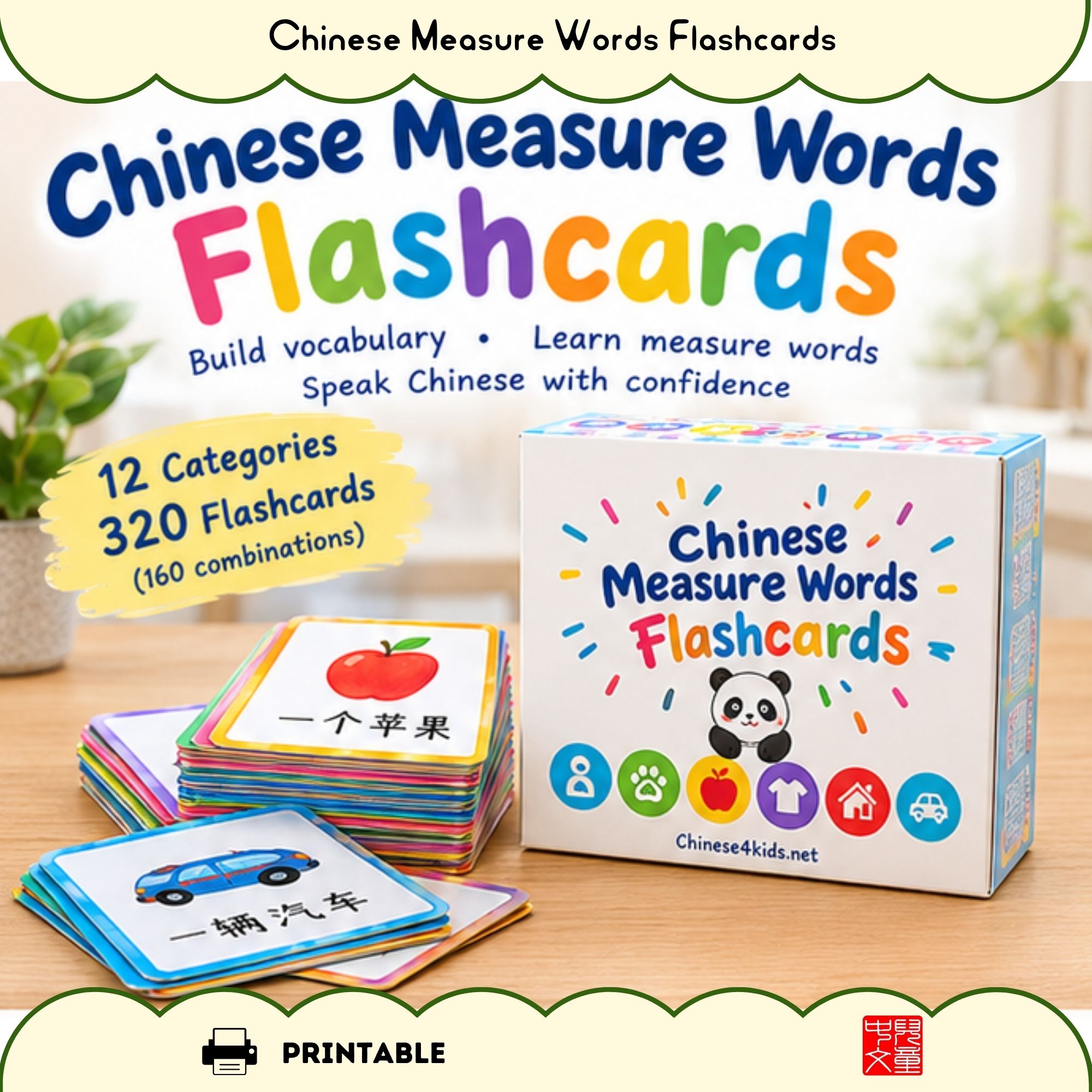
- 📚 Worksheets and printables in the shop — themed packs you can print today
- 🃏 Chinese Flashcards Hive — a huge library of vocabulary cards
- 📖 Chinese Reading Made Easy — the full levelled-reader vault, unlimited access
Perfect for parents and teachers who want quality materials ready to print and use.
Quick Answers — Common Parent Questions About Summer Mandarin
What is the “summer slide” in language learning?
The summer slide is the loss of language skills that happens when children stop practising over the long break. Research shows that students lose about a month’s worth of school-year progress over summer holidays on average — and for foreign languages like Mandarin, which depend on consistent exposure, the loss is sharper.
How do I prevent the Chinese summer slide?
The most effective approach is short, consistent, and fun. Aim for 15–30 minutes of Chinese a day — not all at once. Mix three things: a small amount of structured learning, daily reading (even 10 minutes counts), and one playful activity (a song, game, or craft). Consistency beats intensity.
I don’t speak Mandarin myself. Can I still help?
Yes. Your role is to create the environment, not to teach. Switch device languages to Mandarin. Play Chinese songs in the car. Label household objects. Use a course like Speak Chinese with Kids that gives you the phrases with audio — you just press play and copy. Many of the most effective parent strategies require no Mandarin fluency at all.
How much Chinese should my child do each day in summer?
A workable target is 20–30 minutes a day, split across two or three short activities. This is enough to prevent the summer slide and leave most of the day free for unstructured summer fun. Quality matters more than quantity.
What’s the single most effective summer Mandarin activity?
If you can only do one thing: daily Chinese reading. Even 10 minutes a day, every day, builds vocabulary, recognises characters, locks in tone, and creates the habit of seeing Chinese as something to enjoy — not study. Use levelled readers matched to your child’s stage.
Final Thought — Keep It Fun, Keep It Going
The best way to beat the summer slide is to make Mandarin a natural part of your summer fun. Don’t aim for perfection. Aim for consistent, light, and happy exposure.
Every little bit counts — whether it’s labelling a banana, singing a song, switching the cartoon language, or playing a Bingo round.
By making language learning a joyful part of your family’s summer, you give your child more than vocabulary. You give them confidence, curiosity, and a positive connection to Chinese culture. That’s a gift that lasts a lifetime.
Pick one habit from this guide. Just one. Start tomorrow. By the time school comes back, you’ll have built something real.
夏天来了!Make this summer fun, and Mandarin will follow.
Further Reading on Chinese4kids
- 📖 Learn Chinese in Summer — A Complete Guide for Parents and Teachers — the companion content hub: vocabulary, poems, festivals, products
- 📖 5 Chinese Learning Activities for Kids During Summer Holidays — five specific summer activities
- 📖 Summer Chinese Learning with 3-Part Montessori Flashcards — how to use Montessori flashcards
- 📖 Fun Color by Numbers Activities for Summer — coloring + Chinese
- 📖 3 Chinese Nursery Rhymes for Summer Time — lovely summer rhymes
- 📖 Building a Chinese Immersion Environment at Home — the year-round version of this guide
If you like this post, share it