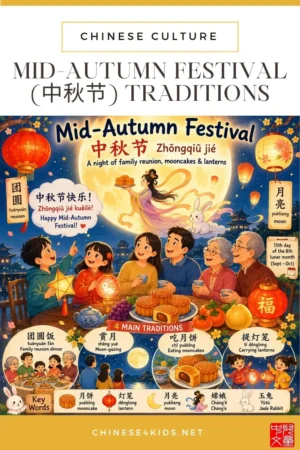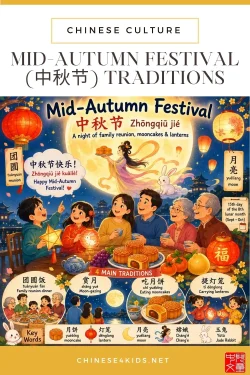
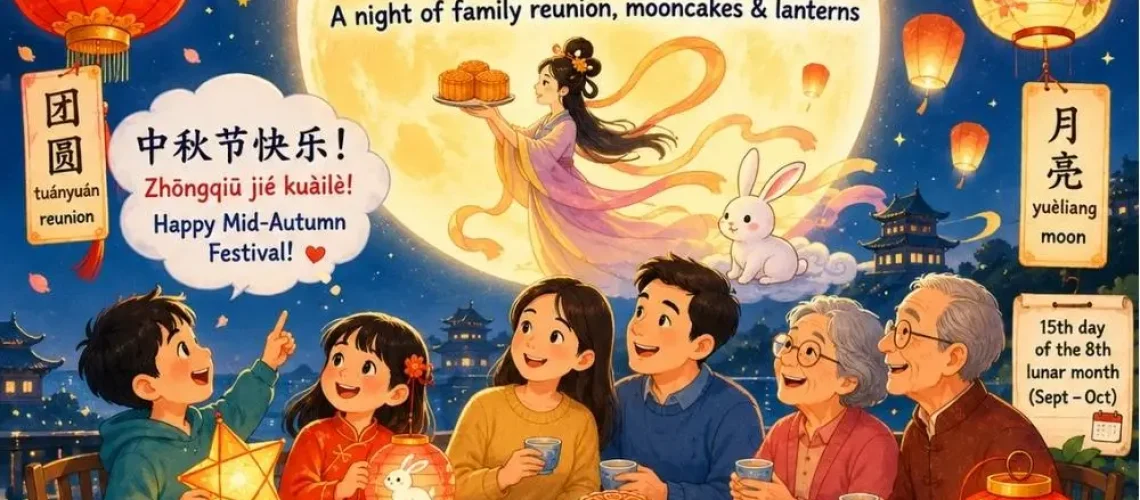
Mid-Autumn Festival (中秋节 Zhōngqiū jié) is a Chinese harvest festival on the 15th day of the 8th lunar month — a night of family reunion, moon-gazing, mooncakes, and lanterns that children in overseas Chinese families can celebrate and learn from wherever they live.
Mid-Autumn Festival Quick Facts
| Chinese name | 中秋节 |
| Pinyin | Zhōngqiū Jié |
| Also called | Moon Festival |
| When | 15th day of the 8th lunar month |
| Gregorian equivalent | September or early October |
| 2025 date | 6 October |
| 2026 date | 25 September |
| Main symbol | Full moon (圆月 yuányuè) |
| Must-have food | Mooncake (月饼 yuèbǐng) |
| Key traditions | Family reunion dinner, moon-gazing, mooncakes, lanterns |
| Famous legend | Chang’e (嫦娥) and Hou Yi (后羿) |
| Festival greeting | 中秋节快乐!(Zhōngqiū jié kuàilè!) |
What is Mid-Autumn Festival?
Mid-Autumn Festival is one of the most important traditional Chinese festivals. Chinese people call it 中秋节 (Zhōngqiū jié). It is also called the Moon Festival.
It is a time for families to come together. They eat, look at the moon, and share mooncakes. For Chinese families living overseas, it is a wonderful chance to connect children with Chinese culture and language.
Why Do Chinese Families Celebrate Mid-Autumn Festival?
This festival is about more than food and lanterns. It carries deeper meanings that are worth sharing with children.
Family reunion (团圆 tuányuán)
The full moon represents wholeness and togetherness. On this night, the wish is that every family member is together — or, if they cannot be, that they are looking at the same moon. The Chinese word 团圆 (tuányuán) means reunion. It is also the shape of the moon: round and complete.
Gratitude for the harvest
Mid-Autumn Festival has roots in ancient harvest celebrations. The 15th day of the 8th lunar month marks the height of autumn, when the harvest is in. Sharing food with family is a way of giving thanks for abundance.
Remembering loved ones far away
For overseas Chinese families, this meaning is especially powerful. Looking at the same moon connects people across continents. The poet Su Shi captured this over 900 years ago:
但愿人长久,千里共婵娟
Dàn yuàn rén chángjiǔ, qiānlǐ gòng chánjuān
“May we live long and share this beautiful moon, though thousands of miles apart.”
Children who grow up hearing this poem understand that Chinese culture holds family and belonging at its heart. The festival is a natural moment to talk about grandparents, extended family, and the places where Chinese is spoken.
Passing culture to the next generation
For families raising children outside China, Mid-Autumn Festival is one of the most accessible entry points into Chinese culture. It needs no special equipment. It does not require fluent Chinese. All it needs is a mooncake, a moon, and a few minutes outdoors together.
When is Mid-Autumn Festival?
Mid-Autumn Festival falls on the 15th day of the 8th month in the Chinese lunar calendar. This usually means September or early October in the Gregorian calendar.
On this night, the moon is full and believed to be at its brightest. That is why moon-gazing is such an important part of the celebration.
Upcoming Mid-Autumn Festival dates
| Year | Date (Gregorian) |
|---|---|
| 2026 | September 25 |
| 2027 | September 15 |
| 2028 | October 03 |
The Legend of Chang’e (嫦娥)
Like most Chinese festivals, Mid-Autumn Festival has a legend behind it. The most famous is the story of Chang’e (嫦娥 Cháng’é) and Hou Yi (后羿 Hòuyì).
Long ago, ten suns burned in the sky at once. The earth was scorched and crops were dying. Hou Yi was a skilled archer. He shot down nine of the suns and saved the people. As a reward, the Queen Mother of the West gave him an elixir of immortality.
Hou Yi did not want to become immortal without his wife Chang’e. He asked her to keep the elixir safe. One day, while Hou Yi was away, a student tried to steal it. Chang’e swallowed the elixir to protect it. She floated up to the moon and has lived there ever since.
Hou Yi was heartbroken. Every year on the night of the full moon, he laid out her favourite foods and hoped she could see him. This became the tradition of moon-gazing and offering food.
Children love this story. Reading it together is a natural way to start a Mid-Autumn Festival conversation in Chinese.
4 Main Traditions
1. Family Reunion Dinner (团圆饭 tuányuán fàn)
Families get together for a big dinner. They often eat outdoors so they can see the moon. The word 团圆 (tuányuán) means reunion — being round and complete, just like the full moon.
Foods vary by region. Common autumn foods include crabs, pumpkins, pomelos (柚子 yòuzi), grapes (葡萄 pútao), and pears (梨 lí).
2. Moon-Gazing (赏月 shǎng yuè)
After dinner, families sit outside and look at the moon together. They drink tea and chat. People who are far from home look at the same moon and think of their families.
3. Eating Mooncakes (吃月饼 chī yuèbǐng)
月饼 (yuèbǐng) — mooncake — is the must-have food of Mid-Autumn Festival. Its round shape represents completeness and togetherness.
Common fillings include red bean paste (红豆沙 hóngdòushā), lotus seed paste (莲蓉 liánróng), and five-nut filling (五仁 wǔrén). Modern flavours include matcha, chocolate, and ice-cream.
Cutting and sharing a mooncake together is a wonderful family activity. Let children say 月饼 (yuèbǐng) and 好吃!(hǎochī! — delicious!) as they eat.
4. Carrying Lanterns (提灯笼 tí dēnglong)
Children carry colourful lanterns after dark. The lanterns come in many shapes — rabbits, fish, stars, and flowers. Children can also float paper lanterns on water or write wishes on sky lanterns.
Making a simple lantern at home is an easy craft activity. It gives children something hands-on to look forward to each year.
How to Celebrate Mid-Autumn Festival at Home with Kids
You do not need a big party or elaborate preparation. Here is a simple evening that works for any family, anywhere in the world.
1. Tell the story of Chang’e. Read it aloud, watch a short video, or tell it in your own words. Ask your child: 你知道嫦娥的故事吗?(Do you know the story of Chang’e?)
2. Make or buy a lantern. Even a simple paper lantern counts. Let children decorate it. Teach them: 这是灯笼。(This is a lantern.)
3. Learn 5 Chinese words. Pick five from the vocabulary section below. Say them at dinner. Repeat them when you look at the moon.
4. Eat mooncakes together. Talk about the shape and the filling. Ask: 你喜欢哪个口味?(Which flavour do you like?)
5. Go outside after dark. Point at the moon. Say together: 月亮真圆!(The moon is so round!)
6. Say the festival greeting. Everyone says 中秋节快乐!(Zhōngqiū jié kuàilè!) — Happy Mid-Autumn Festival!
That is one complete Mid-Autumn Festival evening. It takes less than an hour and gives children a memory they will carry for years.
Key Mid-Autumn Festival Vocabulary
These are the most useful words and phrases for children to know.
中秋节 Zhōngqiū jié Mid-Autumn Festival月亮 yuèliang moon月饼 yuèbǐng mooncake灯笼 dēnglong lantern团圆 tuányuán reunion嫦娥 Cháng’é Chang’e (moon goddess)玉兔 Yùtù Jade Rabbit赏月 shǎng yuè admire the moon秋天 qiūtiān autumn圆 yuán round / complete
Want these as printable flashcards and writing worksheets? The Mid-Autumn Festival Vocabulary Learning pack includes A4 flashcard posters, writing practice sheets, and a one-page mini book — ready to download and use today.
Learning Activities for Kids
These activities work at home and in the classroom. They turn the festival into hands-on learning.
Make a paper lantern
— Cut, fold, and decorate. Children learn 灯笼 (dēnglong) and colour names while they craft.
Make or taste mooncakes
— Talk about the shapes, fillings, and the word 月饼 (yuèbǐng). Ask: 好吃吗?(Is it delicious?)
Learn the Chang’e story
— Tell it, draw it, or act it out. Key characters: 嫦娥、后羿、玉兔 (Chang’e, Hou Yi, Jade Rabbit).
Moon-gazing together
— Go outside after dark. Point at the moon and say 月亮圆圆的 (The moon is round). Ask: 你看到什么?(What do you see?)
Vocabulary matching game
— Print the vocabulary cards. Match Chinese characters to pictures. Great for ages 5–10.
Paste a moon journal page
— Draw the moon each night for a week around the festival. Label it in Chinese: 满月 (full moon), 半月 (half moon).
Phrases to Use at Home on Mid-Autumn Festival
You do not need to be fluent to use Chinese at home during this festival. A few simple phrases go a long way.
| Chinese | Pinyin | English |
|---|---|---|
| 中秋节快乐! | Zhōngqiū jié kuàilè! | Happy Mid-Autumn Festival! |
| 今天是中秋节。 | Jīntiān shì Zhōngqiū jié. | Today is Mid-Autumn Festival. |
| 我们一起赏月吧。 | Wǒmen yīqǐ shǎng yuè ba. | Let’s look at the moon together. |
| 月亮真圆! | Yuèliang zhēn yuán! | The moon is so round! |
| 你想吃月饼吗? | Nǐ xiǎng chī yuèbǐng ma? | Do you want to eat mooncake? |
| 好吃! | Hǎochī! | Delicious! |
| 我们团圆了。 | Wǒmen tuányuán le. | We are together / reunited. |
FOR PARENTS WHO WANT AUDIO-BACKED PHRASE
The Speak Chinese with Kids course gives you audio scripts and printable phrase guides for everyday moments just like this one — including festival scenes. You do not need to be fluent. You just follow along.
The Speak Chinese with Kids course gives you audio scripts and printable phrase guides for everyday moments just like this one — including festival scenes. You do not need to be fluent. You just follow along.
Mid-Autumn Festival vs Chinese New Year
These are the two most important traditional Chinese festivals. They are both about family reunion, but they feel quite different.
| Mid-Autumn Festival (中秋节) | Chinese New Year (春节) | |
|---|---|---|
| When | 15th day of 8th lunar month | 1st day of 1st lunar month |
| Season | Autumn (September / October) | Late winter (January / February) |
| Must-have food | Mooncakes (月饼) | Dumplings (饺子), glutinous rice cake (年糕) |
| Main symbol | Full moon | Red lanterns, firecrakers, dragon |
| Key tradition | Moon-gazing, family dinner | Red envelopes (红包), fireworks |
| Mood | Quiet, reflective, gentle | Festive, loud, celebratory |
| Famous legend | Chang’e and Hou Yi | Nián monster (年兽) |
| Public holiday | 1–3 days in most regions | 7+ days (Golden Week in China) |
Both festivals are excellent opportunities to use Chinese at home with children. Mid-Autumn Festival is often easier to celebrate overseas — it needs no special decoration, just mooncakes and a clear night sky.
Frequently Asked Questions
What do children do on Mid-Autumn Festival?
Children eat mooncakes, carry lanterns, look at the full moon, and hear the story of Chang’e and the Jade Rabbit. Many families also make lanterns or do themed crafts together.
What is the legend of Mid-Autumn Festival?
The most famous legend is about Chang’e (嫦娥), who swallowed an immortality elixir and flew to the moon. Her husband Hou Yi (后羿) was an archer who saved humanity by shooting down nine suns. Every year on the full moon, he set out her favourite foods hoping she could see him. The Jade Rabbit (玉兔) also lives on the moon with Chang’e.
What do you eat at Mid-Autumn Festival?
Mooncakes (月饼 yuèbǐng) are the essential food. Families also eat seasonal fruits such as pomelos (柚子), grapes (葡萄), pears (梨), and persimmons (柿子). Many regions have their own traditional foods too.
What is the difference between Mid-Autumn Festival and Moon Festival?
They are the same festival. “Moon Festival” is the common English translation. “Mid-Autumn Festival” is the more literal translation of 中秋节 (Zhōngqiū jié). Both names are widely used.
How do you say Happy Mid-Autumn Festival in Chinese?
中秋节快乐!(Zhōngqiū jié kuàilè!) — this is the most common greeting. You can also say 中秋快乐!for short.
Is Mid-Autumn Festival a public holiday?
Yes, in mainland China, Hong Kong, Taiwan, and many other places with significant Chinese populations. It is usually a one-to-three day public holiday.
How is Mid-Autumn Festival different from Chinese New Year?
Both festivals centre on family reunion, but they have different moods. Mid-Autumn Festival is quieter and more reflective — focused on the moon, mooncakes, and lanterns. Chinese New Year is more festive, with red envelopes, fireworks, and a week-long celebration.
Quick Summary
- Mid-Autumn Festival (中秋节) falls on the 15th day of the 8th lunar month — usually September or October.
- It celebrates family reunion, gratitude for the harvest, and the memory of loved ones far away.
- The four main traditions are: family reunion dinner, moon-gazing, mooncakes, and lanterns.
- The legend is about Chang’e (嫦娥) flying to the moon and the Jade Rabbit (玉兔) who lives beside her.
- Essential vocabulary: 月饼 (mooncake), 灯笼 (lantern), 月亮 (moon), 团圆 (reunion).
- Tell the story, make a lantern, learn 5 words, eat mooncake, go outside, say 中秋节快乐!
If you like, share it