Quick answer
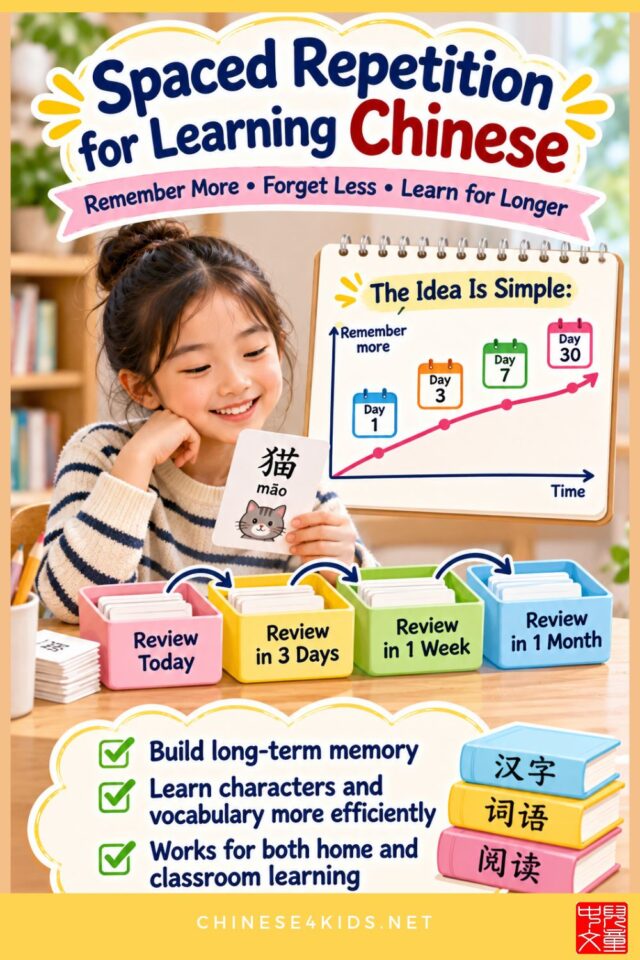
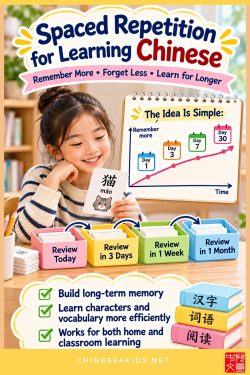
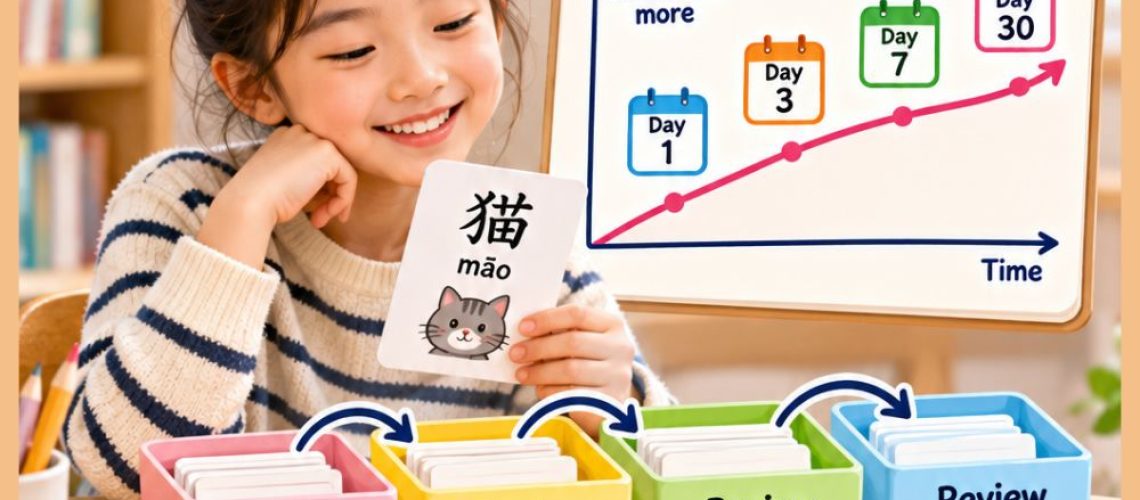
Spaced repetition means reviewing what children have learned at gradually increasing intervals, rather than practising everything in one long session. For example, after learning a set of Chinese words on Day 1, you might review them on Days 2, 4 and 6, then again a week later. This simple routine gives children several chances to remember vocabulary, characters and sentence patterns over time.
Every child forgets. Perhaps your child learned a new Chinese word on Monday, used it confidently during a lesson, but couldn’t remember it when you asked again on Friday. This can feel frustrating, especially when you’ve spent time practising together.
The good news is that forgetting is a normal part of learning. Children need opportunities to revisit new words and use them again before they become familiar. With a little planning, you can help them remember more without adding long study sessions to an already busy day.
That is where spaced repetition comes in. In this guide, you’ll find out what it is, why it works and how to use spaced repetition for Chinese learning with a simple schedule that suits busy families and classrooms.
What Is Spaced Repetition?
Spaced repetition is a way of reviewing material at increasing intervals of time. Imagine your child learns five new words on Monday. Instead of drilling them for an hour, you look at them briefly on Tuesday, again on Thursday and once more on Saturday. Each review is short, but each one gives your child another opportunity to remember what they have learned. The gaps between sessions matter too. Rather than repeating the same words again and again in one sitting, children return to them after some time has passed. Making an effort to remember can help strengthen learning, especially when practice is spread over several days.
Psychologists call the underlying finding the spacing effect: learning spread over time often leads to better retention than practice crammed into one session. Spaced repetition is the practical technique of using it. Researchers have studied the spacing effect since the late 1800s, when Hermann Ebbinghaus tested his own memory for lists of nonsense syllables.
Remember First, Then Check
The most useful reviews involve active recall. This means asking children to remember a word or character before showing them the answer.
For example, show your child the English word “apple” and invite them to say 苹果 (píngguǒ) in Chinese. Or show them the character 学 and ask if they remember its pronunciation and meaning. Give them a moment to think before offering a clue.
If they remember correctly, that’s a good sign. If they don’t, show them the answer, say it together and try again later. The aim is to give children a chance to think and remember, rather than simply look through a pile of cards. If a child glances at a card, reads the answer and says “I know that one”, the memory hasn’t really been tested.
Remembering doesn’t always have to mean producing the correct Chinese word immediately. For beginners, pointing to the right picture, choosing the correct character or matching a word to its meaning can also be useful forms of recall. As children become more confident, encourage them to say the word and use it in a phrase.
Once children get into the habit of trying to remember before checking, the next question is when they should review. This is where spacing makes a difference.
Why Spaced Review Works Better Than Cramming
When we learn something new, we tend to forget some of it unless we meet it again. Cramming can help for tomorrow’s quiz, but it rarely helps for next month.
Research supports the benefits of spaced learning. A large review of 317 experiments found that the time between review sessions can affect how well people remember information. Interestingly, the best interval depends partly on how long we want to remember what we have learned. If we want to retain something for longer, we generally need to leave longer gaps between some review sessions.
Studies with school-age children have also found benefits from spaced vocabulary practice, including in classroom settings. However, the results vary, and no single schedule works best for every learner. The important lesson is simple: spreading practice over time is generally more useful for long-term learning than trying to learn everything at once.
Spaced Repetition for Chinese Learning: A Simple Review Schedule
You don’t need special software. So, how often should children revisit new words? There is no perfect timetable, but the following schedule is a simple way to get started. You can use it for any new set of words, characters or sentences.
| When | What to do |
|---|---|
| Day 1 | Introduce a small set of new words or characters. |
| Day 2 | First review. Try to recall each item before checking. |
| Day 4 | Review again. Give extra attention to difficult items. |
| Day 6 | Review once more. Check which items are becoming familiar. |
| Day 13 | Review again, one week after Day 6. |
This is a sample schedule, not a fixed formula. If a child struggles with a word, bring it back sooner. If your child remembers a word easily over several reviews, you can wait a little longer before reviewing it again. The best schedule is one that matches what your child can actually remember.
How to Use Spaced Repetition for Chinese Vocabulary
Building vocabulary is an important part of learning Chinese, so it’s a good place to start.
- Start with a small list. A handful of words is better than a long list. Choose words that belong together, such as foods, animals or family members.
- Review on the schedule above. At each review, let your child say or point to the word first, then check the answer together.
- Sort the words as you go. Notice which words your child remembers and give the harder ones more attention next time.
- Finish with a lighter review. On the last review, focus mainly on the words that still feel unsteady. Children are often surprised by how many they remember.
Example: Learning Five Chinese Words About Food
Let’s put this into practice with a small set of familiar Chinese words. We’ll use five food words to show how the reviews can work over several days.
| Chinese | Pinyin | English |
|---|---|---|
| 苹果 | píngguǒ | apple |
| 香蕉 | xiāngjiāo | banana |
| 米饭 | mǐfàn | cooked rice |
| 面条 | miàntiáo | noodles |
| 鸡蛋 | jīdàn | egg |
| Day | Activity |
|---|---|
| Day 1 | Introduce the five words using pictures, pronunciation and meaning. Say each word aloud and let your child repeat it. |
| Day 2 | Show pictures and ask children to recall the Chinese words. |
| Day 4 | Show the Chinese characters. Ask children to match them to pictures and say the words aloud. |
| Day 6 | Play a matching game or use two or three words in simple phrases. |
| Day 13 | Review without hints. Notice which words are remembered and which need more practice. |
Keep the activity light. If your child forgets a word, simply practise it together and bring it back in the next review.
The Three-Pile Flashcard Method
The schedule above works well when you have a small list of words. But what happens when your child has dozens of flashcards to review? The three-pile method can make the job easier. It is a simple manual system inspired by spaced repetition, not a precise algorithm, and that is perfectly fine for home use. Make three piles.
| Pile | Which cards | How often |
|---|---|---|
| 1. Needs more practice | New cards or words your child often forgets. | Daily, or every one to two days |
| 2. Getting familiar | Words your child usually remembers. | Every two or three days |
| 3. Well remembered | Words your child remembers confidently. | About once a week |
- When your child remembers a card correctly on two separate reviews without a clue, move it to the next pile.
- If they forget it, move it back to Pile 1.
- Check Pile 3 cards occasionally too. A word that was easy last week may still need another review.
This gives your child a chance to show that they can remember a word more than once, rather than simply recognise it on a single occasion. Older children may enjoy using a spaced repetition app, but a simple set of cards works beautifully for young learners.
How to Use Spaced Repetition for Chinese Characters
Once children become familiar with vocabulary review, they can use the same approach to practise Chinese characters. There are a few additional things to consider, though.
Chinese characters can be challenging because children need to connect their written forms with pronunciation and meaning. Recognising a character is one skill. Remembering how to pronounce it and using it in a word or sentence are additional steps. It also helps to start with familiar words rather than isolated characters, because a character’s meaning and sound can depend on the word it appears in. For example, 学 (xué) means “to study” or “to learn”, while 学校 (xuéxiào) means “school”. Children can gradually learn to recognise the individual characters inside the words they already know.
Take 学校, for example. A child might recognise the written word but forget how to pronounce it. Another might remember the pronunciation but not recognise the characters. These are different skills, so it’s helpful to practise them in different ways.
- Recognise it: Show a familiar word such as 学校 and ask your child to identify its meaning.
- Say it: Show the word and ask your child to pronounce it.
- Recognise it from sound: Say the word aloud and ask your child to find the matching written word.
- Use it: Ask your child to use the word in a simple phrase or sentence.
- Write it: If character writing is part of your child’s learning goals, practise writing the characters too.
You don’t have to do all five activities every time. Choose one or two for each review and vary them over the week. If you’d like a structured path for learning characters, our Chinese Character Building Course offers three self-paced levels.
Spaced Repetition Beyond Words: Sentences, Songs and Rhymes
- Sentence patterns. When children learn a pattern such as 我喜欢…… (I like…), revisit it a few days later using different vocabulary. They might first say 我喜欢苹果 (I like apples), then try 我喜欢香蕉 (I like bananas). This helps children remember the pattern and use it with words they already know.
- Songs and rhymes. Singing a favourite song again a few days later is a lovely form of spaced review. Our guide to Chinese children’s songs shows how to teach and revisit songs.
Tips for Making Review Fun
- Keep it short. Five minutes can be enough for a quick review with young learners. If you’re practising several characters or working on a new sentence pattern, you may need a little longer. Short, regular sessions are usually easier to fit into family life than one long study session.
- Make it a game. Use matching games, flashcard races or a treasure hunt for words around the house. Review does not have to feel like a test.
- Fit it into your routine. Try a quick review at breakfast, in the car or before bed.
- Celebrate what they know. Start each review with a few easy words, so your child feels successful before the harder ones.
- Stay flexible. If a review day gets missed, simply pick up where you left off. A late review still helps.
Ready-Made Chinese Learning Resources
You don’t need an expensive app or a complicated system to start using spaced repetition. A small collection of flashcards, a simple review schedule and a few minutes of practice can go a long way.
Now that you have a simple review routine, you may want some materials to help you put it into practice. Here are a few resources to get you started.
- Chinese4Kids Membership and flashcards library: a portal for busy Chinese teachers and parents, including a library of Chinese learning flashcards that grows with new additions.
- Chinese learning worksheets collection: engaging worksheets and activity sheets for extra practice.
- Chinese Vocabulary Made Easy Course: for building vocabulary step by step.
- Speak Chinese with Kids Course: for using what your child has learned in spoken Chinese.
Frequently Asked Questions
Here are a few questions parents and teachers often ask about spaced repetition.
What is spaced repetition in simple words?
Spaced repetition means reviewing something you’ve learned several times, with gaps between each review. Instead of practising everything in one session, you return to it over several days or weeks. This gives your brain more opportunities to remember the information.
How many Chinese words should my child learn at a time?
Start small. Three to five new words in one session is a reasonable starting point for young beginners. The right number depends on your child’s age, level and familiarity with the topic. It’s better to remember a few words well than rush through a long list.
Do we need an app for spaced repetition?
No. You can use ordinary flashcards, a notebook or a simple review chart. Apps can organise reviews automatically, especially for older children, but they aren’t necessary. The important thing is to review regularly and try to remember before checking the answer.
Does spaced repetition work for Chinese characters?
Yes. You can use it to practise recognising characters, remembering their pronunciation and meaning, and using them in words and sentences. For young learners, start with familiar words and character recognition. Add writing practice when it suits your child’s learning goals.
What if my child forgets a word at every review?
Bring the word back more often and make the practice easier. Use a picture, gesture or familiar phrase to help your child understand it. You might also need to break the learning into smaller steps. Forgetting gives you useful information about what needs more attention.
Is reviewing enough to learn Chinese?
No. Reviewing helps children remember what they have learned, but they also need to meet the language in meaningful contexts. Combine flashcards with listening, speaking, reading, writing, games and everyday conversations. The aim is to help children use Chinese, not simply remember a stack of cards.
If you like this article, share it