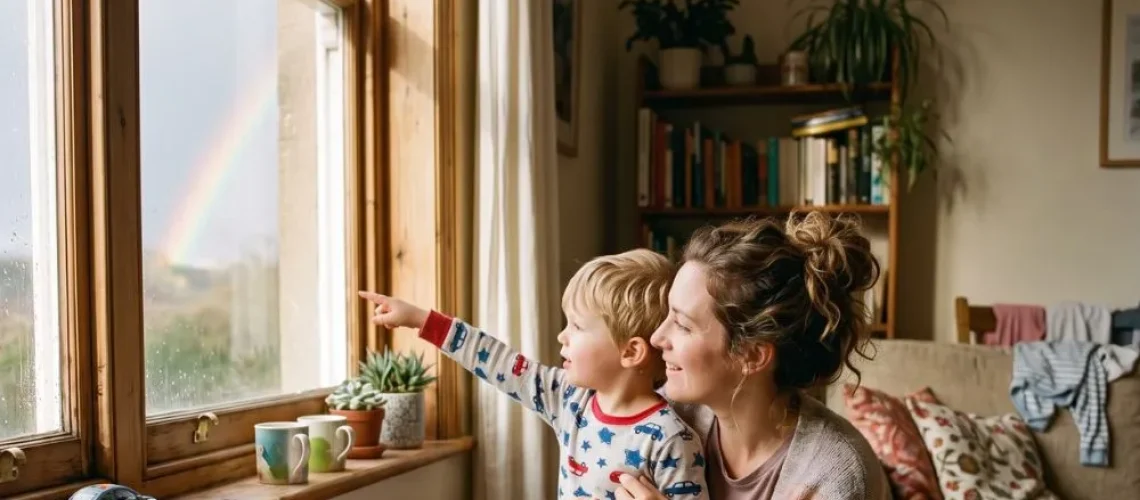
The most sustainable way to maintain Mandarin at home isn’t a lesson. It’s the morning routine spoken in Chinese. It’s pointing to the sofa and saying 沙发 instead of “sofa.” It’s asking 今天天气怎么样? while looking out the window.
This cluster covers 60 words across 6 themes — every one of them rooted in daily life at home. The goal isn’t to study these words. It’s to use them so often they stop feeling like vocabulary and start feeling like your house.
Contents
hide
Why these themes belong together
These six themes are all part of the same context: home, every day. A child who learns them together can describe a complete day in Chinese — waking up, getting dressed, noticing the weather, moving through the rooms, using the appliances, going to sleep. That narrative arc is what makes vocabulary memorable.
今天天气很冷。我穿上毛衣,然后去客厅开暖气。
Jīntiān tiānqì hěn lěng. Wǒ chuānshang máoyī, ránhòu qù kètīng kāi nuǎnqì.
Today’s weather is very cold. I put on a sweater, then went to the living room to turn on the heater.
Weather (冷), clothing (毛衣), rooms (客厅), and appliances (暖气) — four themes in two sentences. One winter morning, entirely in Chinese.
家里房间 | Rooms at home
Room vocabulary turns your home into a Mandarin learning environment. Point to the 客厅, walk into the 厨房, say goodnight from the 卧室 — the house becomes a language lesson without any formal teaching.
▶️ Watch: hear all 10 words in native Mandarin
The 10 words:
| Chinese | Pinyin | English |
|---|---|---|
| 房间 | fángjiān | Room |
| 厨房 | chúfáng | Kitchen |
| 卧室 | wòshì | Bedroom |
| 客厅 | kètīng | Living room |
| 卫生间 | wèishēngjiān | Bathroom / Toilet |
| 院子 | yuànzi | Yard / Courtyard |
| 餐厅 | cāntīng | Dining room / Restaurant |
| 书房 | shūfáng | Study (room) |
| 阳台 | yángtái | Balcony |
| 车库 | chēkù | Garage |
Example sentences:
| Sentence | Pinyin | English |
|---|---|---|
| 我的房间很干净。 | Wǒ de fángjiān hěn gānjìng. | My room is very clean. |
| 卫生间在哪里? | Wèishēngjiān zài nǎlǐ? | Where is the bathroom? |
| 车在车库里。 | Chē zài chēkù lǐ. | The car is in the garage. |
🃏 Get the 家里房间 | Rooms at home Flashcard Set — €5 → Montessori 3-part cards + sentence cards + audio. Instant download, €5.
天气 | Weather
Weather vocabulary is one of the easiest daily habits to build in Mandarin. 今天天气怎么样? (What’s the weather like today?) — one question asked every morning builds a habit that lasts.
▶️ Watch: hear all 10 words in native Mandarin
The 10 words:
| Chinese | Pinyin | English |
|---|---|---|
| 晴天 | qíngtiān | Sunny day |
| 雨天 | yǔtiān | Rainy day |
| 多云 | duōyún | Cloudy |
| 雪天 | xuětiān | Snowy day |
| 雾 | wù | Fog |
| 刮风 | guāfēng | Windy / To be windy |
| 热 | rè | Hot |
| 冷 | lěng | Cold |
| 温暖 | wēnnuǎn | Warm (pleasantly) |
| 凉爽 | liángshuǎng | Cool (pleasantly refreshing) |
Example sentences:
| Sentence | Pinyin | English |
|---|---|---|
| 今天是晴天。 | Jīntiān shì qíngtiān. | Today is a sunny day. |
| 今天早上有大雾。 | Jīntiān zǎoshang yǒu dà wù. | There was heavy fog this morning. |
| 秋天的天气很凉爽。 | Qiūtiān de tiānqì hěn liángshuǎng. | The weather in autumn is very cool. |
🃏 Get the 天气 | Weather Flashcard Set — €5 → Montessori 3-part cards + sentence cards + audio. Instant download, €5.
衣服 | Clothing
Clothing vocabulary builds naturally into the daily getting-dressed routine — one of the easiest contexts for Mandarin at home. If you name every item of clothing in Chinese every morning, these words are learned without any deliberate studying.
▶️ Watch: hear all 10 words in native Mandarin
The 10 words:
| Chinese | Pinyin | English |
|---|---|---|
| 上衣 | shàngyī | Top / Upper garment |
| 裤子 | kùzi | Trousers / Pants |
| 裙子 | qúnzi | Skirt / Dress |
| 鞋 | xié | Shoes |
| 袜子 | wàzi | Socks |
| 帽子 | màozi | Hat / Cap |
| 外套 | wàitào | Coat / Jacket / Outerwear |
| 短裤 | duǎnkù | Shorts |
| 短裙 | duǎnqún | Short skirt |
| 衬衣 | chènyī | Shirt / Blouse |
Example sentences:
| Sentence | Pinyin | English |
|---|---|---|
| 这件上衣很好看。 | Zhè jiàn shàngyī hěn hǎokàn. | This top looks very good. |
| 我的袜子在哪里? | Wǒ de wàzi zài nǎlǐ? | Where are my socks? |
| 他穿着一件白衬衣。 | Tā chuānzhe yí jiàn bái chènyī. | He is wearing a white shirt. |
🃏 Get the 衣服 | Clothing Flashcard Set — €5 → Montessori 3-part cards + sentence cards + audio. Instant download, €5.
家具 | Furniture
Furniture vocabulary turns your home’s objects into Chinese learning anchors. Every room has furniture; every piece of furniture is an opportunity to use Mandarin in passing, without a lesson.
▶️ Watch: hear all 10 words in native Mandarin
The 10 words:
| Chinese | Pinyin | English |
|---|---|---|
| 床 | chuáng | Bed |
| 桌子 | zhuōzi | Table / Desk |
| 椅子 | yǐzi | Chair |
| 沙发 | shāfā | Sofa / Couch |
| 衣柜 | yīguì | Wardrobe / Closet |
| 书架 | shūjià | Bookshelf |
| 茶几 | chájī | Coffee table |
| 台灯 | táidēng | Desk lamp / Table lamp |
| 镜子 | jìngzi | Mirror |
| 地毯 | dìtǎn | Carpet / Rug |
Example sentences:
| Sentence | Pinyin | English |
|---|---|---|
| 我的床很软。 | Wǒ de chuáng hěn ruǎn. | My bed is very soft. |
| 衣服放在衣柜里。 | Yīfu fàng zài yīguì lǐ. | Clothes are put in the wardrobe. |
| 地毯很漂亮。 | Dìtǎn hěn piàoliang. | The carpet/rug is very beautiful. |
🃏 Get the 家具 | Furniture Flashcard Set — €5 → Montessori 3-part cards + sentence cards + audio. Instant download, €5.
家电 | Household Appliances
Household appliance words connect Mandarin to the technology children interact with every day. TV, fridge, washing machine, air conditioner — these are high-frequency words in any modern Chinese household.
▶️ Watch: hear all 10 words in native Mandarin
The 10 words:
| Chinese | Pinyin | English |
|---|---|---|
| 电视 | diànshì | Television / TV |
| 冰箱 | bīngxiāng | Refrigerator / Fridge |
| 空调 | kōngtiáo | Air conditioner |
| 洗衣机 | xǐyījī | Washing machine |
| 微波炉 | wēibōlú | Microwave oven |
| 电风扇 | diànfēngshàn | Electric fan |
| 吸尘器 | xīchénqì | Vacuum cleaner |
| 烤箱 | kǎoxiāng | Oven |
| 洗碗机 | xǐwǎnjī | Dishwasher |
| 电饭煲 | diànfànbāo | Rice cooker |
Example sentences:
| Sentence | Pinyin | English |
|---|---|---|
| 我们晚上看电视。 | Wǒmen wǎnshang kàn diànshì. | We watch TV in the evening. |
| 我用微波炉热饭。 | Wǒ yòng wēibōlú rè fàn. | I use the microwave to heat up food. |
| 电饭煲可以煮饭。 | Diànfànbāo kěyǐ zhǔ fàn. | The rice cooker can cook rice. |
🃏 Get the 家电 | Household Appliances Flashcard Set — €5 → Montessori 3-part cards + sentence cards + audio. Instant download, €5.
日常生活 | Daily Routines
Daily routine words are among the most powerful vocabulary for Mandarin maintenance at home because they attach to actions that already happen every day. Name each step of the morning and bedtime routine in Chinese and these words become automatic.
▶️ Watch: hear all 10 words in native Mandarin
The 10 words:
| Chinese | Pinyin | English |
|---|---|---|
| 起床 | qǐchuáng | To get up |
| 睡觉 | shuìjiào | To sleep |
| 洗脸 | xǐliǎn | To wash face |
| 刷牙 | shuāyá | To brush teeth |
| 吃饭 | chīfàn | To eat (a meal) |
| 喝水 | hēshuǐ | To drink water |
| 上学 | shàngxué | To go to school |
| 回家 | huíjiā | To return home |
| 看书 | kànshū | To read (books) |
| 写字 | xiězì | To write characters |
Example sentences:
| Sentence | Pinyin | English |
|---|---|---|
| 我早上六点起床。 | Wǒ zǎoshang liù diǎn qǐchuáng. | I get up at 6 o’clock in the morning. |
| 我们中午十二点吃饭。 | Wǒmen zhōngwǔ shí’èr diǎn chīfàn. | We eat lunch at 12 o’clock noon. |
| 我在学习写汉字。 | Wǒ zài xuéxí xiě Hànzì. | I am learning to write Chinese characters. |
🃏 Get the 日常生活 | Daily Routines Flashcard Set — €5 → Montessori 3-part cards + sentence cards + audio. Instant download, €5.<
What can your child do with these 60 words?
Not fluent conversation — that’s unrealistic at this stage. But after this cluster, your child or student can:
✅ Name every room in the house in Chinese and use them in natural sentences (去厨房, 在卧室)
✅ Talk about the weather every morning in Mandarin — one of the easiest daily habits to build
✅ Name every item of clothing while getting dressed — turning the morning routine into a language lesson
✅ Identify furniture and household appliances in Chinese — the objects children interact with every day
✅ Describe a full day at home in Mandarin, from waking up to going to sleep
Home is where language survives or disappears for overseas children. These 60 words give Mandarin a place to live inside the daily routine.
How to actually get these words to stick
Many parents and teachers think “show the word, say the word, done.” But getting words to the point where a child spontaneously uses them takes three layers:
Input layer — daily exposure. 5–10 minutes a day of these words in conversation, songs, picture books, or flashcards.
Interaction layer — the parent or teacher asks using these words, and the child responds. Even a one-word answer counts. Don’t demand full sentences yet.
Application layer — the child uses the words unprompted. This is the real “knows it” benchmark.
Most overseas families get stuck at layer 2 — the child is asked in Chinese but answers in English. This isn’t the child’s failure; it’s a missing tool.
For parents who don’t speak Mandarin themselves
If you want your child to learn Mandarin but don’t speak it fluently yourself: don’t give up. Speak Chinese with Kids was built for exactly this situation. Each daily-life scenario comes with 30 of the most useful Mandarin sentences, complete with audio and video. You don’t need to know any Chinese to use it — you read along with the audio. Combined with these flashcard themes, you and your child can start learning together at home.
Learn more about Speak Chinese with Kids →
Putting it all together
Home is where language lives or dies for overseas children. Not in the classroom, not in the textbook — at home, in the morning, in the evening, in the small moments that happen every day without planning. These 60 words turn those moments into Mandarin.
Get the Full Bundle — €79 → Or browse all 30 individual themes from €5 each.
→ Cluster 1: All About Me (family members, body parts, personal pronouns, emotions)
→ Cluster 2: Building Blocks (numbers, colors, action verbs)
→ Cluster 3: Food & Meals — the most natural Mandarin context for overseas Chinese families
→ Cluster 4: Home & Daily Life — wiring Mandarin into the daily routine
→ Cluster 5: School Life — words your child can use today
→ Cluster 6: The World Outside — animals, transportation, places, nature
Each cluster has its own complete guide with vocabulary, sentences, and teaching tips.
If you like this article, share it