Quick Answer
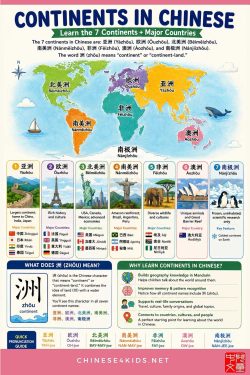
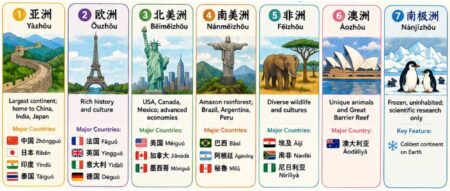
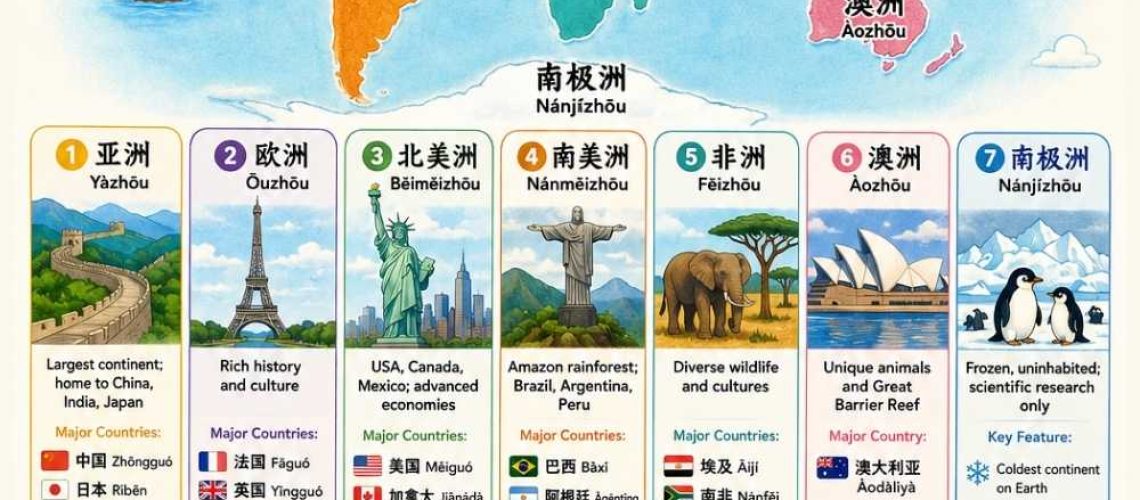
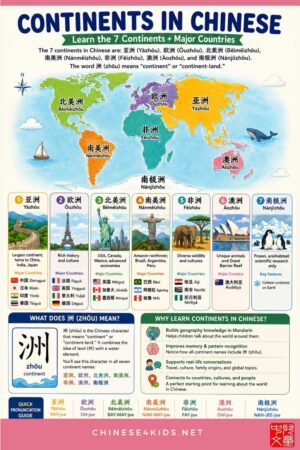
The 7 continents in Chinese are: 亚洲 (Yàzhōu = Asia), 欧洲 (Ōuzhōu = Europe), 北美洲 (Běiměizhōu = North America), 南美洲 (Nánměizhōu = South America), 非洲 (Fēizhōu = Africa), 澳洲 (Àozhōu = Australia), and 南极洲 (Nánjízhōu = Antarctica). The word 洲 (zhōu) means “continent” or “continent-land.”
The 7 continents in Chinese are: 亚洲 (Yàzhōu = Asia), 欧洲 (Ōuzhōu = Europe), 北美洲 (Běiměizhōu = North America), 南美洲 (Nánměizhōu = South America), 非洲 (Fēizhōu = Africa), 澳洲 (Àozhōu = Australia), and 南极洲 (Nánjízhōu = Antarctica). The word 洲 (zhōu) means “continent” or “continent-land.”
This lesson teaches all seven continents in Mandarin Chinese with pronunciation guides, tone practice, and learning strategies. Whether you’re teaching geography vocabulary to children, learning continent names in Chinese yourself, or looking for classroom-ready geography activities, this guide covers everything you need for ages 6-14, heritage learners, and non-native speakers. Includes pronunciation practice, common mistakes to avoid, and major countries in each continent.
Contents
hide
Continents in Chinese
| Continent (English) | Chinese Characters | Pinyin | Key Feature |
|---|---|---|---|
| Asia | 亚洲 | Largest continent; home to China, India, Japan | |
| Europe | 欧洲 | Rich history and culture; France, UK, Italy | |
| North America | 北美洲 | USA, Canada, Mexico; advanced economies | |
| South America | 南美洲 | Amazon rainforest; Brazil, Argentina, Peru | |
| Africa | 非洲 | Diverse wildlife and cultures; Egypt, Kenya | |
| Australia | 澳洲 | Unique animals and Great Barrier Reef | |
| Antarctica | 南极洲 | Frozen, uninhabited; scientific research only |
What does 洲 (zhōu) mean?
洲 (zhōu) is the Chinese character that means “continent” or “continent-land.” It combines the idea of land (州) with a water element. You’ll see this character in all seven continent names: 亚洲、欧洲、北美洲、南美洲、非洲、澳洲、南极洲. Learning this one character helps you understand and remember all continent names at once.
Asia – 亚洲 (Yàzhōu)
亚洲 (Yàzhōu) | Pronunciation: YAH-joe | Key countries: 中国、日本、印度 | Largest by population
Why teach Asia first?
When children learn 亚洲 early, they unlock a vocabulary chain. The character 亚 (yà) appears later in: 亚洲人 (Asian person), 亚洲国家 (Asian country), 亚洲文化 (Asian culture), and 亚洲地图 (map of Asia). Research on vocabulary learning suggests that learning related words together helps children remember them more easily and recall them in new contexts.
For heritage learners, Asia is personal. Many children have family in China, Vietnam, Thailand, or India. Connecting the continent name to family stories makes the vocabulary meaningful. For non-heritage learners, Asia is familiar ground—they can think of friends, food, technology, and cultures they already know.
💡 Pronunciation tip:
Yà (fourth tone, falling) + zhōu (first tone, high). Practice saying it as “YAH-joe.”
Yà (fourth tone, falling) + zhōu (first tone, high). Practice saying it as “YAH-joe.”
Major Countries in Asia
China
中国 (Zhōngguó)
India
印度 (Yìndù)
Japan
日本 (Rìběn)
Thailand
泰国 (Tàiguó)
👉 For a complete list of Asian countries and their Chinese names, see Exploring Chinese Vocabulary: Countries and Nationalities.
💡 Classroom Strategy
Connect to things children already know: Ask “Where is Disneyland?” (USA = 美国). “Where is the Great Wall?” (China = 中国). “Where are sumo wrestlers?” (Japan = 日本). When vocabulary connects to a child’s existing interests, they remember it better and can recall it more easily.
Connect to things children already know: Ask “Where is Disneyland?” (USA = 美国). “Where is the Great Wall?” (China = 中国). “Where are sumo wrestlers?” (Japan = 日本). When vocabulary connects to a child’s existing interests, they remember it better and can recall it more easily.
Africa – 非洲 (Fēizhōu)
非洲 (Fēizhōu) | Pronunciation: FAY-joe | Key countries: 埃及、南非 | 54 countries (most of any continent)
Africa spans 54 countries and is home to over 1.3 billion people, making it incredibly diverse. Children often remember 非洲 fastest when they first learn animal vocabulary—they already associate lions, elephants, and giraffes with Africa. Introduce the continent name before teaching animal vocabulary, then revisit it when reading stories or looking at maps.
💡 Pronunciation tip: Fēi (first tone, high) + zhōu (first tone, high). Practice saying it as “FAY-joe.”
Major Countries in Africa
Egypt
埃及 (Āijí)
South Africa
南非 (Nánfēi)
Nigeria
尼日利亚 (Nírìlìyà)
Kenya
肯尼亚 (Kěnníyà)
👉 For a complete list of Asian countries and their Chinese names, see Exploring Chinese Vocabulary: Countries and Nationalities.
💡 Learning Tip
非洲 is the standard Chinese name for Africa. The first character 非 appears in many other Chinese words, although in this continent name it does not carry its usual meaning of “not.” Learning the different uses of characters helps children build a deeper understanding of Chinese vocabulary.
非洲 is the standard Chinese name for Africa. The first character 非 appears in many other Chinese words, although in this continent name it does not carry its usual meaning of “not.” Learning the different uses of characters helps children build a deeper understanding of Chinese vocabulary.
North America – 北美洲 (Běiměizhōu)
北美洲 (Běiměizhōu) | Pronunciation: BAY-MAY-joe | Key countries: 美国、加拿大、墨西哥 | Notice: 北 = north
North America is the third-largest continent, covering about 24.7 million square kilometers. It includes developed economies and is famous for natural wonders like Niagara Falls and the Grand Canyon.
💡 Pronunciation tip: Běi (third tone, down-up) + měi (third tone, down-up) + zhōu (first tone, high). Practice as “BAY-MAY-joe.”
Major Countries in North America
United States
美国 (Měiguó)
Canada
加拿大 (Jiānádà)
Mexico
墨西哥 (Mòxīgē)
Cuba
古巴 (Gǔbā)
👉 For a complete list of Asian countries and their Chinese names, see Exploring Chinese Vocabulary: Countries and Nationalities.
🧭 Direction Words Pattern
北 (north) and 南 (south) appear in many Chinese geography terms. Compare 北美洲 (North America) with 南美洲 (South America)—the structure is identical, only the direction changes. Noticing this pattern helps children predict and remember new geography vocabulary.
北 (north) and 南 (south) appear in many Chinese geography terms. Compare 北美洲 (North America) with 南美洲 (South America)—the structure is identical, only the direction changes. Noticing this pattern helps children predict and remember new geography vocabulary.
South America – 南美洲 (Nánměizhōu)
南美洲 (Nánměizhōu) | Pronunciation: NAHN-MAY-joe | Key countries: 巴西、阿根廷 | Notice: 南 = south
South America is the fourth-largest continent, spanning 17.8 million square kilometers. It’s famous for the Amazon rainforest, the Andes Mountains, and vibrant cultures.
💡 Pronunciation tip: Nán (second tone, rising) + měi (third tone, down-up) + zhōu (first tone, high). Practice as “NAHN-MAY-joe.”
Major Countries in South America
Brazil
巴西 (Bāxī)
Argentina
阿根廷 (Āgēntíng)
Peru
秘鲁 (Bìlǔ)
Chile
智利 (Zhìlì)
👉 For a complete list of Asian countries and their Chinese names, see Exploring Chinese Vocabulary: Countries and Nationalities.
💡 Learning Tip
巴西 (Brazil) is easy to remember: the first character 巴 (bā) is often used in Chinese names for foreign places that sound like “Ba-” (Brazil → Bāxī = Ba-xi). Same pattern with 巴基斯坦 (Pakistan = Bājīsītǎn).
巴西 (Brazil) is easy to remember: the first character 巴 (bā) is often used in Chinese names for foreign places that sound like “Ba-” (Brazil → Bāxī = Ba-xi). Same pattern with 巴基斯坦 (Pakistan = Bājīsītǎn).
Europe – 欧洲 (Ōuzhōu)
欧洲 (Ōuzhōu) | Pronunciation: OH-joe | Key countries: 法国、德国、英国 | 欧 is a special character used only for Europe
Europe is the sixth-largest continent, but has tremendous historical and cultural influence. It covers 10.18 million square kilometers and includes 44 recognized countries.
💡 Pronunciation tip: Ōu (first tone, high) + zhōu (first tone, high). Practice as “OH-joe.”
Major Countries in Europe
France
法国 (Fǎguó)
Germany
德国 (Déguó)
Italy
意大利 (Yìdàlì)
United Kingdom
英国 (Yīngguó)
👉 For a complete list of Asian countries and their Chinese names, see Exploring Chinese Vocabulary: Countries and Nationalities.
🔤 Character Spotlight
欧 is a unique character—it appears in Europe-related vocabulary and nowhere else in everyday Chinese: 欧洲 (Europe), 欧元 (Euro), 欧盟 (EU). Once children learn this character, they recognize any European reference in Chinese text.
欧 is a unique character—it appears in Europe-related vocabulary and nowhere else in everyday Chinese: 欧洲 (Europe), 欧元 (Euro), 欧盟 (EU). Once children learn this character, they recognize any European reference in Chinese text.
Australia – 澳洲 (Àozhōu)
澳洲 (Àozhōu) | Pronunciation: OW-joe | Unique: Both a continent and a country | Short name 澳洲 vs. formal name 澳大利亚
Australia is unique: it’s both a continent and a country. In geography, some sources refer to the continent as Australia, while others use Oceania for the broader region that includes Australia, New Zealand, and many Pacific islands. In everyday Chinese, 澳洲 (Àozhōu) usually refers to Australia specifically. The short name 澳洲 is most common in everyday speech, while the full formal name 澳大利亚 (Àodàlìyà) appears in official contexts.
💡 Pronunciation tip: Ào (fourth tone, falling) + zhōu (first tone, high). Practice as “OW-joe.”
📝 Short vs. Formal Names
In Chinese, Australia has both a short form and a formal form: 澳洲 (casual, everyday speech) vs. 澳大利亚 (formal, official documents). Teaching both helps children understand that the same place can have multiple names in Chinese depending on the context.
In Chinese, Australia has both a short form and a formal form: 澳洲 (casual, everyday speech) vs. 澳大利亚 (formal, official documents). Teaching both helps children understand that the same place can have multiple names in Chinese depending on the context.
Antarctica – 南极洲 (Nánjízhōu)
南极洲 (Nánjízhōu) | Pronunciation: NAHN-JEE-joe | Unique: No countries | Governed by international treaty for scientific research only
Antarctica is the fifth-largest continent, covering 14.2 million square kilometers. It’s the coldest, driest, and windiest continent. No countries exist here—it’s designated for scientific research only.
💡 Pronunciation tip: Nán (second tone, rising) + jí (second tone, rising) + zhōu (first tone, high). Practice as “NAHN-JEE-joe.”
Key Geography Terms
South Pole
南极 (Nánjí)
North Pole
北极 (Běijí)
Arctic
北极圈 (Běijíquān)
Ice
冰 (Bīng)
🌍 A Unique Place
Antarctica is the only continent that isn’t divided into countries. It’s governed internationally by scientific agreement, not by nations. This makes it an interesting teaching point: children can learn that geography is sometimes about more than just borders and countries—it’s about how humans choose to use and share land.
Antarctica is the only continent that isn’t divided into countries. It’s governed internationally by scientific agreement, not by nations. This makes it an interesting teaching point: children can learn that geography is sometimes about more than just borders and countries—it’s about how humans choose to use and share land.
Click here to get these Continents Bookmarks for free
Pronunciation Practice: Say All 7 Continents
🎯 Practice Activity
Repeat aloud: Say each continent name 3 times slowly, then 3 times at normal speed.
亚洲 (Yàzhōu) — Asia
欧洲 (Ōuzhōu) — Europe
北美洲 (Běiměizhōu) — North America
南美洲 (Nánměizhōu) — South America
非洲 (Fēizhōu) — Africa
澳洲 (Àozhōu) — Australia
南极洲 (Nánjízhōu) — Antarctica
Best For…
- Heritage learners (ages 6-12)
Bridging home conversations about family’s home country with geography. - Classroom instruction
Integrating social studies + Mandarin in bilingual programs. - Reading readiness
Building topic vocabulary before tackling graded readers set in other places. - Parents learning with kids
Both can study and practice these words together at home.
Common Mistakes to Avoid
Mistake 1: Confusing 亚洲 (Asia) with 欧洲 (Europe)
Both end in 洲, but the first characters are different. 亚 (yà = “sub-” or “second”) vs. 欧 (ōu = Europe-specific). Repeat them aloud: “YAH-joe” vs. “OH-joe.”
Mistake 2: Forgetting the direction words 北 and 南
Many students mix up North and South America because they forget: 北 (běi = north) = 北美洲, 南 (nán = south) = 南美洲. Memorize these two directional words—they appear in dozens of other place names.
Mistake 3: Using the full name for Australia every time
澳大利亚 (Àodàlìyà) is the official full name, but in daily conversation, Chinese speakers usually say 澳洲 (Àozhōu). Short forms are more natural.
Mistake 4: Tone errors with 洲 (zhōu)
洲 is first tone (high, flat): zhōu. NOT zhóu (second tone) or zhǒu (third tone). This matters because incorrect tones make the word hard to understand.
Key Questions About Continents in Chinese
Why do all seven continent names end in 洲?
The character 洲 (zhōu) means “continent” or “landmass.” Using this character in all seven continent names helps learners recognize the pattern immediately. Once children understand that 洲 = continent, they can decode new continent names they haven’t explicitly studied.
Which continent is China in?
China is in 亚洲 (Asia). For children learning Chinese, connecting the continent to their family heritage or a country they already know is one of the best ways to remember continent names.
Is 澳洲 the same as 大洋洲?
No. 澳洲 (Australia) refers specifically to the country/continent of Australia. 大洋洲 (Oceania) is a broader geographical region that includes Australia, New Zealand, and many Pacific island nations. In everyday conversation, 澳洲 is more commonly used.
Which continent has the most countries?
非洲 (Africa) has 54 recognized countries, the most of any continent. 亚洲 (Asia) has 48 countries. This is a good fact to share with older children studying geography.
Why doesn’t Antarctica have countries?
南极洲 (Antarctica) is governed by international agreement, not by individual countries. The Antarctic Treaty of 1959 designated the continent for peaceful scientific research only. No permanent settlements or countries exist there.
Learning Strategies by Age & Context
What age should children start learning continent names?
Children as young as 5-6 can start with the seven continent names, especially if learning through songs, games, or pictures. By age 8-10, they can learn the major countries in each continent. Learning geography vocabulary early builds a foundation for later social studies and cultural discussion.
Why do some country names in Chinese seem so different from English?
Chinese country names are phonetic approximations or semantic descriptions, not direct translations. For example: 美国 (Měiguó = “beautiful country”) for USA, 加拿大 (Jiānádà ≈ sounds like “Canada”) for Canada. This is normal across all languages.
Is there a memory trick to remember all 7 continents in Chinese?
Create a story using the first character of each: 亚、欧、北美、南美、非、澳、南极. Or group by sound patterns: the “ōu/zhōu” and “yà/zhōu” rhymes. Visual flashcards with maps also help learners connect the names to actual geography.
How do I teach continent names to a mixed-heritage family (one parent speaks Chinese)?
Use maps, videos, and hands-on activities. Let the Chinese-speaking parent introduce names during travel discussions or when watching international news together. Pair the words with real photos or videos of landmarks in each continent to make learning concrete and engaging.
What’s the difference between 美国 and 北美洲?
美国 (Měiguó) = United States (one country). 北美洲 (Běiměizhōu) = North America (the entire continent, which includes Canada, Mexico, USA, and many others). The character 美 (měi = beautiful) is used as a short form for “America.”
Do I need to learn simplified AND traditional characters?
For continent names, simplified and traditional are very similar or identical. Examples: 亚洲 is the same in both. Focus on simplified if your child is learning in mainland China or most overseas settings. If studying in Taiwan or Hong Kong, learn traditional versions.
How can I check my pronunciation?
Use free tools like Google Translate (audio feature), Forvo.com (crowdsourced pronunciations), or Pleco app. YouTube videos of native speakers saying these names are also helpful. Listen repeatedly and try to match the tone patterns.
Quick Summary
- 7 continents in Chinese: 亚洲、欧洲、北美洲、南美洲、非洲、澳洲、南极洲
- The character 洲 (zhōu) means “continent” and appears in all seven names
- Direction words matter: 北 (north) and 南 (south) help distinguish regions
- Learn by groups: Pair each continent with 3-6 major countries to build vocabulary depth
- Practice out loud: Tones are important; repeat aloud 3-5 times for each continent
- Make it real: Connect names to family stories, travel plans, or current events
Test Your Knowledge: Quick Quiz
Try this 5-question quiz. If you score 5/5, you’re ready to teach others!
❓ 1: Which continent is China in?
❓ 2: What does the character 洲 (zhōu) mean?
❓ 3: Europe in Chinese is 欧洲 (Ōuzhōu). Which character means “Europe”?
❓ 4: Which two characters appear in both 北美洲 and 南美洲?
❓ 5: True or False: Antarctica (南极洲) has permanent countries.
Next Steps: From Learning to Retention
Knowing the seven continent names is just the beginning. To move from recognition to retention, children need to see and use these words repeatedly in different contexts.
Start here: Download the free continent bookmarks (link at the top). Print them, laminate them, and tuck them into your child’s favorite books. They’ll see the continents every time they read. This passive, daily exposure is how long-term memory begins.
>Then layer in hands-on practice with our Continents Montessori 3-Part Flashcards (€9). The three-part method—control card, picture card, label card—teaches one thing at a time. Kids match, check themselves, and build confidence independently. No adult prep needed.
Add visual reinforcement with our Continents Poster (€9). Hang it on the bedroom wall or classroom wall. Every time your child sees it, they absorb the shapes and names a little deeper. Visual repetition is powerful.
Reinforce through creativity with our Continents Coloring Pages (€5). Color the continents. Say the Chinese names aloud. This combination of movement, color, and speech locks vocabulary into long-term memory.Want everything at once? Get our Continents Bundle (€17)—poster + flashcards + coloring pages together. You save €4 and have a complete learning system.
All products work for ages 4-14 and can be used at home or in classrooms. Print as many times as you need. No expiration, no limits.
Did this lesson help? Share it with a parent or teacher who’s teaching Chinese geography. Every share helps more families discover Chinese4kids resources. 🌏
If you like this post, share it
Related Resources & Learning Materials
-
- Exploring Chinese Vocabulary: Countries and Nationalities — Learn individual country names and how to say “I am from…” in Chinese
- Continents Chinese Montessori 3-Part Flashcards — Printable flashcard set for visual learning and memory work
- Countries Chinese Montessori 3-Part Flashcards — Printable flashcard set for visual learning and memory work
- Continents Chinese Learning Posters
- Continents Chinese Learning Coloring Pages
- Continents Chinese Learning Bundle
- Theme-Based Learning Packs — Structured lessons and activities for each continent
- Leveled Readers AA–C — Graded stories featuring different countries and continents