

If your child is just starting to learn Mandarin Chinese, you’ve probably come across the word pinyin. Maybe a teacher mentioned it. Maybe you saw it printed above the characters in a beginner’s textbook. Maybe you learned it yourself as a child — or maybe you grew up with a completely different system and aren’t quite sure what to make of it.
Whatever your starting point, one question tends to come up sooner or later:
Does my child actually need to learn pinyin? Or is it just an extra step that slows things down?
This article answers that question — and explains why, for children growing up outside of China, pinyin isn’t a detour. It’s the foundation.
Pinyin — short for Hànyǔ Pīnyīn (汉语拼音) — is the official romanisation system for Mandarin Chinese. Developed in the 1950s and adopted as an international standard by the ISO in 1982, it uses the Latin alphabet to represent the sounds of Mandarin, with the addition of tone marks above the vowels.
In simple terms: pinyin tells you how to pronounce a Chinese character.
Take the character 妈 (mother). In pinyin, it’s written as mā — “m” is the initial consonant, “a” is the vowel, and the horizontal line above the “a” indicates the first tone (flat and high). See the pinyin, and you know exactly how to say it.
Without pinyin, when a child meets an unfamiliar character, they have no reliable way of knowing how to pronounce it. They’re left guessing.
Want a deeper dive into how the pinyin system works? Read our full guide: An Introduction to Hanyu Pinyin
This is one of the most common — and most important — misconceptions to address early on.
Pinyin uses the same 26 letters as the English alphabet, so at first glance it can look familiar. But here’s the critical difference:
The letters in pinyin do not sound like their English equivalents.
A few examples:
| Pinyin letter | How it sounds in pinyin | How it sounds in English |
| x | Like “sh” in “she” (but softer) | “eks” |
| q | Like “ch” in “cheese” (but lighter) | “kyoo” |
| zh | Like “j” in “jump” (with a curl of the tongue) | “zee-aitch” |
| e | Like “uh” or the vowel in “her” | “ee” |
| c | Like “ts” in “cats” | “see” |
If a child tries to read pinyin using their English pronunciation instincts, the result will be completely wrong — and worse, those mispronunciations can stick.
This is why it’s so important to introduce pinyin as its own system from the very beginning, separate from English. The letters look familiar, but the sounds need to be learned fresh.
Every syllable in Mandarin can be broken down into three components:
Initial + Final + Tone
Initials (声母, shēngmǔ) are the consonants that begin a syllable — b, p, m, f, d, t, and so on. There are 23 initials in total. Finals (韵母, yùnmǔ) are the vowels or vowel combinations that follow — a, o, e, ai, ou, and more. Finals come in three types: single finals, compound finals, and nasal finals. There are 24 finals altogether.
Tones are the pitch patterns that give each syllable its meaning. Mandarin has four tones plus a neutral (light) tone, and this is where things get interesting for families who didn’t grow up speaking a tonal language.
In Mandarin, the same syllable spoken in a different tone means a completely different thing:
Same letters. Four entirely different words. Getting the tone wrong doesn’t just sound a little off — it changes the meaning entirely. Pinyin gives children a clear, visual way to learn and remember which tone goes with which word.
There’s one more category worth knowing about: overall syllable recognition (整体认读音节). These are syllables like zhi, chi, shi, ri, yi, wu, and yu that are pronounced as a whole unit, rather than being spelled out as separate initials and finals. They’re an important part of the pinyin system and come up regularly in early learning.
One of the most useful things you can do when a child starts learning pinyin is to give them a complete visual reference — something they can look at while practising, post on the wall of their study space, or keep in their learning folder.
The Hanyu Pinyin Syllables Table Poster from Chinese4kids does exactly that. It lays out the full pinyin system in a clear, organised table — all the initials, finals, and their combinations — making it easy for learners to see how the system fits together at a glance. Available in both A3 and A4 sizes, it works equally well as a classroom display or a home study reference.
Having the whole system visible in one place takes away a lot of the anxiety around pinyin. Children can check their work, spot patterns, and build confidence without having to flip through pages of a textbook.
Children growing up in China are immersed in Mandarin from birth. They hear it everywhere — at home, on television, in the street, at school. By the time they’re formally introduced to pinyin in primary school, their ears are already tuned to the sounds of the language. Pinyin acts as a label for sounds they already know.
Children growing up overseas are in a fundamentally different situation.
For many of them, Mandarin is limited to conversations at home, a weekly language class, or occasional visits to family. Sounds that don’t exist in English — like the retroflex consonants zh, ch, sh, and r, or the rounded vowel ü — aren’t in their everyday environment. There’s no natural immersion filling in the gaps.
Without pinyin, these children have no map.
Pinyin gives them a reliable system to decode pronunciation — not by guessing, not by relying on imperfect models, but by reading a consistent set of symbols that correspond directly to sounds. For a child learning Mandarin in an English-speaking world, that clarity is invaluable.
It also gives parents and teachers a shared reference point. When a child mispronounces something, you can point to the pinyin and work through it together. That’s much harder to do when you’re relying on memory alone.
Learning pinyin is not the finish line — it’s the starting gate.
Once a child can read and produce the sounds of Mandarin accurately, the next step is building a foundation in Chinese characters. And this is where many families hit a wall.
Which characters should we learn first? How do we organise it? How do we make sure the vocabulary actually sticks?
The most effective approach is to start with the characters and words that appear most frequently in everyday Chinese — the words that show up again and again in conversations, stories, and simple texts. Mastering the most commonly used Chinese words gives a child the ability to recognise a significant portion of content in everyday Chinese texts — enough to begin reading simple, levelled books independently.
This is exactly the challenge that Vocabulary Made Easy was designed to solve.
Built specifically for overseas children aged 6–10, the course takes learners systematically through the 300 most essential Chinese words — the ones that give the biggest return on learning time. The vocabulary covered aligns closely with HSK Levels 1 and 2, so children are building towards a recognised standard without the stress of formal test preparation.
More importantly, completing the course sets children up to move confidently into independent reading. The pinyin foundation handles pronunciation; Vocabulary Made Easy handles the characters — and the path from there to reading real Chinese books becomes much shorter than most families expect.
First: Pinyin is not a detour. For children learning Mandarin outside of China, it is the most reliable way to build accurate pronunciation from the beginning.
Second: Pinyin letters look like English letters, but they don’t sound like them. This distinction needs to be taught clearly and early — before incorrect habits take hold.
Third: Pinyin is the foundation, not the destination. Once your child has it, the next step is building vocabulary in a structured, high-frequency-first way — so that all that pronunciation work translates into real reading ability.
Chinese Mandarin Pinyin Flashcards from Amazon 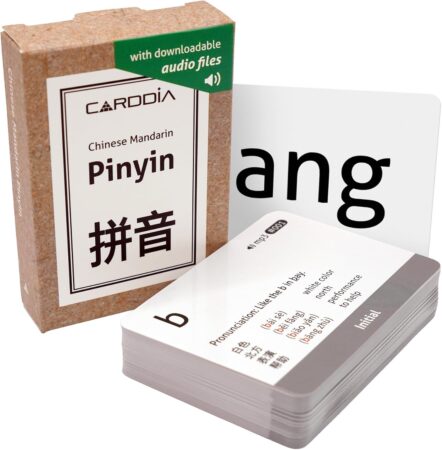
If you like this article, share it




You cannot copy content of this page