Author name: Chinese4kids

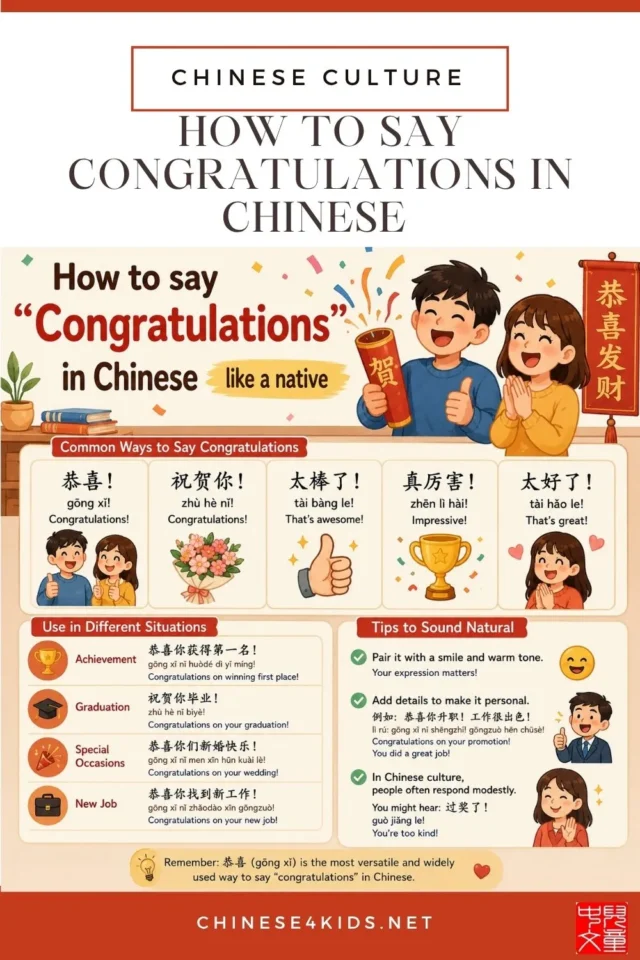
Learn all the ways to say congratulations in Chinese for every occasion — graduation, new baby, wedding, birthday, and more.

How to say “Congratulations” in Chinese like a native

One-Sentence Answer The two main ways to say congratulations in Chinese are 恭喜 (gōng xǐ) for informal occasions and 祝贺 (zhù hè) for formal ones — but native speakers also use many occasion-specific phrases. Why “Congratulations” in Chinese Is More Than One Phrase In English, you can say “Congratulations!” to almost anyone in almost any […]

How to say “Congratulations” in Chinese like a native Read More »

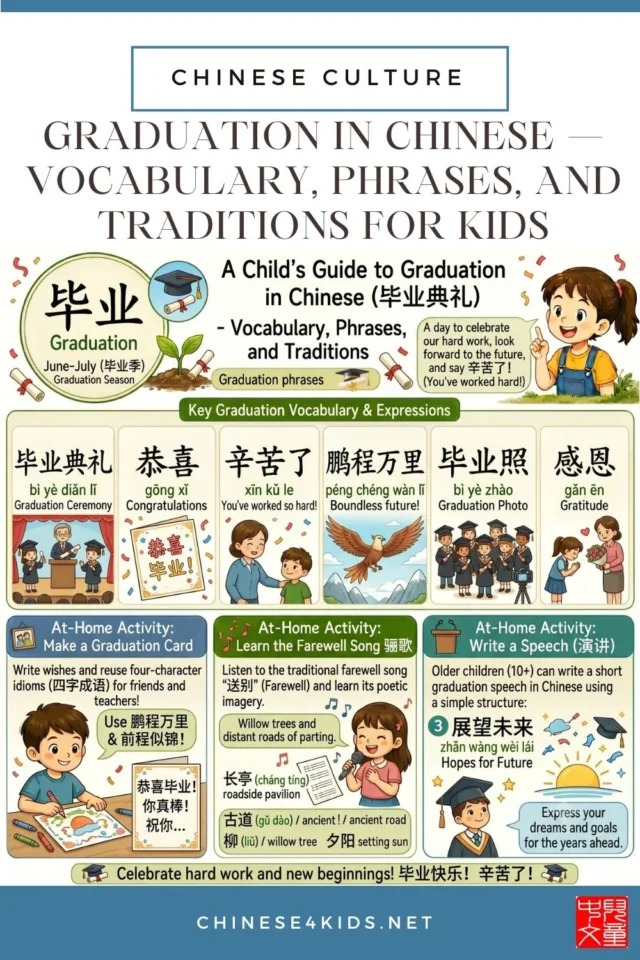
Learn graduation vocabulary in Chinese, congratulations phrases, traditional wishes, and how to celebrate 毕业 with kids.

Graduation in Chinese — Vocabulary, Phrases, and Traditions for Kids and Families

One-Sentence Answer The Chinese word for graduation is 毕业 (bì yè), and the most common congratulations phrase is 恭喜毕业 (gōng xǐ bì yè) — but Chinese has a rich set of graduation wishes, farewell expressions, and cultural traditions that go far deeper than that single phrase. 毕业 — The Chinese Word for Graduation 毕业 (bì

Graduation in Chinese — Vocabulary, Phrases, and Traditions for Kids and Families Read More »

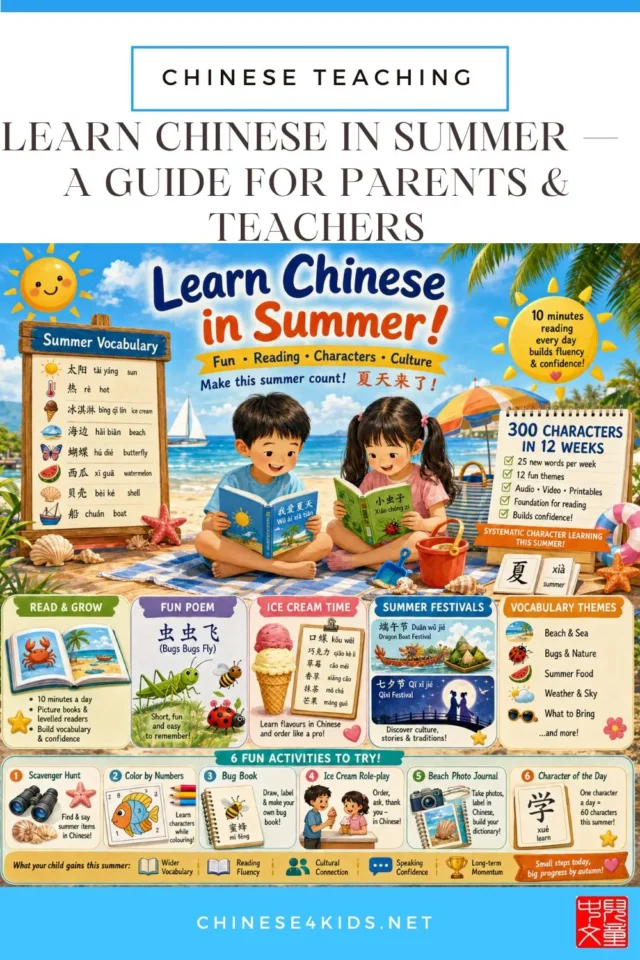
Learn Chinese in summer: vocabulary, summer poems, reading, activities ... and how to build Chinese characters for kids.

Learn Chinese in Summer — A Complete Guide for Parents and Teachers

Sunny and hot — summer is officially here. If you ask a child which season they love most, the answer is almost always summer. It is the season of holidays, ice cream, beach days, and free time. For Chinese-heritage families, summer is also a hidden gold mine. With school out and pressure off, children can

Learn Chinese in Summer — A Complete Guide for Parents and Teachers Read More »

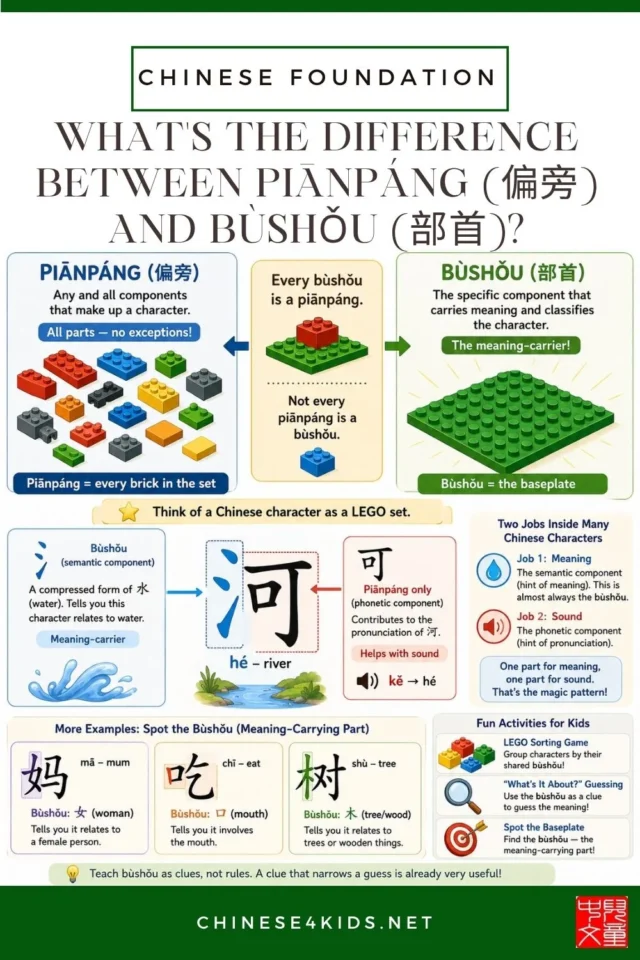
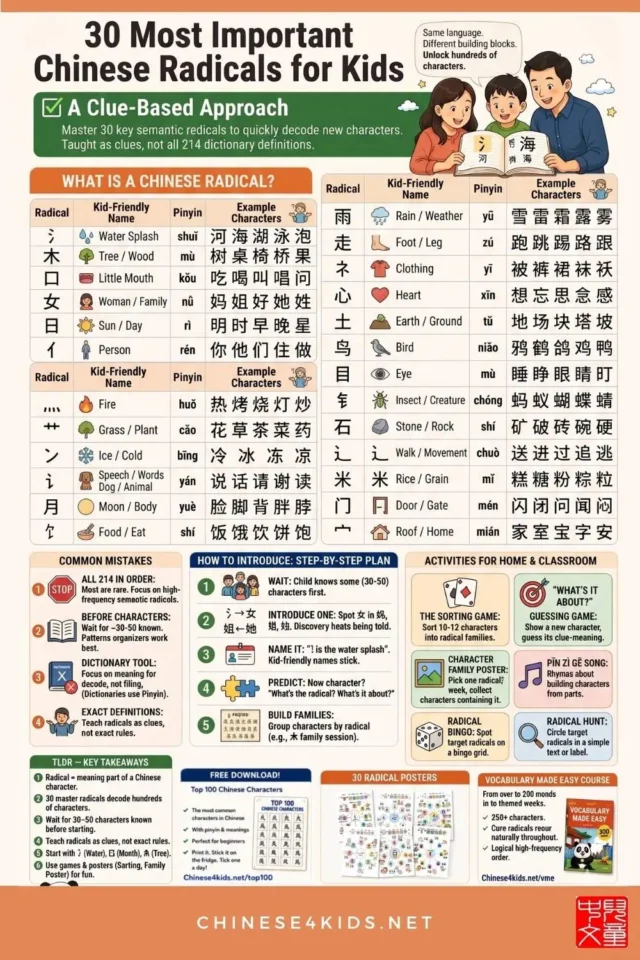
What’s the Difference Between Piānpáng (偏旁) and Bùshǒu (部首)?

Quick Summary Piānpáng (偏旁) means any component inside a Chinese character — the term covers all parts. Bùshǒu (部首) is the specific component that carries meaning and classifies the character in a dictionary. Every bùshǒu is a piānpáng. Not every piānpáng is a bùshǒu. Children don’t need to memorise these terms. What matters is learning

What’s the Difference Between Piānpáng (偏旁) and Bùshǒu (部首)? Read More »

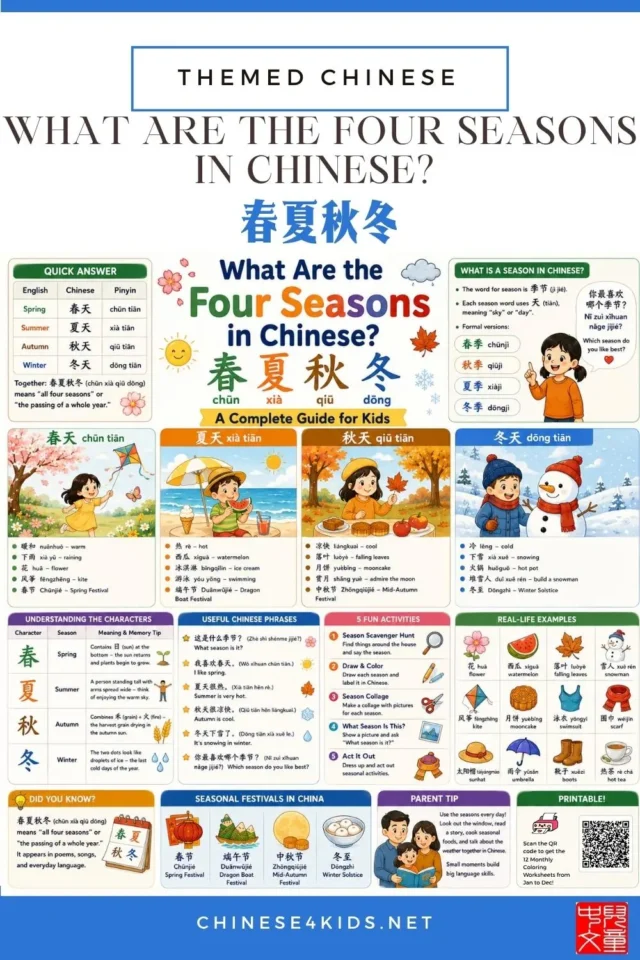
What are the four seasons in Chinese? What is the typical weather in each season? What do people wear? Learn the seasons in Chinese #Chinese4kids #seasons #MandarinChinese #Chineselearning

What Are the Four Seasons in Chinese? 春夏秋冬 (A Complete Guide for Kids)

Learning the four seasons in Chinese is one of the easiest ways for children to build practical Mandarin vocabulary. Seasons connect naturally to weather, clothing, festivals, food, and everyday conversations — making them an ideal topic for beginners, heritage learners, and young Mandarin students alike. In this guide, you will learn the four season names

What Are the Four Seasons in Chinese? 春夏秋冬 (A Complete Guide for Kids) Read More »

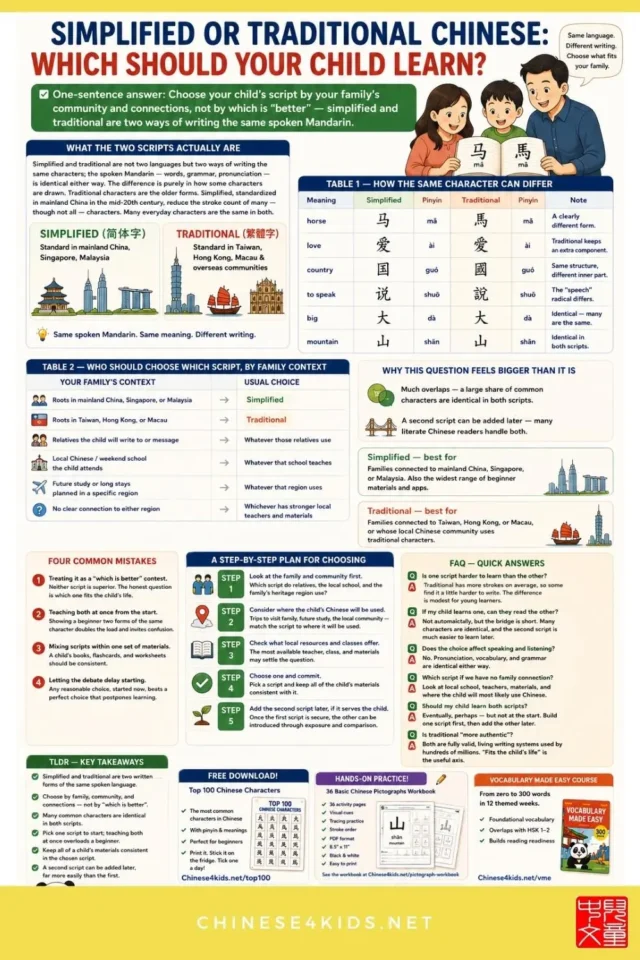
Simplified or Traditional? Discover how to choose the right Chinese script for your child based on your family's situation & learning goals.

Simplified or Traditional Chinese: Which Should Your Child Learn?

Simplified or traditional Chinese? Here is one-sentence answer: Choose your child’s script by your family’s community and connections, not by which is “better” — simplified and traditional are two ways of writing the same spoken Mandarin, so the decision is about fit, not language. What the two scripts actually are Simplified and traditional are not

Simplified or Traditional Chinese: Which Should Your Child Learn? Read More »

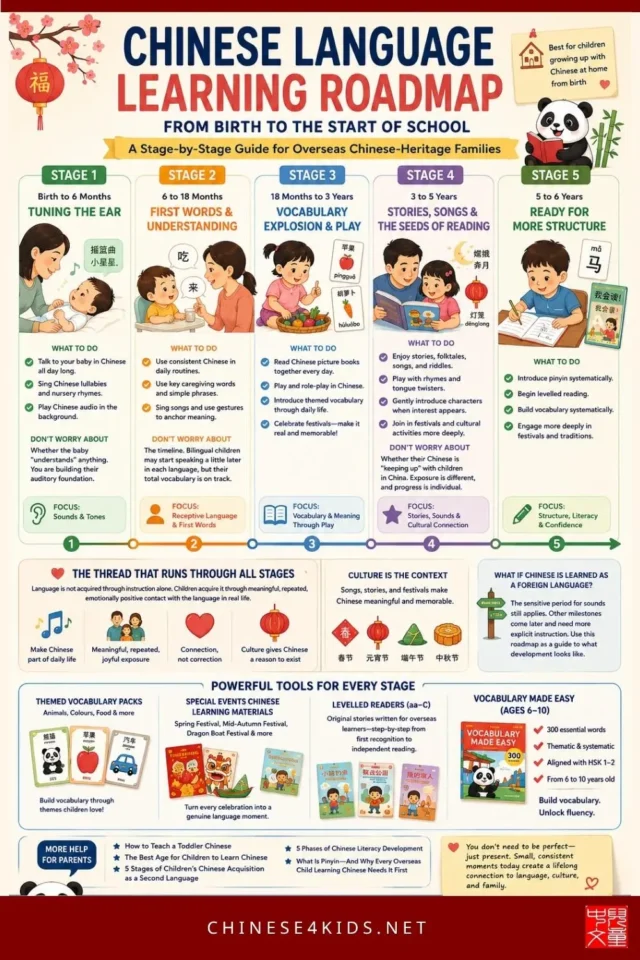
Raising a Chinese-speaking child abroad? This 0–6 roadmap shows exactly what to do at each stage, from tuning your baby's ear to tones to early reading readiness.

Chinese Language Learning for Ages 0–6: A Stage-by-Stage Roadmap for Overseas Families

If you are raising a child overseas and hoping to pass on Chinese, the early years feel both urgent and overwhelming. Urgent, because everyone tells you the window is short. Overwhelming, because no one tells you what to actually do — not in the vague, general sense of “expose them to the language,” but specifically:

Chinese Language Learning for Ages 0–6: A Stage-by-Stage Roadmap for Overseas Families Read More »

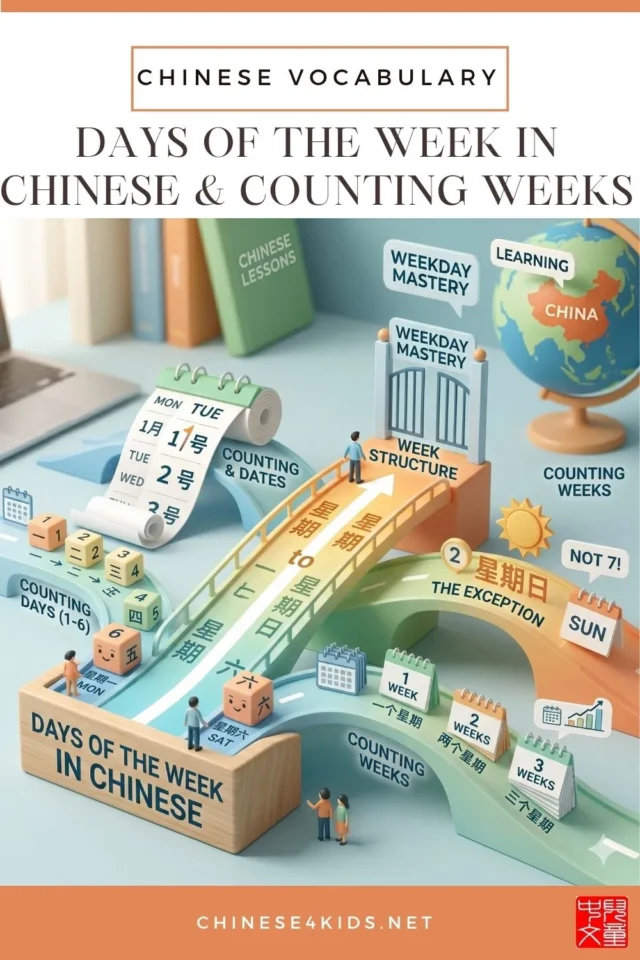
Learn the days of the week in Chinese the easy way. Say Monday to Sunday, count weeks, and find printables for kids learning Mandarin.

Days of the Week in Chinese: How to Say Monday, Tuesday and Count Weeks (A Parent & Teacher Guide)

Is your child learning Mandarin? Have they just asked “how do you say Monday in Chinese?” You’ve picked one of the easiest topics to teach. In English, the seven weekdays are seven different words. Children have to memorise each one. The days of the week in Chinese are far simpler. They follow one logical pattern.

Days of the Week in Chinese: How to Say Monday, Tuesday and Count Weeks (A Parent & Teacher Guide) Read More »

Unsure of your overseas child's Chinese level? Use our age-by-age checklist to track milestones and unlock reading fluency.

What Chinese Level Is My Child Actually At? An Age-by-Age Checklist for Overseas Parents and Teachers

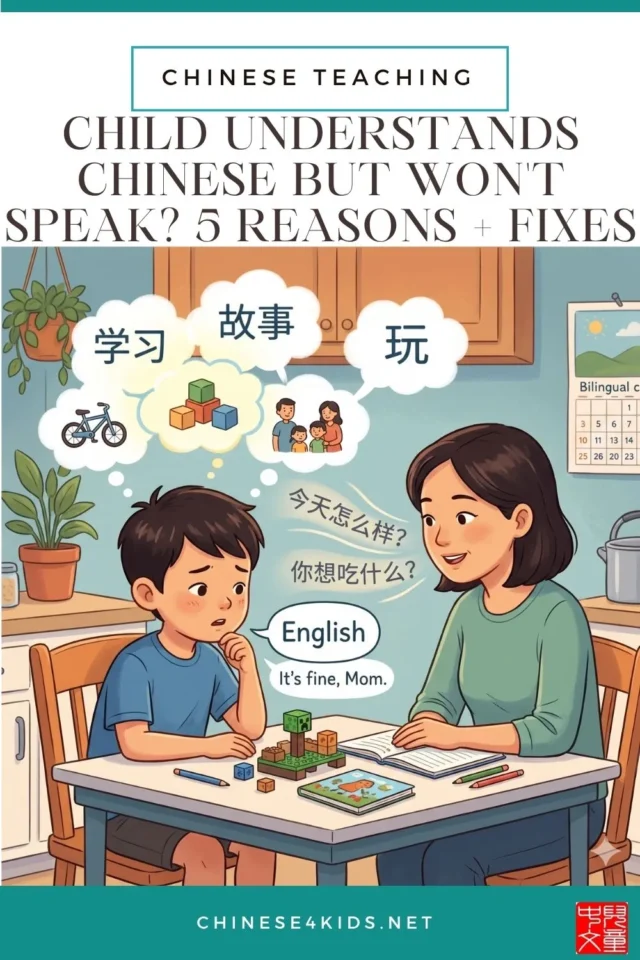
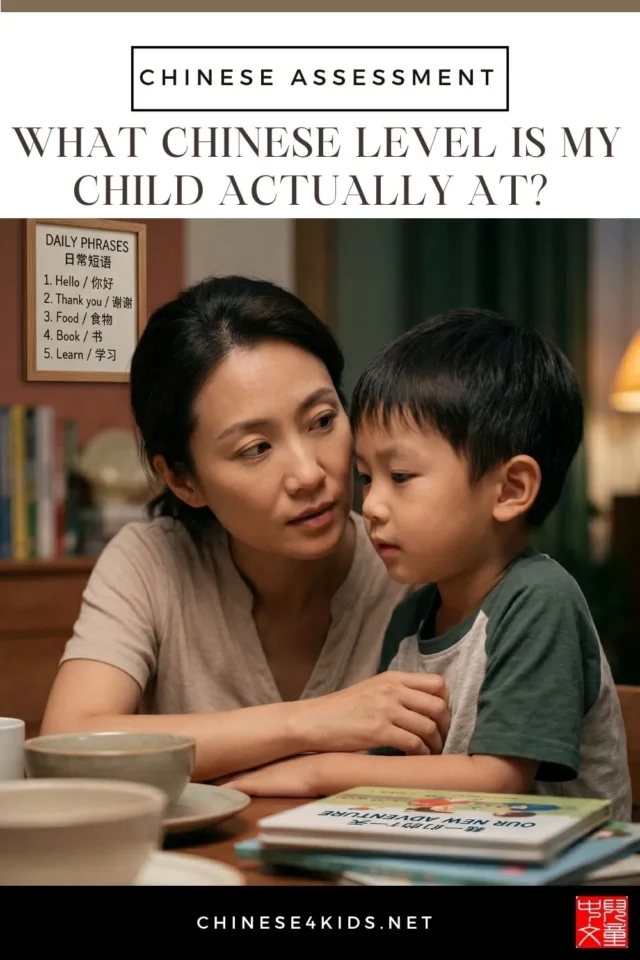
It’s dinner time. You casually ask your child in Chinese, “今天学校怎么样?” They glance up and reply, “It was fine. You pause for half a second, and that familiar question surfaces again — What level is his Chinese, really? Not for a test. Not to compare with someone else’s child. Just to know: is what we’re

What Chinese Level Is My Child Actually At? An Age-by-Age Checklist for Overseas Parents and Teachers Read More »

What is pinyin ? Learn how pinyin helps overseas children build accurate Mandarin pronunciation and a strong foundation for reading Chinese.

What Is Pinyin — And Why Every Overseas Child Learning Chinese Needs It First

If your child is just starting to learn Mandarin Chinese, you’ve probably come across the word pinyin. Maybe a teacher mentioned it. Maybe you saw it printed above the characters in a beginner’s textbook. Maybe you learned it yourself as a child — or maybe you grew up with a completely different system and aren’t

What Is Pinyin — And Why Every Overseas Child Learning Chinese Needs It First Read More »

A practical guide for overseas parents on teaching toddlers (ages 1–3) Chinese at home — no fluency required. 4 pillars + a free phrase pack.

How to Teach a Toddler Chinese: A Practical Guide for Overseas Families

If you’re raising a one- or two-year-old overseas and hoping Chinese will become a real part of their life, you’ve probably heard one piece of advice a hundred times: “Start early. The earlier the better.” That advice is correct. It also doesn’t tell you what to actually do. What should you say? What should they

How to Teach a Toddler Chinese: A Practical Guide for Overseas Families Read More »

Qingming Festival (清明节) is one of China's most meaningful holidays. Learn what it is, key phrases, and fun learning activities for kids.

Qingming Festival 清明节: What It Is, What It Means, and How to Explore It with Your Child

Quick Answer Qingming Festival (清明节, Qīngmíng Jié) is a traditional Chinese holiday for honouring ancestors and celebrating the arrival of spring. Families visit graves, offer food, and fly kites. It falls around 4–6 April each year and is a public holiday in mainland China, Hong Kong, Taiwan, and Macau. Every spring, millions of Chinese families

Qingming Festival 清明节: What It Is, What It Means, and How to Explore It with Your Child Read More »

Chinese riddles make learning Mandarin fun for kids. Discover 10+ example riddles with pinyin, fun facts, and easy ways to use them at home or in class.

Chinese Riddles: A Fun Way to Learn the Chinese Language

Why Chinese Riddles Are One of the Best Learning Tools Chinese riddles are short. They are funny. They make kids think. For overseas children learning Mandarin, riddles are one of the most effective ways to practise vocabulary without it feeling like work. Called 谜语 (míyǔ) in Chinese, riddles have been part of Chinese life for

Chinese Riddles: A Fun Way to Learn the Chinese Language Read More »

By incorporating outdoor Chinese learning activities, you can make Mandarin lessons more dynamic, memorable, and fun.

Spring into Chinese: Fun Outdoor Activities to Help Kids Learn Mandarin This Season

Spring  is nature’s biggest show-off — and it’s also one of the best seasons to take Chinese lessons outside! For kids learning Mandarin as a foreign language, swapping the classroom for the garden, park, or backyard can make vocabulary stick faster, build confidence in speaking, and turn study time into something kids actually look forward

Spring into Chinese: Fun Outdoor Activities to Help Kids Learn Mandarin This Season Read More »

A simple guide to the 6 types of Chinese characters for parents and teachers. Examples, history, and what your child should learn first.

Introduction to Chinese Characters: The 6 Types Every Parent and Teacher Should Know

Why Understanding Chinese Characters Matters Chinese characters (汉字 hànzì) look intimidating. Thousands of them. No alphabet. Strokes that seem to go in every direction. Many parents and teachers feel a little lost before they even start. Here’s the good news: Chinese characters are not random. They follow a system. Once you understand the 6 types

Introduction to Chinese Characters: The 6 Types Every Parent and Teacher Should Know Read More »

Learn how to say spring in Chinese — 春天 (chūn tiān). Discover spring vocabulary, weather words, activities, and Chinese New Year connections.

How to Say Spring in Chinese: 春天 (chūn tiān) — Vocabulary, Activities & Resources

Spring is one of the most beloved seasons in Chinese culture. It brings warmth, new growth, and two of the most important festivals in the Chinese calendar — Chinese New Year and Qingming Festival. For children learning Mandarin, spring is a wonderful vocabulary theme. It connects language to nature, weather, clothes, animals, flowers, and celebrations

How to Say Spring in Chinese: 春天 (chūn tiān) — Vocabulary, Activities & Resources Read More »